
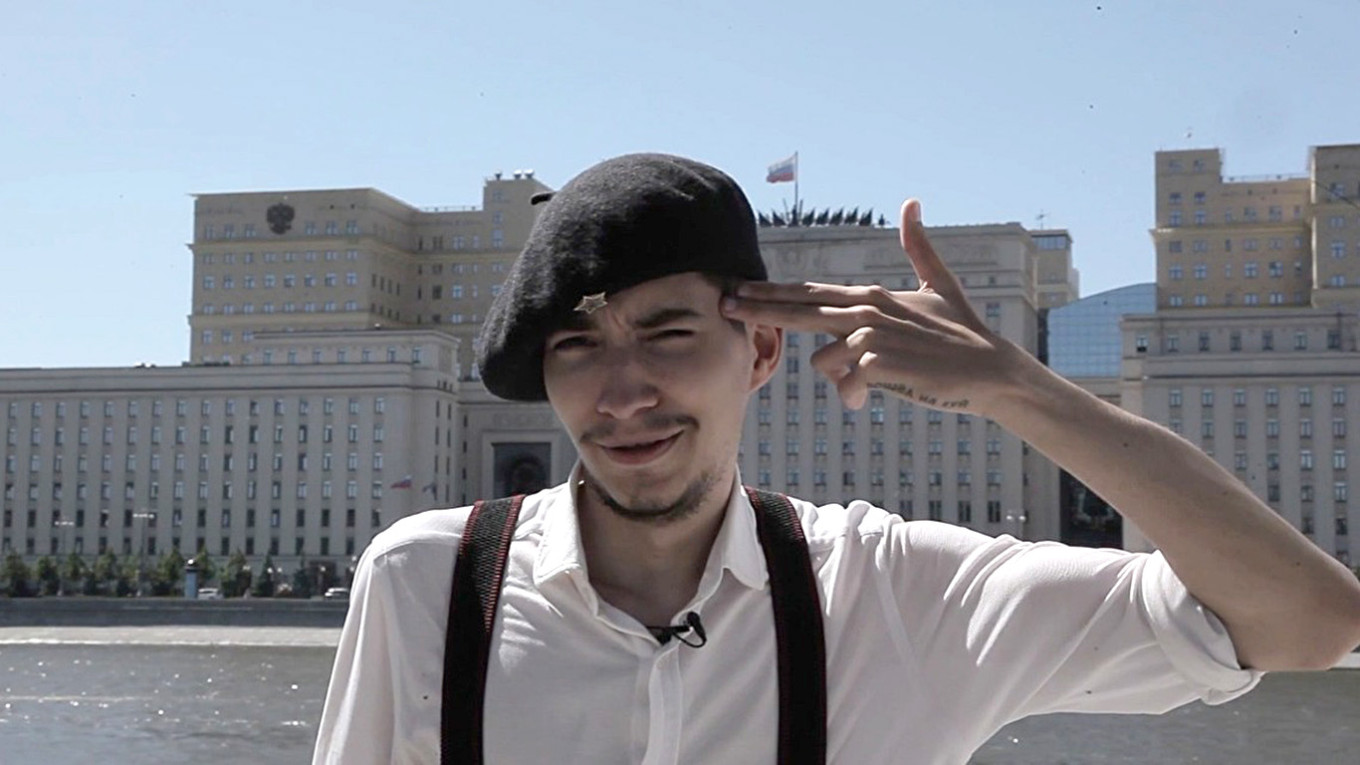
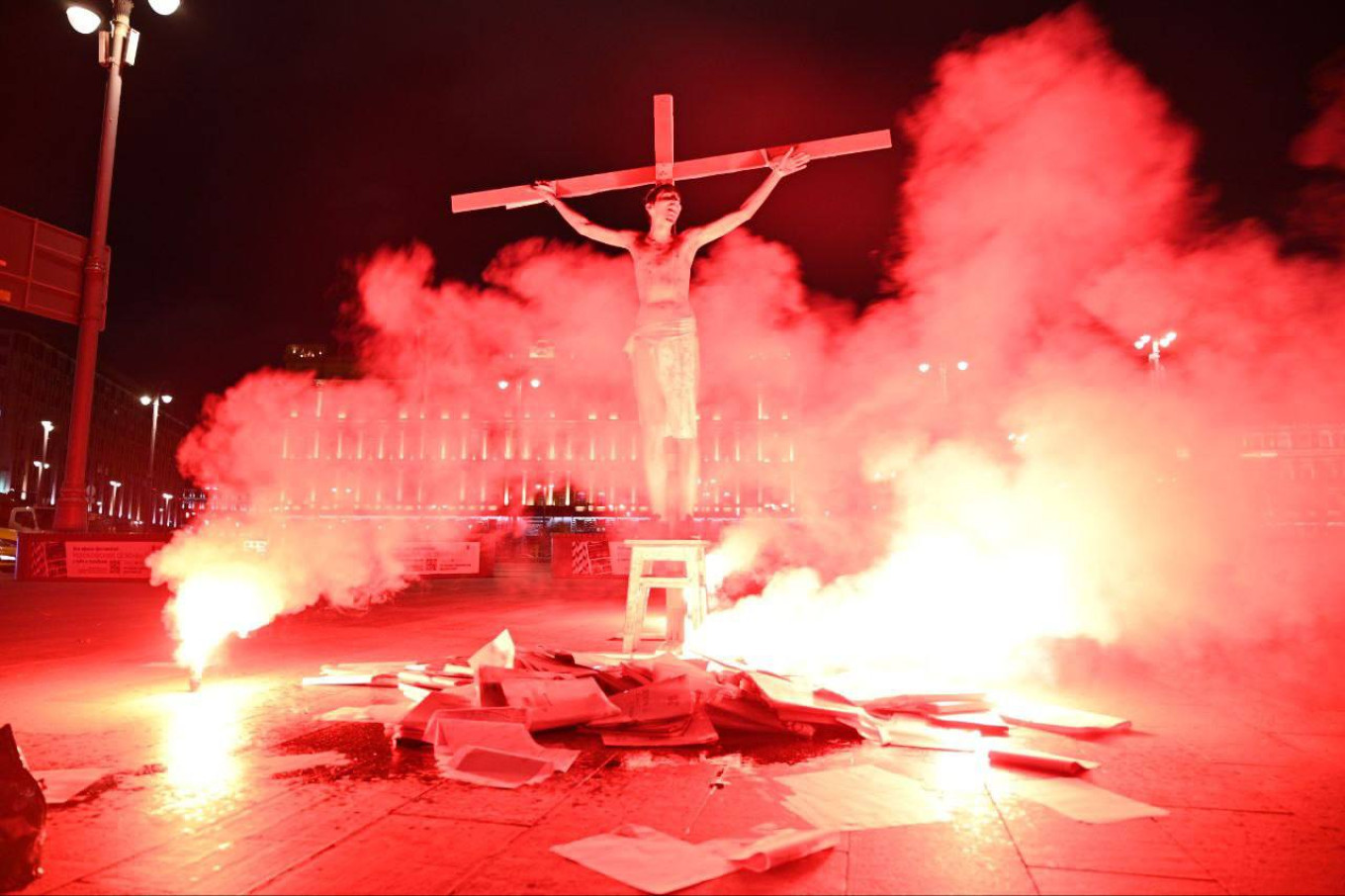
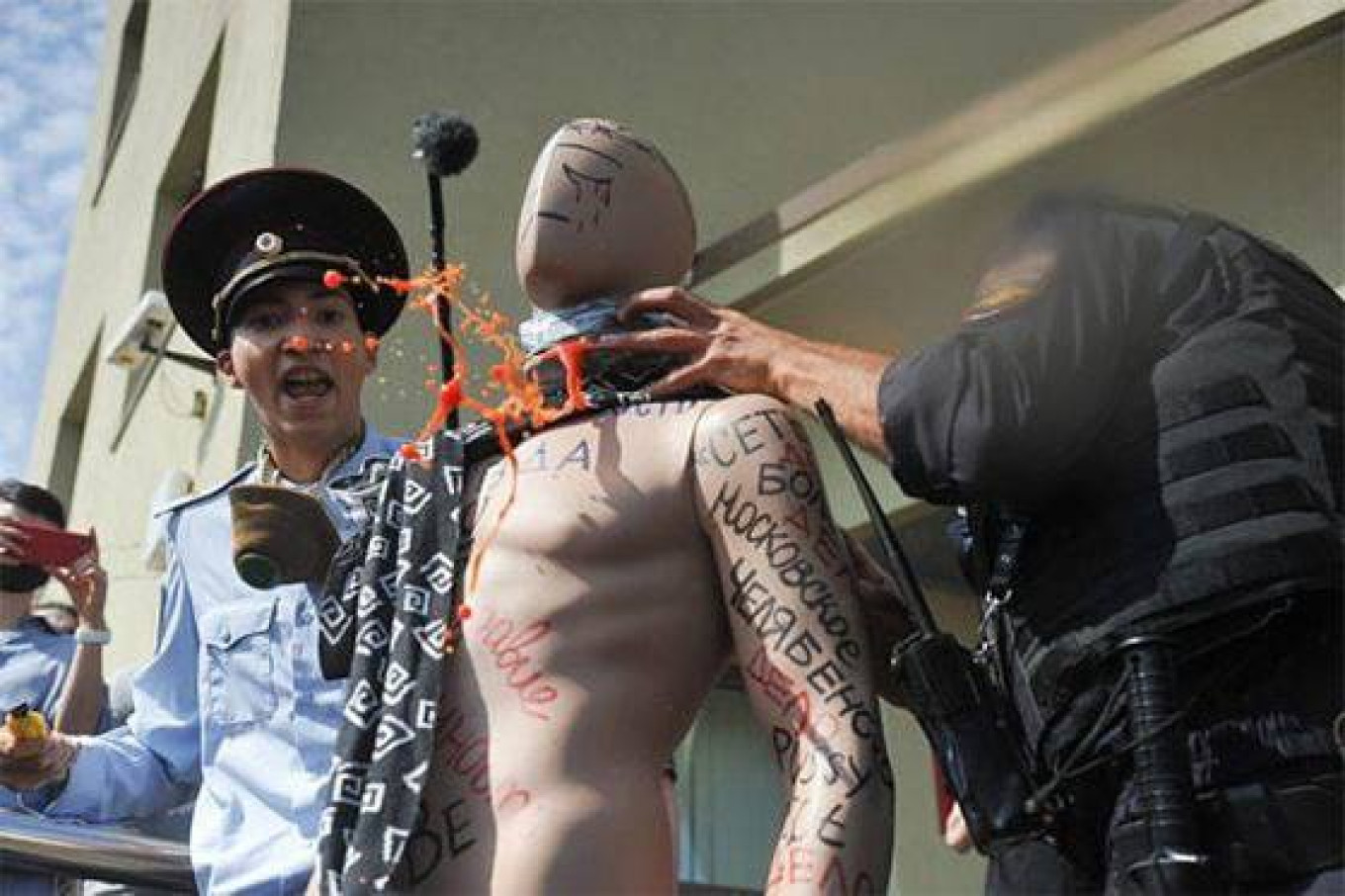
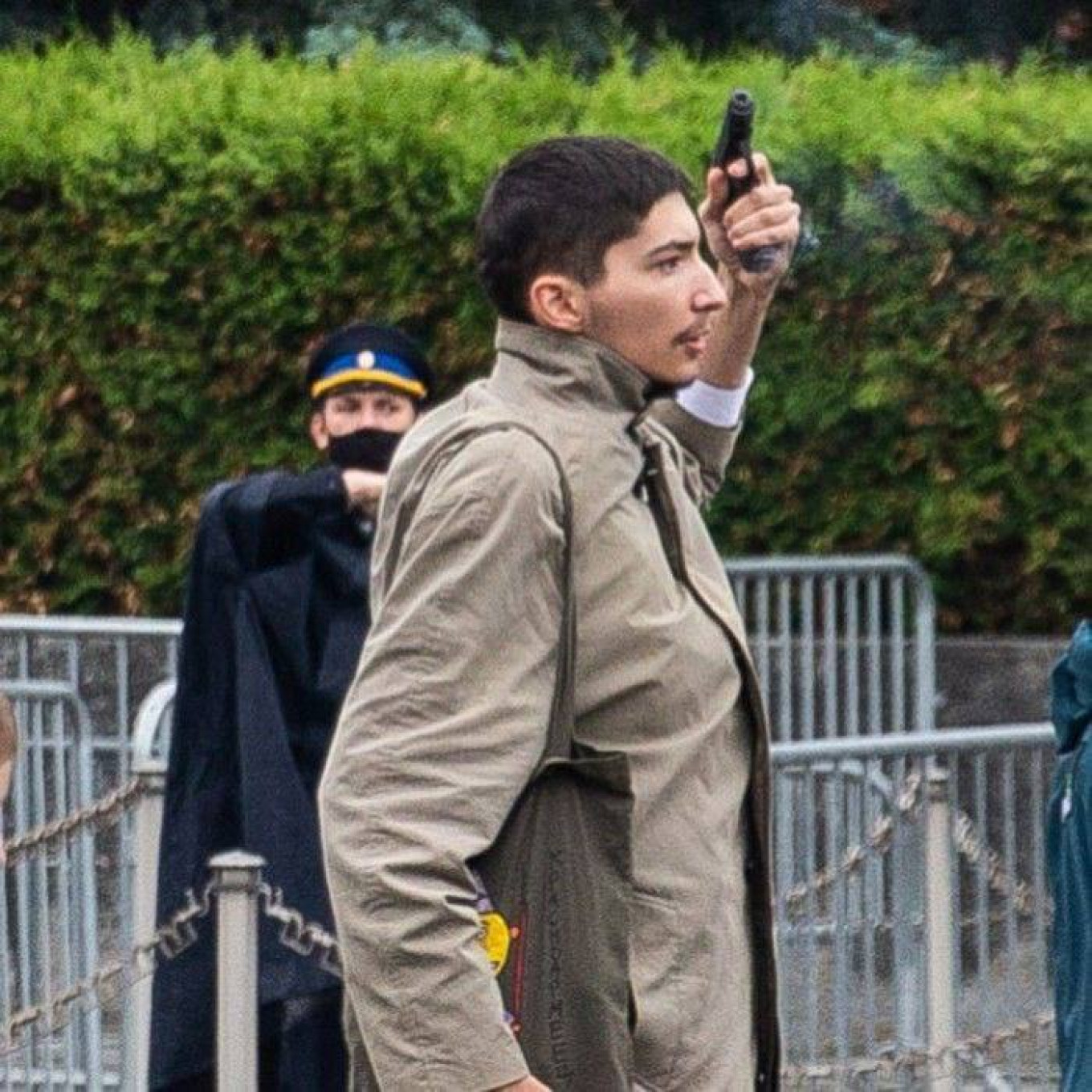
Pavel Krisevich once handcuffed himself to the fence of the Russian district court and sat dressed as a prisoner trapped in a ball made of barbed wire. He once cut a mannequin with a knife while dressed as a police officer, posed as Jesus on the cross around burning piles of papers in front of the FSB headquarters on Lubyanka. Using an unloaded gun, he staged a pretend suicide attempt at the heart of Russia’s totalitarian state — Moscow’s Red Square.
Krisevich is a young Russian performance artist and former political prisoner now living in exile, like me. I first heard about him when I was in jail myself for an act much more modest than the things he did.
A year ago, when Krisevich was released early from his sentence in a penal colony, I asked him via messenger to throw a public event with me, called “Skochilenko and Krisevich’s first time seeing each other,” which he agreed to. With no moderator involved, the audience could witness two creative people with similar backgrounds in discussion, asking and answering questions that only fellow prisoners of consciousness and artists could.
The main thing that I wanted to figure out is from what source Krisevich derived his creative powers. You see, this is a really practical question for me because I am also an artist and my job requires constant effort to keep these powers fresh and useful.
And of course, I am jealous of Krisevich's productivity. He produced around two thousand artworks while sitting in jail and a penal colony! I didn't have enough willpower to push myself in the creativve process so often in the detention center, despite having plenty of spare time compared to Kris, who was obliged to work days and nights in the colony.
Also, I am jealous of his bravery. I would never dare to organize a shocking religiously conceptualized performance in front of the building where hundreds of people were tortured by the siloviki for almost 100 years, even if I wanted to (it wouldn’t be my style). So I was eager to know what makes him try so hard and stage such daring acts?
But we never did that event that time because at the very moment he was released, he began to act again, although he noticed he was being surveilled by the police. When I asked him what he would do, he said that he had an idea to buy an airship and draw an anti-war image on it, something that he called the “repressive storm cloud,” and hang it over the city. I texted him to say that he was an idiot and I would buy him that airship if he would flee to Germany immediately (not that I had to money to do so).
It never came to an airship anyway. Pavel was arrested in November 2025 for having his photo taken dressed as a cowboy in front of a Soviet-era monument of a rocket. I don’t think the security services immediately understood an allusion to Stanley Kubrick's “Doctor Strangelove.” It's more likely they just thought that if Krisevich was wearing some costume again. It wasn't a good sign.
So, he was arrested and got administrative charges and served 15 days of detention. He served it, got out and was then arrested again on new fake administrative charges. This, in Russia, is called a carousel of arrests. A person gets arrested for administrative reasons, only to be released, then arrested again, sometimes even several times. While this individual is being held behind bars, a more serious criminal case is being built against him.
That November, I thought it was too late. I waited for too long and maybe lost my chance to see him ever again.
But a miracle happened. They let Kris go free and he finally left Russia. So I decided not to postpone our meeting any longer.
Oh, so interesting to finally see how the guy who depicted thousands of skeletons in jail robes, working with some strange raw materials, including bad sheets and his own blood, looks and acts? He must be a risk taker with a taste for the brutal, maybe something in the vein of Pyotr Pavlensky.
So, we went on air. And there he was on my monitor, an unassuming, nerdy, shy guy in glasses wearing an oversized, soft grey jumper, with a little toy koala and plants on the shelves behind him.
It's obviously not his studio, but still he looks very natural in this cosy, calm and slightly girlish atmosphere without a hint of toxic masculinity. He spoke with me very gently, politely, never interrupting or mansplaining.
We agreed to prepare questions for each other carefully and also to show art of the prisoners who are yet behind bars and share our opinions on their works. And the first question from Krisevich was whether I’d ever felt survivor's guilt for having been released.
He explained that he feels it. If he could, he'd swap his place with someone else. I told him that I was selfish, I love my life so much and I wouldn’t exchange my place with anyone. But of course, I feel that guilt too.
And since we both felt it, we immediately fell into discussing political prisoners we know, recalling details from their cases, showing their pictures and discussing them with as much excitement as if they were masterpieces from the Louvre. We both know how uplifting it is when you are sitting in jail, but know that your works are shown somewhere and people still remember you and talk about you.
So we talked about many people. We talked about Ludmila Rasumova, who went through a murder attempt by a cellmate and endless days of SHIZO punishment cell, drawing about her harshest experience. We talked about Asya Dudyaeva, an imprisoned academic and artist, who was held in my detention center before I arrived. It appeared that she taught Kris to draw via letters when she was still free herself. We talked about Yegor Balezeykin, who may not be an artist but still is a very deep and talented young man. He was in the same detention center as me, when he was a minor and then was transferred to the same penal colony as Krisevich when he turned eighteen, as were many other young people.
So that was it. Actually, I didn't manage to ask him personal questions. But I still found out something: he said he had been painting so much because it was a great distraction from reality.
I realized that the fuel of his brutal and sometimes shocking art is not rage, but love and care for other people. These autoregressive, bloody, shocking performances that he's done, he mainly did them to stand up for people who were imprisoned. Whether being handcuffed to a court in protest against the targeting of the non-existent “Network” terrorist group, cutting mannequins, taking a stand against the “New Greatness” case or performing on the cross with burning papers — it was all for the sake of political prisoners.
Despite my initial intention, I didn’t even ask him directly what he sees as the source of his creative powers. We were both too busy trying to talk about those who can’t be heard. Time slipped, and two hours passed as two minutes, as on a prison date in a jail with a good friend of yours, when you are talking via old telephones and looking at each other through glass, which sometimes looks like a mirror where you see yourself.
A Message from The Moscow Times:
Dear readers,
We are facing unprecedented challenges. Russia's Prosecutor General's Office has designated The Moscow Times as an "undesirable" organization, criminalizing our work and putting our staff at risk of prosecution. This follows our earlier unjust labeling as a "foreign agent."
These actions are direct attempts to silence independent journalism in Russia. The authorities claim our work "discredits the decisions of the Russian leadership." We see things differently: we strive to provide accurate, unbiased reporting on Russia.
We, the journalists of The Moscow Times, refuse to be silenced. But to continue our work, we need your help.
Your support, no matter how small, makes a world of difference. If you can, please support us monthly starting from just $2. It's quick to set up, and every contribution makes a significant impact.
By supporting The Moscow Times, you're defending open, independent journalism in the face of repression. Thank you for standing with us.

Remind me later.