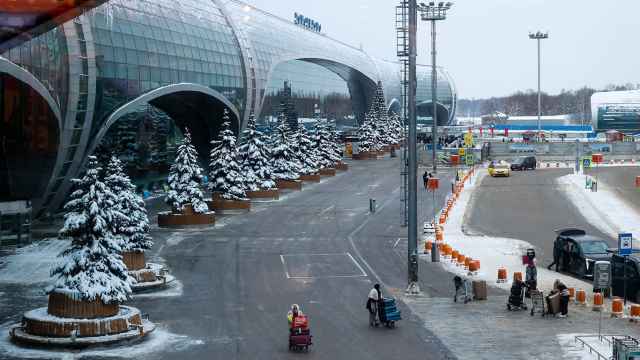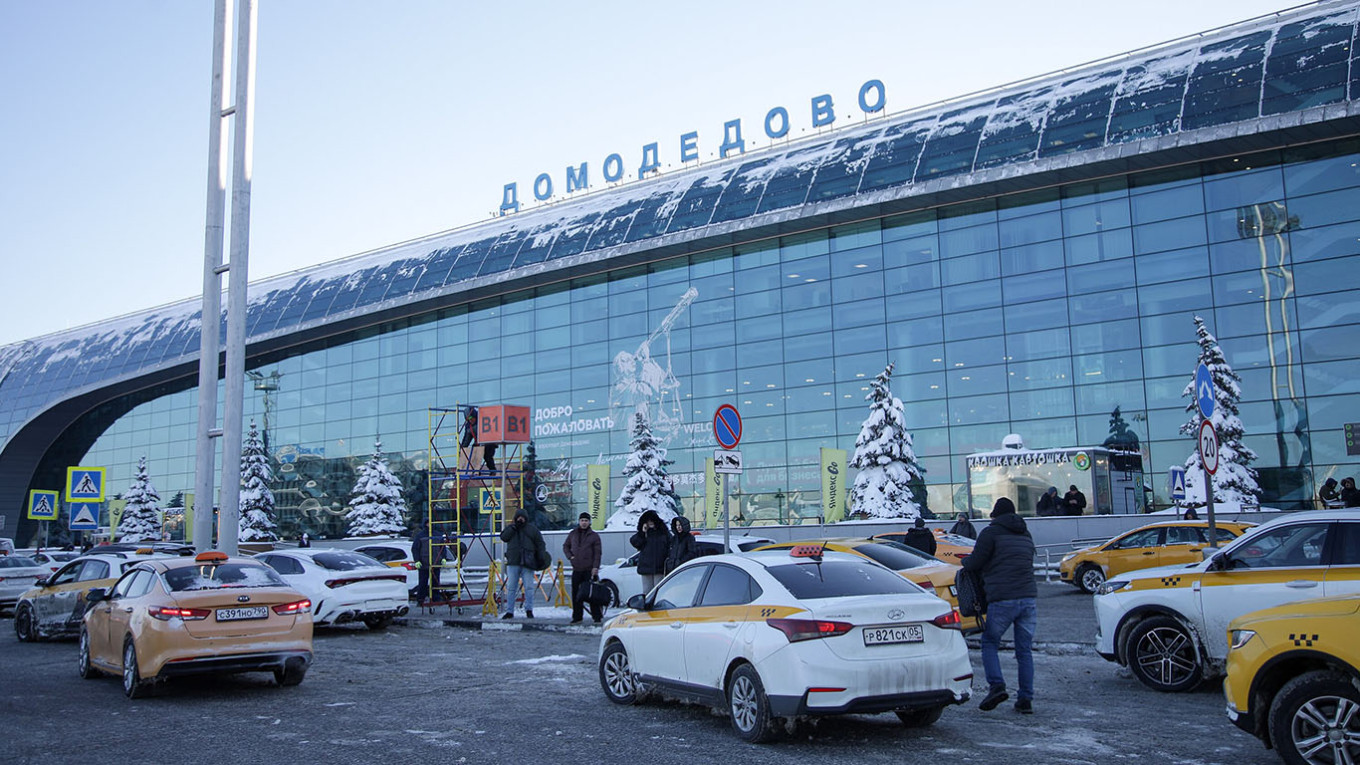
When a book is someday written about the life and death of private business in Russia, the story of Domodedovo Airport will surely have a well-deserved feature. It encapsulates not only the rise and disappearance of Russian free enterprise, but arguably the history of the country itself.
As the old joke that dates back to the end of the U.S.S.R. goes, Russia is bad at adding and multiplying but good at dividing and taking away. The saying neatly captures the twists and turns of the era we have lived through (but don’t be fooled — it is not over). It also answers perennial questions like why Russia never managed to become a prosperous and calm member of the club of advanced nations despite its vast wealth of natural resources and bright, skilled citizens
Still, the seizure of Domodedovo deserves special attention. It neatly brings together the gangster lawlessness of the 1990s, the crude greed of an emerging bureaucracy, the rise of the FSB’s business empire and the full ascendance of an elite that originated in the backwaters of the Ozero cooperative and basement fight clubs, but consolidated its power behind the Kremlin walls.
In the early 1990s, Domodedovo was a dump. Not just any dump, but a criminal one. It was a major hub for shuttle traders and contraband and was controlled by the Orekhovskaya crime group.
Into this swamp stepped Dmitry Kamenshchik. In one of his rare interviews, he later said it was almost accidental: a group of impoverished students founded East Line and decided to go into freight forwarding, since it required no capital. At the time, shuttle traders needed someone to manage the logistics of their operations that were clothing and feeding the country. There were many such firms in the early 1990s, but only one eventually became the owner of an airport, turned it into one of the country’s main hubs and pushed out both criminals and the state itself.
Domodedovo was never privatized through the loans-for-shares auctions. Kamenshchik developed it in partnership with a state management company and, after that company went bankrupt, bought out all its shares.
The first case against Kamenshchik stemmed from this arrangement. He acquired the shares during the 1998 crisis and, by 2003, the airport administration — which had leased him the airfield for 75 years — decided the deal had been improper.
Journalists didn’t like Kamenshchik much at the time: he was seen as too secretive, too aggressive and involved in shuttle trading back when that business was rife with shady dealings. But Domodedovo had already become such a convenient choice that even reporters, like ordinary Russians discovering cheap foreign travel, preferred flying from there.
That dispute dragged on. The airport administration lost in court and, in 2005, the far more powerful Federal Property Agency stepped in. It lost as well, though Kamenshchik was forced to make concessions, including higher lease payments to the state. And in 2004, Valery Kogan, a man reputed to know how to solve problems and considered close to the FSB, became chairman of Domodedovo’s supervisory board.
Domodedovo continued to grow and improve. By 2011, it was Russia’s leading airport. Meanwhile, the state poured money into Sheremetyevo, building a modern hub for the state-owned Aeroflot and luring major international airlines there. A healthy competition between public and private investment was taking shape, benefiting passengers.
Then came the terrorist attack that same year. A suicide bomber, unwilling to pass through passenger screening, detonated himself outside the terminal. With so many people corralled into one area, the death toll was high: 37 killed and around 170 wounded.
Curiously, the question of responsibility for the attack was also raised twice. The first attempt to charge the airport with security violations failed — Domodedovo quickly proved that security fell under a federal agency’s jurisdiction. The law said as much, and the case was dropped for lack of corpus delicti.
But by then, all oil fields and export-oriented sectors had been carved up, leaving aviation as an attractive, largely untapped source of wealth. As a new redistribution cycle — led this time by security services rather than gangsters — gathered momentum, few were surprised when Kamenshchik was sent to pretrial detention in 2016, personally charged with security violations. Another coincidence: he was arrested shortly after being forced to cancel a planned London IPO due to the attack and subsequent investigation.
Had Domodedovo become a publicly traded international company, taking it would have been harder. But the predators smelled blood.
At the time, it was widely believed that Arkady Rotenberg — who held a stake in Sheremetyevo — was among the figures eyeing up Domodedovo. A well-placed source in the aviation industry told me, “From the moment Kamenshchik proved it was an asset rather than a pile of junk, they were looking for ways to take it from him. There was a serious assault when [former Alrosa chairman] Sergei Ivanov Jr. and [businessman Roman] Trotsenko were allowed to bite off a piece — they were told no one would interfere. Kogan played a big role; he has extremely powerful connections. Most likely the FSB helped fend it off.”
Kamenshchik survived, but understood the message. From 2016 onward, Domodedovo underwent a visible decline. He likely realized the asset would eventually be taken, making further investment pointless.
Why didn’t he sell? Those familiar with the situation give two answers: nobody would offer a satisfactory price and he had already put so much of his own money into the project. Rumors of sale talks circulated, though remained unconfirmed by the taciturn owner. Both explanations may well be true.
Today’s predatory businessmen share an unpleasant trait with the Kremlin’s frenzy of expropriations: they don’t just want the asset — they want to humiliate its owner, preferably by paying a grotesquely low price or nothing at all.
This is a strange psychological affliction. Buying a good asset at a low price minimizes future risks. VEON’s Russian subsidiary VimpelCom was bought in 2023 for 130 billion rubles ($1.6 billion), though management expected it to go for 370 billion a year earlier ($4.8 billion). Moscow demands a 50% discount on its own valuation of a company in these situations.
But Domodedovo was coveted by people whose businesses depended entirely on special ties to the state and President Vladimir Putin himself. Their strategies only extended as far as the current system lasts.
They likely don’t consider that the current system will last forever. After the state seized Domodedovo in 2025, the airport’s finances deteriorated rapidly: losses rose from 6.8 billion rubles ($88.4 million) in 2023 to 10 billion ($130 million) in 2025, while debt climbed to 70 billion ($910 million).
Kamenshchik resisted to the end. After the law was amended in 2023 to allow the state to seize not only privatized assets, but any deemed “strategic” and under “foreign control,” he moved Domodedovo’s assets from offshore jurisdictions back into Russia.
It didn’t help. Prosecutors cited his residence permits for Turkey and the United Arab Emirates and Kogan’s Israeli citizenship as evidence that Domodedovo was under foreign control. The asset transfers, they claimed, created a “false appearance” of the airport’s ownership that would harm Russia’s economy. On top of that, they also accused the pair of siphoning 18 billion rubles ($234 million) abroad between 2021 and 2023 as loan repayments to “unfriendly jurisdictions.”
This is not satire — you can read the court filings yourself.
The work of the courts is still dragging on. On Jan. 29, the Supreme Court rejected Kamenshchik’s appeal to overturn decisions by lower courts. In a particularly elegant detail, the court is now headed by Igor Krasnov, who led the Prosecutor General’s Office when it seized the airport.
Litigation didn’t prevent the sale. On Jan. 20, Domodedovo was put up for auction for 130 billion rubles ($1.7 billion) — with no takers. Or rather, one bidder appeared: an individual entrepreneur taxi driver named Yevgeny Bogaty. Apparently, he was a mere placeholder to simulate competition. When real buyers couldn’t agree on a price, the taxi driver admitted he had no money.
On Jan. 29 — the same day the Supreme Court dismissed airport chairman Dmitry Kamenshchik's appeal — the airport was sold for the “right” price: 66 billion rubles ($856 million). The buyer, Perspektiva, is a wholly owned subsidiary of Sheremetyevo controlled by Rotenberg.
In short, the Domodedovo story is Russia’s story. The country tried to build a market democracy in the 1990s, but failed to overcome gangsters. It produced people capable of building real businesses, only for them to be squeezed out first by security services, then by a narrow elite little different from the criminals of the 1990s.
The cycle has come full circle. Whether Russia will ever break it remains an open question.
A Message from The Moscow Times:
Dear readers,
We are facing unprecedented challenges. Russia's Prosecutor General's Office has designated The Moscow Times as an "undesirable" organization, criminalizing our work and putting our staff at risk of prosecution. This follows our earlier unjust labeling as a "foreign agent."
These actions are direct attempts to silence independent journalism in Russia. The authorities claim our work "discredits the decisions of the Russian leadership." We see things differently: we strive to provide accurate, unbiased reporting on Russia.
We, the journalists of The Moscow Times, refuse to be silenced. But to continue our work, we need your help.
Your support, no matter how small, makes a world of difference. If you can, please support us monthly starting from just $2. It's quick to set up, and every contribution makes a significant impact.
By supporting The Moscow Times, you're defending open, independent journalism in the face of repression. Thank you for standing with us.

Remind me later.