Young Russians are split between a majority that is content with the state and their place in it and a minority that suffers from isolation and dictatorship. What unites both groups is their pragmatism and unwillingness to sacrifice anything.
Let us begin with the minority. If anything resembling solidarity actions took place in Russia in 2025 that allowed this minority to make itself visible, it was the defense of the band Stoptime.
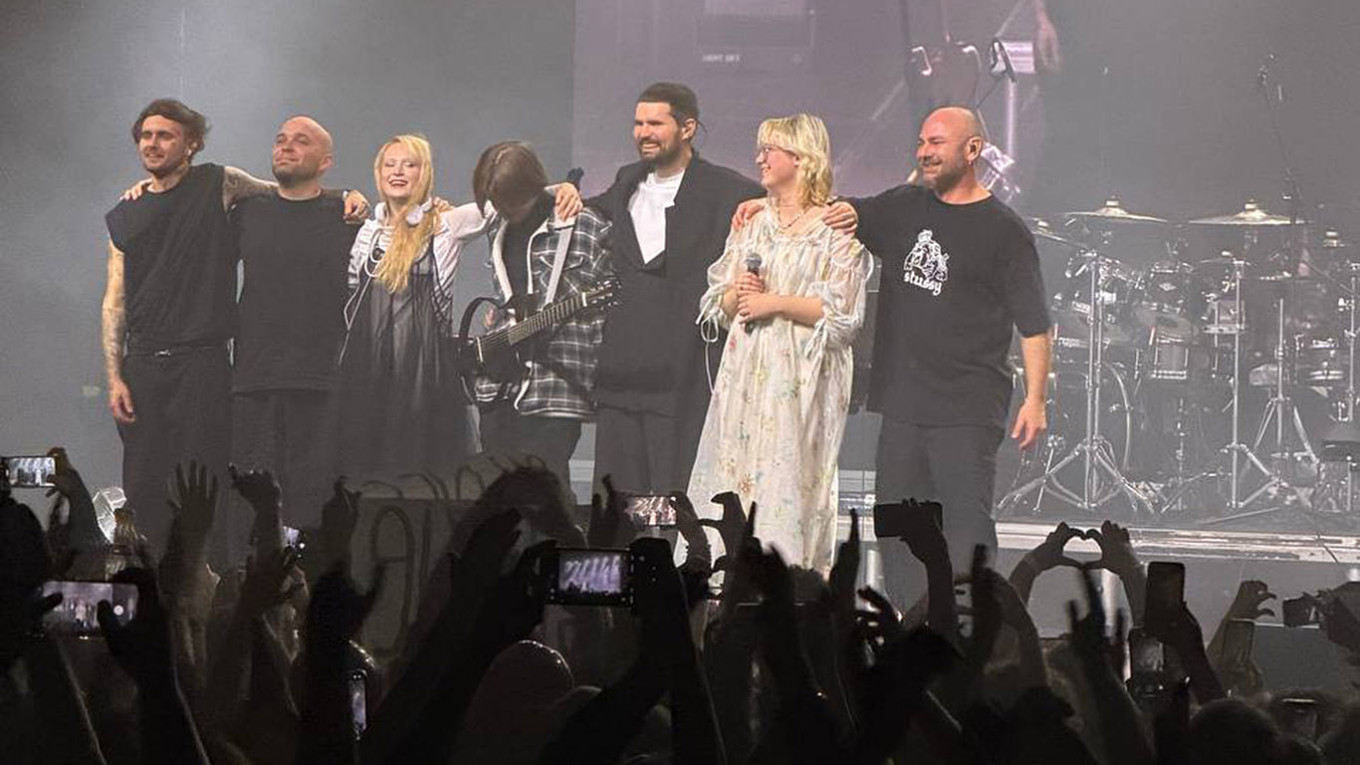
Dozens of sympathizers attended court hearings in St. Petersburg. At the end of October, about 100 people gathered outside the district court to submit appeals in defense of frontwoman Daria Loginova — who goes by “Naoko” — and her friends.
This solidarity can by no means be described as a mass event, but what did exist seems to have surprised the authorities. It is possible that it is precisely why the musicians were allowed to leave the country instead of being imprisoned for several years for performing songs by “foreign agents.”
The saga ended with Naoko and Stoptime guitarist Alexander Orlov staging a joint concert in Vilnius with Noize MC and Monetochka (whose songs had triggered Stoptime’s punishment). The reaction to that concert on the group’s Telegram channel is an illustrative snapshot of the mood of Russia’s opposition-minded youth.
The first thing you notice is that being a Kremlin loyalist is completely unacceptable in this milieu. Most comments were nothing but delight.
Some commenters reflected whistfully on the mechanics of emigration: the countries they would move to if they could, which are easiest and most desirable to settle in. Others wondered if it would be possible to wait for the current regime to die out — and whether Putin’s death would herald a better future.
Even the few sarcastic remarks — perhaps from regime agents — accuse Naoko not of anti-patriotism but merely of wanting to arrange a more comfortable move to the West.
What is entirely absent in this circle is the spirit of struggle for lofty public goals that youth is so often credited with. There is only depression: “There’s a theory that we all died on 24.02.2022 and what we’re seeing now is us in hell.”
Self-censorship, of course, still exists. Various surveys show that between 30% and 60% of young people admit they avoid publicly sharing their views for fear of punishment. But is it worth looking for what was never hidden? These unspoken political views are the same as the spoken ones. There is no desire among opposition-minded youth to stand up for a “beautiful Russia of the future.”
If there were, it would have manifested itself in at least some visible demonstrations of solidarity — some of which are not even punished yet.
Which university’s students rose to defend one of their own who was arrested? Do opposition-minded young Russians have any centers of gravity, communities or figures they are ready to stand up for and protect? Those who came out for Stoptime have not been published. And how many of them were there?
Let us look from the inside. Opposition-minded youth are concentrated mainly in major cities, which are also the best places for young people to live.
The average monthly salary among employed Muscovites under 35 has exceeded 140,000 rubles ($1,755) and 110,000 rubles ($1,380) in St. Petersburg. Nationwide, 41% of young people surveyed by the Public Opinion Foundation said their material situation was good, while only 10% said it was bad, compared to 22% of the population as a whole who were satisfied. At the same time, 44% of young people also expect their situation to improve further in the coming year, compared to only 25% of all Russians.
This is not just about money, access to market goods or the current ease of finding jobs in big cities. Young people see that ideological alignment opens many doors, while calibrated conformism allows one simply to live quite well — at least for now.
That is why official polls showing that youth self-identification as patriots has shot up to nearly 100%, and that 24% of young people promise to report to the authorities anyone who insults Putin (compared to only 14% among Russians overall), do not look entirely implausible.
Let’s put ourselves in the shoes of those graduating from an elite institution such as Moscow State University, HSE, or the European University. Those with dissident thoughts have decent prospects if they choose to settle in the West. Loyalists are aiming for careers in respectable Russian institutions and also have good chances.
The moral judgments we make about each group will differ. But we must acknowledge one important point on which these young oppositionists and these young loyalists converge: they are all planning to live without risk and without sacrifice.
The same can be said of the youth more broadly. Opposition-minded individuals among them are more likely to stay in Russia than emigrate. Even the most eager loyalists will have to accept that high ranks and titles are out of their reach. But the prevailing mood is the same: to live without sacrifice and not fight for anything. The question is whether these hopes are realistic for either group.
I do not know whether part of the population will be allowed to continue sitting quietly in its shell, waiting for something. Pressure is growing and any conformism short of 100% may become punishable. As for loyal citizens, they are being asked to make sacrifices right now.
The regime is waging a war that claims around 100,000 Russian lives a year. Each fallen soldier must be replaced by a new loyal subject. This need fundamentally contradicts the majority of young loyalists’ ideas about how life should be lived. For now, this contradiction is sidestepped in two ways: by postponing new forced mobilizations and by recruiting middle-aged or older mercenaries to avoid touching the youth.
But it would be a mistake to think Russia’s young are exempt from sacrifice. One in four of the county’s dead, identified by Mediazona and the BBC, is under 30. Almost all of them come from outside major cities. That supply of young human material from the hinterland is shrinking and the need for manpower from the front puts pressure on the authorities to demand a blood tax from the rest of the population as well.
This is exactly what all Russian youth fear equally — loyalists and non-loyalists alike. Neither group’s vision of a desirable future includes making such sacrifices.
Fears of a new mobilization have grown in recent months. More than half of Russians now fear this prospect, but young people especially. This explains their heightened pacifism.
Among all respondents surveyed by Russian Field, the share of supporters of peace negotiations with Ukraine was 50%, while those proposing to continue the war accounted for 37%.
But among younger respondents (under 30), the ratio is different: 63% to 21%. Most of these pacifists are also loyalists. They want not so much peace as for the war not to affect them personally.
Whether we like it or not, today’s young Russians are not a force opposing tyranny and ready to build something else in its place. Loyalists and non-loyalists resemble each other more than is commonly assumed.
Both groups show little idealism and much pragmatism, though both are shortsighted about what going with the flow could result in.
They believe that everyone is on their own and is just as ill-suited to collective action as previous generations of Russians. But it is far from certain that the regime will allow them to live as calmly and safely as they hope.
A Message from The Moscow Times:
Dear readers,
We are facing unprecedented challenges. Russia's Prosecutor General's Office has designated The Moscow Times as an "undesirable" organization, criminalizing our work and putting our staff at risk of prosecution. This follows our earlier unjust labeling as a "foreign agent."
These actions are direct attempts to silence independent journalism in Russia. The authorities claim our work "discredits the decisions of the Russian leadership." We see things differently: we strive to provide accurate, unbiased reporting on Russia.
We, the journalists of The Moscow Times, refuse to be silenced. But to continue our work, we need your help.
Your support, no matter how small, makes a world of difference. If you can, please support us monthly starting from just $2. It's quick to set up, and every contribution makes a significant impact.
By supporting The Moscow Times, you're defending open, independent journalism in the face of repression. Thank you for standing with us.

Remind me later.