
That the Caucasus is a zone of diverging political interests is nothing new. With Armenia long more Russian-aligned, Georgia seeking Euro-Atlantic integration, while Azerbaijan invests in ties with Turkey, diversity has been the norm in the Caucasus’ relations since 1991.
However, while 2025 saw a continuation in that trend, it also saw a recasting of the main players. Armenia looked westward as Azerbaijan set a new tone in relations with Russia. Meanwhile, Georgia slipped further into alignment with the Kremlin.
Perhaps the single biggest shift in the Caucasus’ regional dynamic came in August.
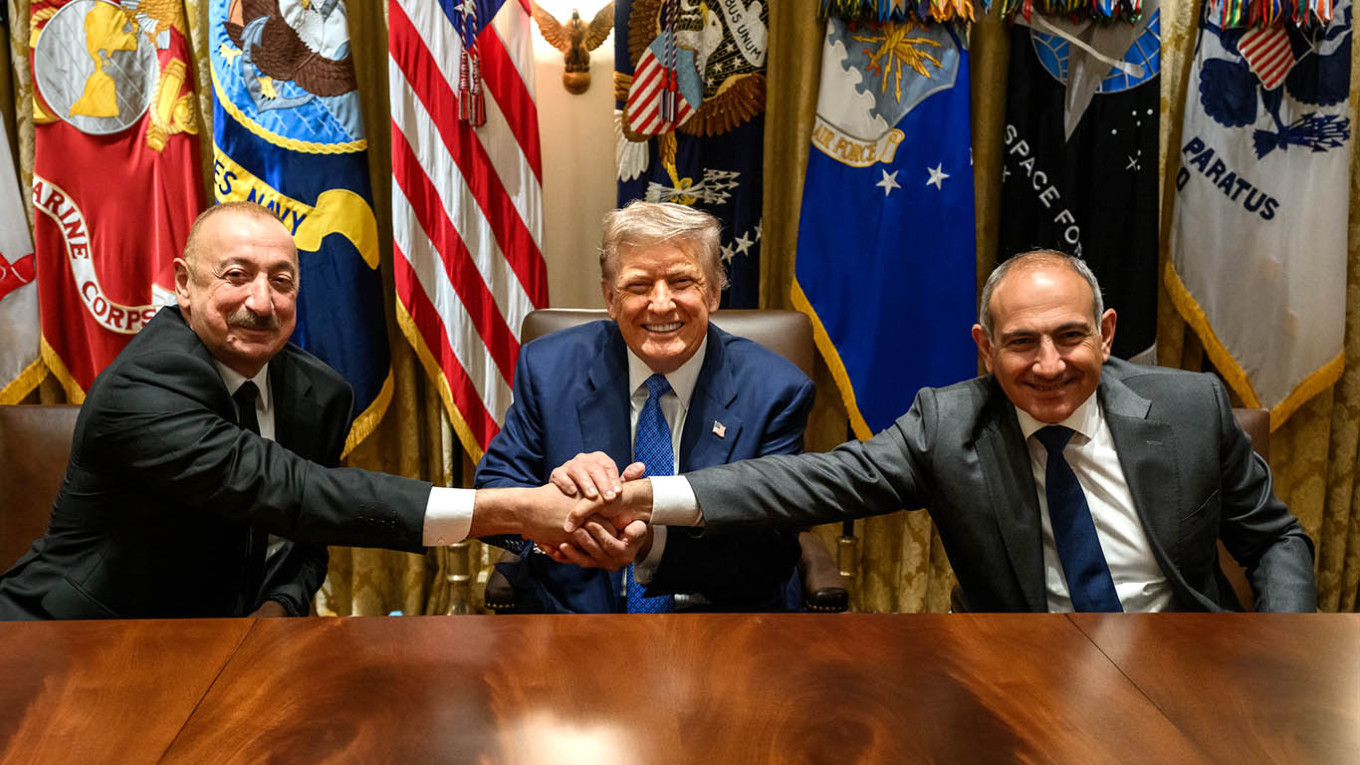
That month, United States President Donald Trump hosted Armenian Prime Minister Nikol Pashinyan and Azerbaijani President Ilham Aliyev as part of Trump’s drive to settle myriad conflicts across the world. Although the depth of Trump’s knowledge of the Nagorno-Karabakh conflict is doubtful (he referred to Armenia as “Albania” several times), the August summit bore real policy outcomes.
With normalization talks having dragged on for over a year, the Washington meeting provided a useful diplomatic catalyst. Convening the two leaders, Trump proclaimed that they had agreed to the core tenets for a final normalization deal with the United States becoming the primary backer of what he termed the “Trump Route for International Peace and Prosperity” (TRIPP).
Under the deal, the United States is to be granted a multi-decade lease and exclusive development rights for the strip of Armenian territory constituting TRIPP. In September, it was announced that Washington would provide $145 million for the first phase of construction. U.S. officials have become regular visitors to Yerevan and Baku as the project begins to take shape.
Trump’s backing of the route appears to have provided a more palatable variation of what Azerbaijan has long called the Zangezur Corridor. The initiative aims to connect Azerbaijan to its Nakhchivan exclave through a transit corridor across Armenian territory. Baku has long demanded the establishment of such a corridor as a component of any peace settlement, despite contention surrounding how such a project would be implemented without infringing on Armenian sovereignty. By stepping in, Washington provided a crowd-pleasing solution. Aliyev gained Trump’s attention, with the pair signing a memorandum to form a Washington-Baku strategic partnership. Pashinyan received a new Washington-backed, renamed version of the corridor, likely an easier sell to his constituents than previous iterations.
Often at the center of previous peacemaking efforts, Moscow now finds itself as an outsider looking in. The country providing the political and financial capital for the project is not Turkey or any non-aligned state, but the United States. Moscow has recently stated interest in taking part in the TRIPP project, only to be rebuffed by Armenia’s parliamentary speaker.
Trump has had far more positive relations with the Kremlin than any other U.S. president in recent memory. Nevertheless, that the United States, and not Russia, will have a physical presence in the South Caucasus demonstrates the extent to which Russia’s once overbearing role in the region has diminished.
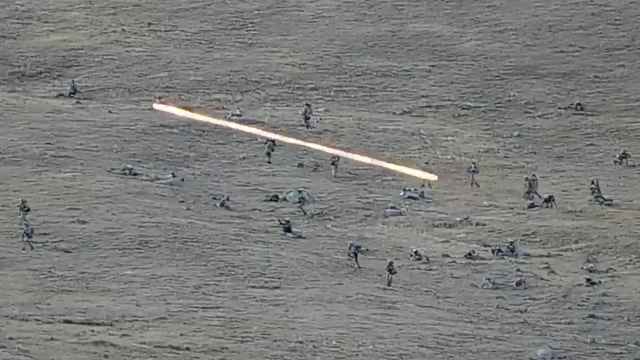
Only five years ago, the 44-day Armenia-Azerbaijan war ended with Russian peacekeepers on the ground in Nagorno-Karabakh, seemingly a sign of a reasserted place for Moscow in the Caucasus. Now, it will be U.S. companies and diplomatic officials who establish their own presence in the region.
Armenia’s westward tilt also brought the country closer to the European Union this year. In December, Armenia and the European Union adopted a shared Strategic Agenda for economic development and political reform. European investments in Armenia, a country largely economically dominated by Russia, are growing. Most recently, the EU’s European Investment Bank announced a 100 million euro partnership for business growth in Armenia.
Even Azerbaijan, at times a pariah in the halls of European capitals, saw its ties to Brussels somewhat improve this year. The EU’s top diplomat Kaja Kallas visited Baku in April, where she called Baku an “important partner” and announced a return to negotiations for a new partnership agreement.
The year's other big geopolitical story in the Caucasus was the diplomatic rupture between Baku and Moscow.
In late June, Russian police in Yekaterinburg arrested dozens of Azerbaijanis, killing two in the process. Coming in the aftermath of Russia accidentally shooting down an Azerbaijani civilian aircraft in December 2024, the killings resulted in an explosion of outrage. Azerbaijani officials condemned what they described as “torture and murder with extreme cruelty.” Meetings between Russian and Azerbaijani officials were canceled as Azerbaijani media began churning out dramatic anti-Russian content.
In Baku, Azerbaijani security forces arrested pro-Russian Sputnik Azerbaijan journalists and rounded up Russian nationals authorities claimed were involved in drug trafficking. Russia reacted in much the same way, arresting Azerbaijanis in Russia.
In another potential retaliatory measure, Russian forces bombed Ukrainian properties owned by Azerbaijan’s all-important state oil and gas company in August.
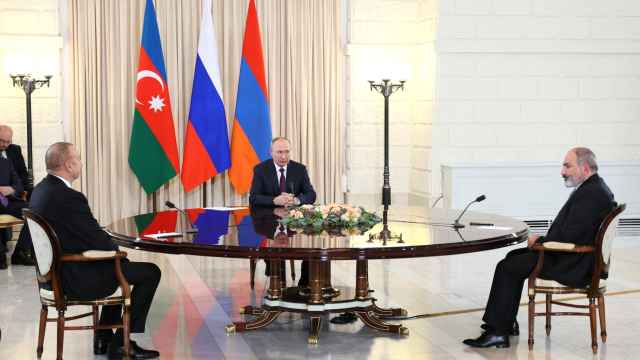
The months following the fallout saw minimal signs of warming ties until this fall. Then, in October, on the sidelines of a Russia-Central Asia summit in Tajikistan, Aliyev met with President Vladimir Putin. During the following public press conference, Putin delivered a rambling and vague apology for the downing of the Azerbaijani flight in December 2024. Pro-Azerbaijani media labeled the moment a “triumph.”
This symbolic concession was followed by Baku releasing some of the Russian nationals it had arrested over the summer and other signs of improving relations. Reports have surfaced of government media taking down anti-Russian articles they had previously published.
In retrospect, the clash between Moscow and Baku appears to resemble a resetting of relations between the pair rather than a full break. Retaliatory measures never targeted core components of the relationship, such as the north-south transit corridor that runs from Russia to Iran through Azerbaijan. Actions remained largely symbolic and seemed designed to communicate that Azerbaijan was not a small ex-colony, but an independent rising regional power that would not back down to a challenge.
The final image generated, that of Putin’s awkward apology, was one of a far more egalitarian relationship between Moscow and Baku.
As Moscow finds frustration and new challenges in Armenia and Azerbaijan, its consolation prize looks to be Georgia.
While Georgia’s firm break with the country’s traditional Western partners can be traced to 2024, this year saw a fast-paced consolidation of the Georgian Dream party’s rule. The party, which has spurned the European Union and sought reconciliation with Russia, weathered mass protests in late 2024 and has spent much of 2025 arresting leading opposition figures.
Long accused of pro-Russian leanings, Georgian Dream’s consolidation bodes well for Russia’s influence in the Caucasus. The party has recast Georgia’s former ruling party as being at fault for the 2008 Russo-Georgian war, depicted the European Union and Ukraine as war-mongers, and sought a close partnership with China. Bidzina Ivanishvili, the billionaire oligarch at the center of Georgian Dream, maintains financial interests in Russia and is believed to be in contact with Russian intelligence and oligarchs by U.S. intelligence services.
Economically, under Georgian Dream, the country has become an important route for Russian sanctions evasion. Billions of dollars worth of goods are believed to be laundered through Georgia and on to Russia, including dual-use materials. This fall, Georgia began refining Russian crude oil for the first time at the newly established Kulevi oil refinery.
In Georgia’s separatist-administered Russian-occupied territories, this year saw further Russian encroachment. After the local overthrow of Abkhazia’s de facto President last year, Kremlin-endorsed Badra Gunba won Abkhazia’s presidential vote in March. Sergey Kiriyenko, Russia’s First Deputy Chief of Staff of the Presidential Administration, has become a regular visitor to the territory, backing Gunba and cutting ribbons for new Russian-financed infrastructure projects.
Of the three Caucasus states, Georgia is an outlier in this growing closeness to Russia. While in economic terms, Russia remains highly important for Armenia and Azerbaijan, broader political trendlines are in the opposite direction.
Much of this diminished role for Russia can be traced to the outbreak of the war in Ukraine, which degraded Moscow’s capacity and status. Yet other factors also matter. The end of the conflict between Armenia and Azerbaijan in 2023 removed a tool Moscow has used to cement its influence in the region. The growing Middle Corridor project has made the region increasingly relevant to Western policymakers as well.
Overall, this year saw Armenia and Azerbaijan hit key bellwether moments in their recalibration of ties to Moscow. While Georgia drifts northward, Armenia and Azerbaijan are investing in new relationships, signaling a new dynamic with Russia.

A Message from The Moscow Times:
Dear readers,
We are facing unprecedented challenges. Russia's Prosecutor General's Office has designated The Moscow Times as an "undesirable" organization, criminalizing our work and putting our staff at risk of prosecution. This follows our earlier unjust labeling as a "foreign agent."
These actions are direct attempts to silence independent journalism in Russia. The authorities claim our work "discredits the decisions of the Russian leadership." We see things differently: we strive to provide accurate, unbiased reporting on Russia.
We, the journalists of The Moscow Times, refuse to be silenced. But to continue our work, we need your help.
Your support, no matter how small, makes a world of difference. If you can, please support us monthly starting from just $2. It's quick to set up, and every contribution makes a significant impact.
By supporting The Moscow Times, you're defending open, independent journalism in the face of repression. Thank you for standing with us.

Remind me later.