

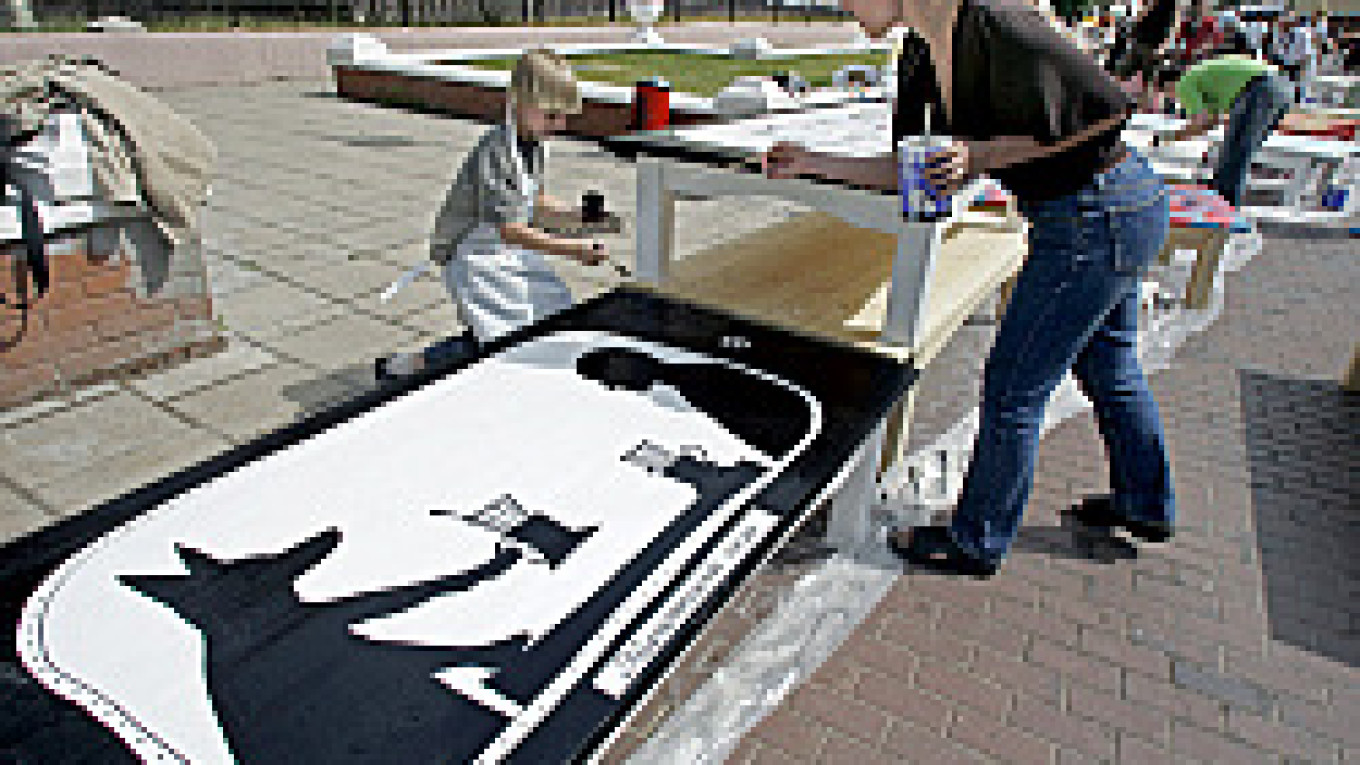
This week, two-thirds of the bench's segments were scattered in public spaces around the city. The remaining 50 benches, which, at two-by-three meters resemble squat coffee tables more than ordinary municipal benches, will remain in front of the museum until they are sold in October at a charity auction to raise money for orphanages.
Although many of the painters were local, others hailed from Taiwan, France, Tajikistan and Uzbekistan. "This is a truly international project in spirit," the leading organizer, artist Andrei Popov, commented on Friday. "The bench symbolizes friendship and unity through art. When people sit down, we hope that they will talk about the art and demolish cultural barriers."
Conversation flowed as the artists labored, and the event had the ambience of a street fair, complete with live music. The artists, wearing paint-splattered aprons with the slogan "World Bench 2007," played to an audience of passersby who stopped to watch them at work.
"At least two little girls came up to me today and asked to help paint. We had a great time," Sergei Tsigal, a jovial artist and food critic, recounted on Friday. "These interchanges are what make the project eminently fun." All day Tsigal could be found collaborating with Popov on a lively portrait of a giraffe while a crowd of spectators gawked with similarly craned necks.
Following the event's theme, many designs included depictions of globes and landscapes. But the wooden canvases yielded wildly differing creations, among them a super-sized chessboard, a life-sized mural of a man sleeping on a bench and a photorealistic painting of an eyeball.
Ivan Yazykov, a graphic artist, brought his wife to help speed up the painting. The couple sketched a pair of black-and-white pieces entitled "Railroad Life." As Yazykov put it, one depicted "the view into a train window, where two silhouettes, one canine and one human, drink tea, revealing the phantasmagoric world of the railway." The other, in similarly fantastic style, showed "the world that races by the speeding train," he said. The couple painted miniature figures, telephone lines and even drying laundry.
Another monochrome bench stood close by, inscribed: "A White Polar Dog Saw a White Polar Bear." The bench's author, Andrei Bartenev, the artist and designer, was clad in a characteristically eccentric outfit and, in the spirit of the cosmopolitan project, represented the Yamalo-Nenetsky autonomous district around his arctic hometown, Norilsk. "What would the world be without polar bears?" he appealed rhetorically. "That would be a horrible world. It wouldn't be a world at all!"
The event's organizers have ambitious plans. "Next year, we'll have a day where benches are created all over the planet," Popov said. But some adjustments might be needed before the idea goes global. "The problem with same-day painting is that you can't wait for it to dry," Tsigal said. "I saw several artists who sat down on their creations and stood up with spectacular pieces of modern art on their behinds."
The? benches? will? be? on? display? until October. For details of their locations,? see? the? project's? web? site, www.lavkamira.com.
A Message from The Moscow Times:
Dear readers,
We are facing unprecedented challenges. Russia's Prosecutor General's Office has designated The Moscow Times as an "undesirable" organization, criminalizing our work and putting our staff at risk of prosecution. This follows our earlier unjust labeling as a "foreign agent."
These actions are direct attempts to silence independent journalism in Russia. The authorities claim our work "discredits the decisions of the Russian leadership." We see things differently: we strive to provide accurate, unbiased reporting on Russia.
We, the journalists of The Moscow Times, refuse to be silenced. But to continue our work, we need your help.
Your support, no matter how small, makes a world of difference. If you can, please support us monthly starting from just $2. It's quick to set up, and every contribution makes a significant impact.
By supporting The Moscow Times, you're defending open, independent journalism in the face of repression. Thank you for standing with us.

Remind me later.