

All these elements feature in Rustam Abdrashev's "The Gift to Stalin," though in a vastly different historical context: the closing years of the Stalin era, when in a remote Kazakh village traditional values and personal humanity are set against the cruelty of the effectively occupying regime.
The film begins around 1949, and the period is captured well. Ills wrought by the terrorizing government appear immediately with the arrival of a prisoner train at a far-flung station, where the dead are to be removed from prison carriages. Eight-year old Sashka (Dalen Shintemirov) witnesses his Jewish grandfather expire there before being hidden with the corpses and narrowly escaping death himself after being rescued by two local railway repairmen, who are forced to bury those who have not survived the gulag transport.
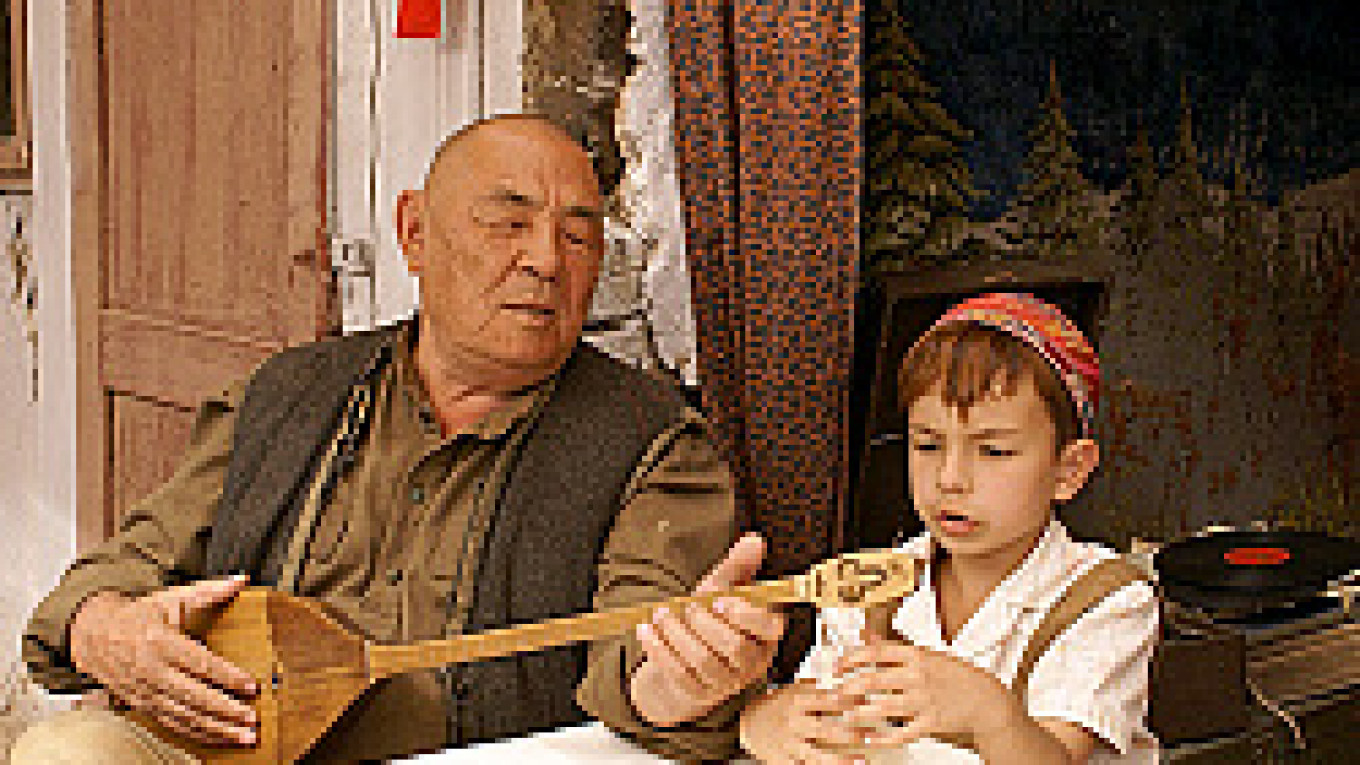
He's transported, literally and emotionally, into a new and protective environment. His prime protector is Kasym (Nurjuman Ikhtimbayev), a heavily scarred war veteran whose damaged face speaks more powerfully than any words he utters. All of "Gift," in fact, communicates more through silence and visual detail than through speech.
If their relationship becomes that of father-son, or more like grandfather-son, there is maternal care from another deportee, Vera (played powerfully by Yekaterina Rednikova), as well as the presence of an exiled Polish doctor whose relationship with the woman brings a tragic plot development near the end. To hide his identity, Sashka is effectively rebaptised as Sabyr and is cured of a lingering illness by a shaman. This apparently benign world is threatened only by surrounding Soviet power, in the form of a sadistic KGB major (Alexander Bashirov) and a corrupt Kazakh policeman, both of whom unabashedly use sexual violence to emphasize their control over others. Trouble also comes from a band of orphan children who live harsh lives and resort to crime to survive.
The film's title alludes to the fact that the year concerned marks the 70th birthday of Soviet leader Josef Stalin (although it seems to stretch history by a year on that front). Radio campaigns engage the nation's children to compete to present him with the greatest gift, and the event makes for a heart-breaking moment as Sabyr sacrifices the goat that is his only real possession in the hope that he may see his parents again. There's a chilling allusion to that theme developed subtly in early moments as well, when we see that the location borders Semipalatinsk, the site of the first Soviet nuclear weapon test ?€” the gift perhaps prized most by Stalin.
Woven throughout the action in the Kazakh village is a retrospective narrative strand, in which an older Sashka-Sabyr appears in contemporary Jerusalem, where he has obviously found sanctuary after many years. Whether that weakens the essential drama of the story or gives it context is a moot point: It gives it an extra depth and perspective as well as appeal to an international audience.
In other hands ?€” think Hollywood ?€” a film like this might milk the potential sappiness of a drama that portrays victims of a totalitarian regime, presenting viewers with a kind of "Stalinism lite". But "Gift" doesn't hold back ?€” the emotions are real, backed up by strong performances all around. The technical work is professionally done, though underplayed, with the striking steppe landscape almost speaking for itself. It's a landscape that both dwarfs the lives of its inhabitants and yet in no way diminishes the tenderness of their small dramas.
4 / 5
A Message from The Moscow Times:
Dear readers,
We are facing unprecedented challenges. Russia's Prosecutor General's Office has designated The Moscow Times as an "undesirable" organization, criminalizing our work and putting our staff at risk of prosecution. This follows our earlier unjust labeling as a "foreign agent."
These actions are direct attempts to silence independent journalism in Russia. The authorities claim our work "discredits the decisions of the Russian leadership." We see things differently: we strive to provide accurate, unbiased reporting on Russia.
We, the journalists of The Moscow Times, refuse to be silenced. But to continue our work, we need your help.
Your support, no matter how small, makes a world of difference. If you can, please support us monthly starting from just $2. It's quick to set up, and every contribution makes a significant impact.
By supporting The Moscow Times, you're defending open, independent journalism in the face of repression. Thank you for standing with us.

Remind me later.