

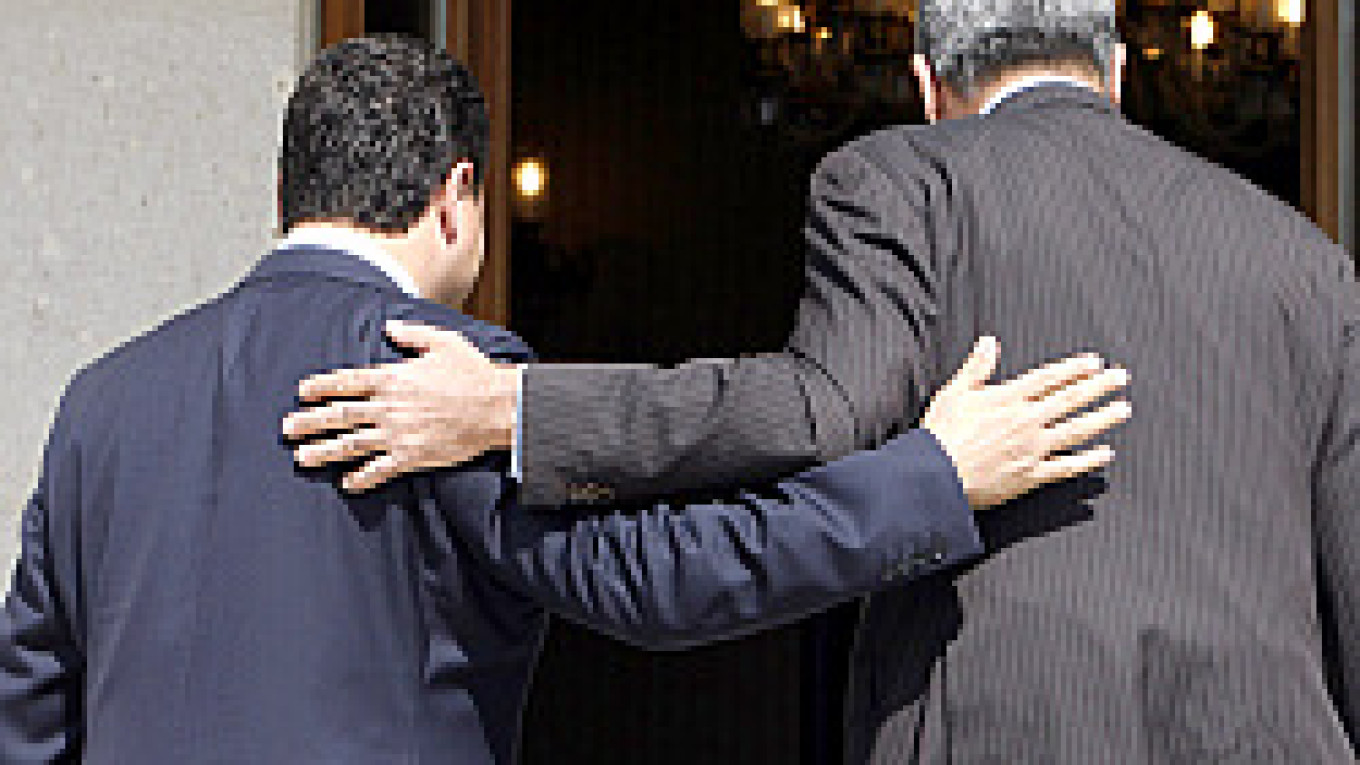
Lavrov said Turkey was not being "singled out" for stringent checks at border checkpoints. Turkish officials say hundreds of trucks taking exports to Russia have been held up since Russian authorities began closely scrutinizing consignments about a month ago.
"This is not an action directed against Turkey. Turkey is not being singled out," Lavrov said at a joint news conference in Istanbul with his Turkish counterpart, Ali Babacan. "There can be no politics involved in trade."
Two U.S. ships laden with humanitarian aid for Georgia last month passed through the Turkish straits connecting the Mediterranean to the Black Sea.
Russia suggested Monday that U.S. ships that took humanitarian aid to Georgia's Black Sea coast could also have delivered weapons. Turkey has helped train and equip Georgia's military. Turkey suggested that it would retaliate with its own, stricter trade rules but drew back from the threat Monday, saying it wanted to resolve the dispute through talks.
Russia is Turkey's largest trade partner, with $38 billion in mutual trade seen for this year, and a Turkish business group said Turkish exporters could lose $3 billion if the dispute is not ended soon. Russia is also the supplier of two-thirds of Turkey's natural gas.
Russia is "not only a neighbor and friend, at the same time it is a leading partner in energy and trade," Babacan said Tuesday. "We are also observing with pride the success of Turkish businessmen in the Russian Federation."
Lavrov said the stricter border controls were imposed because unspecified countries breached customs regulations. He said the two countries were trying to solve the dispute.
Lavrov on Tuesday also backed plans for a group of regional nations to try to overcome the Georgia crisis and stabilize the Caucasus region. The Turkish-proposed group would include Turkey, Russia, Georgia, Azerbaijan and Armenia. "The countries of the region should solve their own problems. Other countries should be supportive but not impose their own prescriptions," Lavrov said.
Meanwhile, U.S. President George W. Bush discussed Georgia in a telephone conversation with Turkish President Abdullah Gul.
The two underlined the importance of full compliance with a six-point European Union-brokered cease-fire agreement, said Gordon Johndroe, a spokesman for the U.S. National Security Council.
"The two leaders also talked about their support for efforts to improve Turkish-Armenian relations and the growing Turkish-Iraqi relationship," Johndroe said.
A Message from The Moscow Times:
Dear readers,
We are facing unprecedented challenges. Russia's Prosecutor General's Office has designated The Moscow Times as an "undesirable" organization, criminalizing our work and putting our staff at risk of prosecution. This follows our earlier unjust labeling as a "foreign agent."
These actions are direct attempts to silence independent journalism in Russia. The authorities claim our work "discredits the decisions of the Russian leadership." We see things differently: we strive to provide accurate, unbiased reporting on Russia.
We, the journalists of The Moscow Times, refuse to be silenced. But to continue our work, we need your help.
Your support, no matter how small, makes a world of difference. If you can, please support us monthly starting from just $2. It's quick to set up, and every contribution makes a significant impact.
By supporting The Moscow Times, you're defending open, independent journalism in the face of repression. Thank you for standing with us.

Remind me later.