

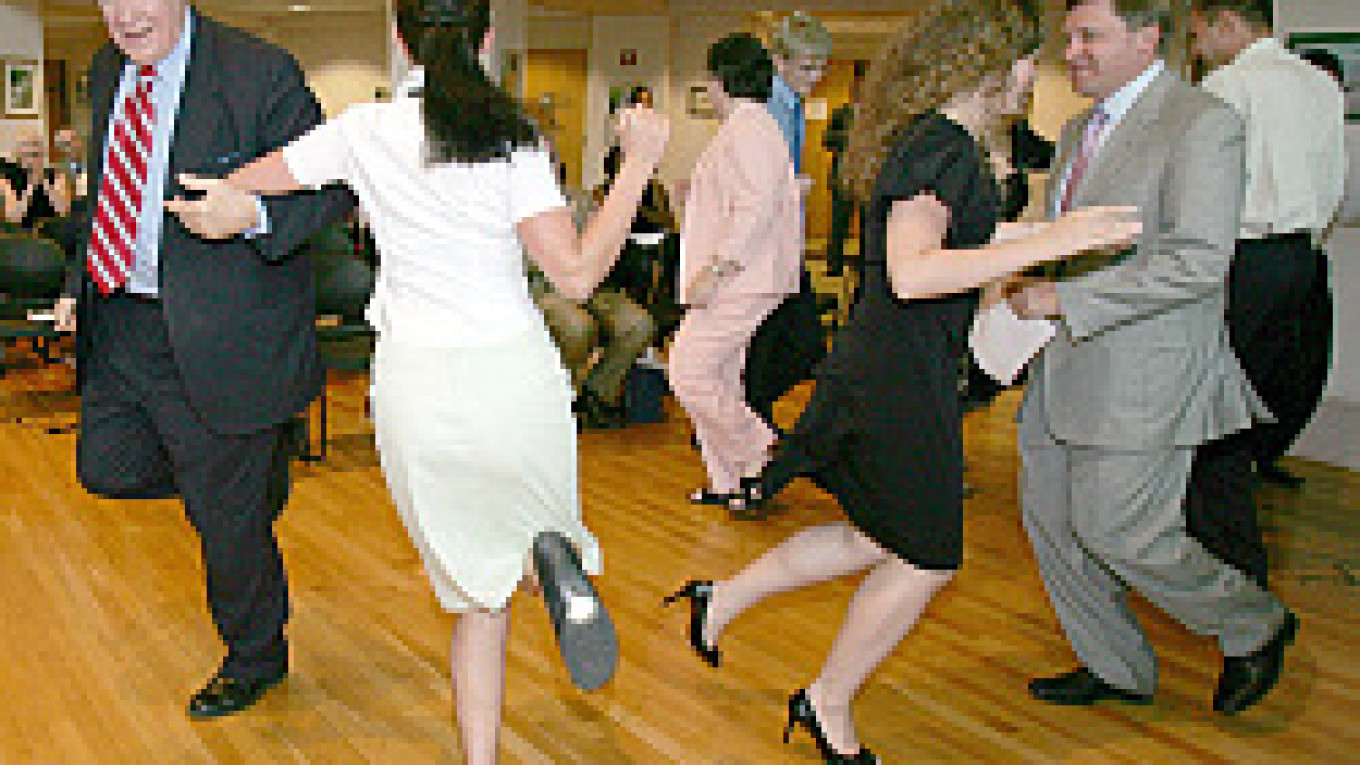
The young Russians, participating in a yearlong program at area colleges that is partially funded with federal money, sang a karaoke version of the Beatles' "Let It Be" and a Russian folk song last month. They even pulled Taylor and Ambassador Yury Ushakov into an impromptu dance.
"It offers as much to United States students as it does to Russian students," said the Republican lawmaker, who started the program last year.
The 65-year-old banker and timber magnate is one of the wealthiest members of the U.S. Congress. But he is not well known beyond the rugged mountains of his district, keeps a low profile and rarely speaks to reporters from outside the district. Yet, over the past decade, he has developed extensive business and political ties to Russia.
Starting in the mid-1990s, Taylor financed a series of construction projects in and around Ivanovo, a city of 430,000 about 240 kilometers northeast of Moscow. In the late 1990s, Taylor was a major player in the Russian Leadership Program, a congressionally funded legislative exchange with the State Duma. In 2003, he purchased the Bank of Ivanovo.
Taylor has an obvious passion for Russia and its history. When a Russian reporter asked him this year why he hired Russian managers for his bank, he answered, "[If] you read Pushkin and learn the history of Russia, you understand how to do business in Russia better than when listening to foreign managers."
Last year, Taylor secured $100,000 in federal money for the International Trade and Small Business Institute. It brings foreign students to the United States to study at seven colleges and universities in western North Carolina.
This year, the federal budget for 2007 contained a $1 million earmark for the program. Taylor has said the program is also funded by the colleges involved and by private donations. Taylor's office says the program's "mission is to encourage a trade relationship that benefits both local businesses and developing capitalist economies in Russia, Eastern Europe, the Middle East and Africa." But the first two classes of students have come only from Russia.
One of last year's participants, Svetlana Morozova, said she had a summer work-study internship at the Bank of Ivanovo after she returned to Russia.
In a statement, Taylor's office said that was a mistake because institute policy bars employment of participants in "any business venture with which Congressman Taylor is associated."
The bank has since ended its participation in the work-study program.
Democrat Heath Shuler, a former NFL quarterback who is challenging Taylor's bid for a ninth term in the House, has made a campaign issue of Taylor's Russian connections, as well as past ethics questions. "All congressmen should help their districts and try to bring programs and needed money in," said Shuler's campaign manager, Hayden Rogers. "But I'm not clear how helping Russian students benefits the people of western North Carolina, and I don't think the taxpayers' checkbook should be used to pay for interns for Congressman Taylor's bank."
Taylor declined through a spokeswoman to respond to questions about why he did not go to greater lengths to separate his business and political activity. Asked at last month's kickoff event about criticism of the program's federal support, Taylor said Russian students were not taking classroom seats from Americans.
"No student is being denied entrance to Brevard College or Appalachian [State University] or Western Carolina [University] because of this program," Taylor said. "They're benefiting from their [the Russians'] presence here."
Morozova, who studied at Pfeiffer and Brevard colleges, said the program was a wonderful experience "whose aim is to educate a new generation of entrepreneurs and leaders working to develop small businesses and expand cooperation in trade around the world."
She said her ultimate goal was to start her own small business in Russia.
In Russia, Taylor's primary business partner is a former KGB agent and Supreme Soviet deputy named Boris Bolshakov; the two met in the early 1990s through Bolshakov's wife, Marina, an English teacher who had contacts in the American community at the U.S. Air Force base in Ramstein, Germany.
Bolshakov said the Bank of Ivanovo's credit portfolio had grown from $1.4 million to more than $18.6 million since Taylor and the Bolshakovs bought the bank in 2003. "[Everywhere] we go, we say thank you to the Congress of the U.S. that it took this decision," Bolshakov said, referring to the public money for the institute. "Our country is indeed in a state of imbalance: We have no middle class, therefore there is no stability and therefore there is a chance that we could return to the [Soviet] past."
A Message from The Moscow Times:
Dear readers,
We are facing unprecedented challenges. Russia's Prosecutor General's Office has designated The Moscow Times as an "undesirable" organization, criminalizing our work and putting our staff at risk of prosecution. This follows our earlier unjust labeling as a "foreign agent."
These actions are direct attempts to silence independent journalism in Russia. The authorities claim our work "discredits the decisions of the Russian leadership." We see things differently: we strive to provide accurate, unbiased reporting on Russia.
We, the journalists of The Moscow Times, refuse to be silenced. But to continue our work, we need your help.
Your support, no matter how small, makes a world of difference. If you can, please support us monthly starting from just $2. It's quick to set up, and every contribution makes a significant impact.
By supporting The Moscow Times, you're defending open, independent journalism in the face of repression. Thank you for standing with us.

Remind me later.