

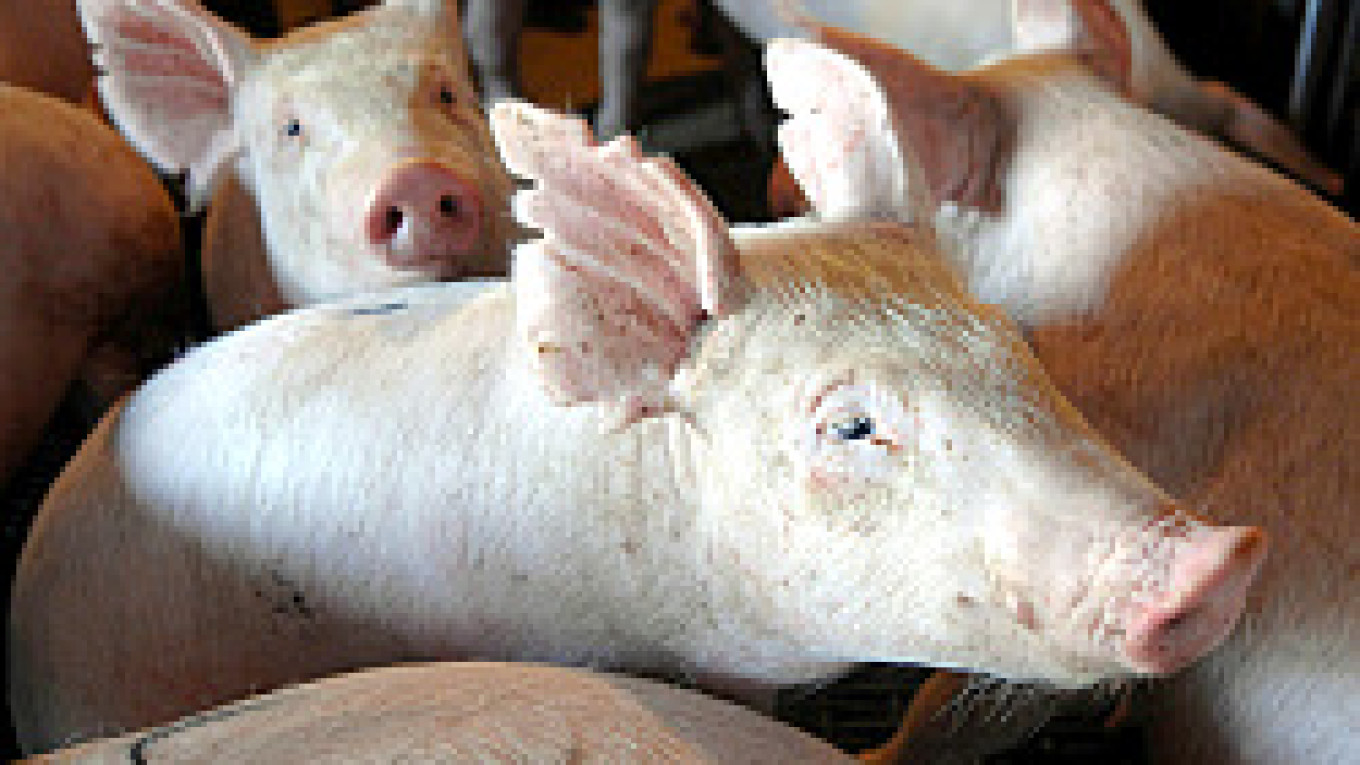
In May alone, 110,000 live pigs were brought into Russia for slaughter, Mikhail Popov, general director of the Ostankino Meat processing plant, said Tuesday at a meeting of the National Pork Producer's Union.
About 8,250 tons of live pork is imported into the country every month, which comes out to almost 100,000 tons of pork annually, or 19 percent of the 2009 pork import quota of 531,000 tons, Popov said.
While pork imports are normally subject to a 15 percent duty, those in excess of the quota are subject to a tariff of 40 percent to 75 percent of their customs value.
Live pigs, however, are only subject to a 5 percent import tax, Popov said.
Sales of all types of meat fell by 16.5 percent to $933 million for the period between January and April, compared with the same period in 2008.
Importers first attempted to circumvent the quota with live pigs in 2004, when 55,000 pigs were brought into the country in the first eight months of the year, compared with only 25,000 in all of 2003.
Companies said at the time that importing a live pig from Poland and slaughtering it in Russia was 20 percent cheaper than buying frozen Russian pork.
Meat producers did not see the imports as a threat, believing that the number of pigs brought into the country would be kept in check by a lack of modern slaughtering methods.
In the last three years, however, Russia's slaughterhouses have become 30 percent more efficient, said Musheg Mamikonyan, president of the Meat Union.
By 2008, pork imports rose to 603,000 head of swine, and the first five months of this year have shown that this trend is continuing, said Alexander Nikitin, head of the Miratorg meat processing plant.
Up to 367,000 pigs have already been imported this year, Nikitin said, and the main company importing them, Agrogalimeks, was doing so in 2004 as well.
Agrogalimeks was not available for comment.
The difference in price between domestic and imported pigs has not changed, said Sergei Yushin, head of the National Meat Association.
The average cost of a live Russian pig is 1.70 euros ($2.40) per kilogram, compared with up to 1.4 euros per kilogram -- including transportation -- for imported pigs.
Nikitin said pork producers have already tried to convince the government to "plug the hole," without success. "The government alluded to WTO talks," he said.
In 2007, then-Agriculture Minister Alexei Gordeyev, now governor of the Voronezh region, proposed raising the tariff on live pigs up to 35 percent, but a final decision on the matter was never made.
A Message from The Moscow Times:
Dear readers,
We are facing unprecedented challenges. Russia's Prosecutor General's Office has designated The Moscow Times as an "undesirable" organization, criminalizing our work and putting our staff at risk of prosecution. This follows our earlier unjust labeling as a "foreign agent."
These actions are direct attempts to silence independent journalism in Russia. The authorities claim our work "discredits the decisions of the Russian leadership." We see things differently: we strive to provide accurate, unbiased reporting on Russia.
We, the journalists of The Moscow Times, refuse to be silenced. But to continue our work, we need your help.
Your support, no matter how small, makes a world of difference. If you can, please support us monthly starting from just $2. It's quick to set up, and every contribution makes a significant impact.
By supporting The Moscow Times, you're defending open, independent journalism in the face of repression. Thank you for standing with us.

Remind me later.