

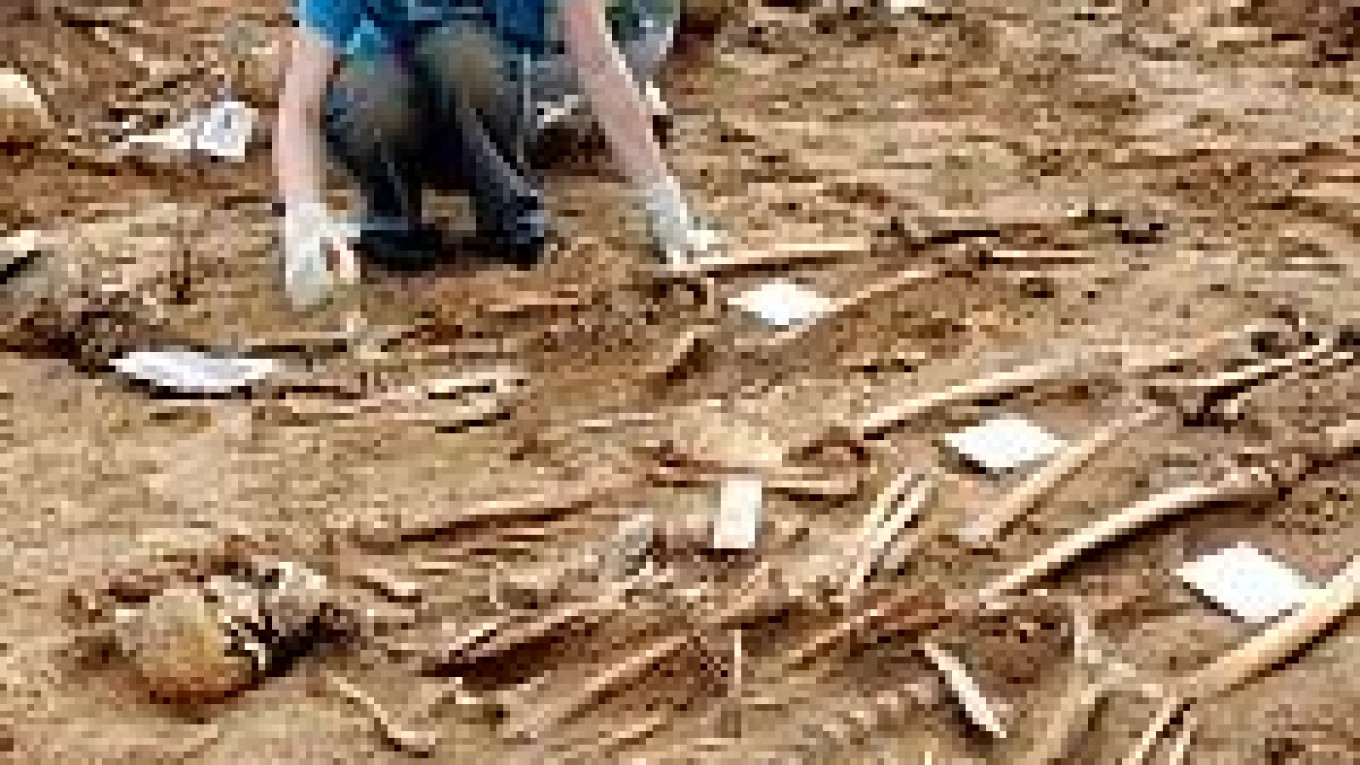
Human skulls and bones, fragments of coffins and pointed German military helmets emerge from the dirt, unearthed by a team of Lithuanian archeologists.
"We are here to restore the historical truth. Those German soldiers deserve to be buried properly," said Albinas Kuncevicius, a Vilnius University archaeology professor leading the excavations in Panevezys, some 140 kilometers north of the capital.
Kuncevicius and his colleagues believe at least 600 German soldiers were buried here during World War I. Their remains tell grim tales of war: Some have bullet holes in their skulls, others are missing legs or arms.
German troops occupied Lithuania from 1915 to 1918 and built the cemetery next to a military hospital. It was left intact until the Red Army occupied Lithuania in 1940. The Soviets bulldozed the cemetery, crushing the tombstones, and built a stadium on top of it.
But its history was never forgotten: People used to say they were treading on the dead when they played soccer on the field.
Last year the Lithuanian government allocated 200,000 litas ($70,000) to exhume the soldiers' remains and rebury them at a cemetery in Klaipeda, a seaport some 300 kilometers west of Vilnius. The process is expected to take until September.
"For Lithuanians, it has always been very important to bury the departed ones in a proper way. The Soviet regime humiliated the memory of those Germans. Now the time has come to fix this injustice," said Raimondas Dambrauskas, the local school principal behind the project.
Dambrauskas first learned about the graves underneath the stadium's grass when reading a history book 15 years ago, but it was only recently that he was able to persuade the local government to finance excavations and reburials.
"It took longer than I thought. Now my conscience is clear. Graves should not be trampled by soccer players' feet," he said.
Kuncevicius showed a 77-year-old map of the cemetery, where all tombstones are marked with numbers and burial dates.
"Back in Berlin, they must have more detailed plans of cemeteries like this with names of the troops. We have already discovered several golden rings, marked with soldiers' names. After our search is completed, someone in Germany may receive news of their grandparent's fate," Kuncevicius said.
After they are marked and placed in plastic bags, the soldiers' remains are taken to the gym at Dambrauskas' nearby school for closer examination.
Some of the older teachers are uncomfortable with having hundreds of skeletons lined up in the gymnasium. They cross themselves when they walk by, and some have suggested the building should be consecrated, Dambrauskas said.
The students, however, are eager to help.
"No basketball here this summer. But this grave-digging thing is even more interesting," said Petras Jurakas, 16, who assists the scientists every day as they examine skulls, bones and teeth, trying to determine the sex and age of the skeletons.
Simone Stemmler, a spokeswoman for the German Embassy in Vilnius, said the project was very important.
"We applaud the Lithuanian authorities for the decision to rebury those soldiers at their final place of rest," Stemmler said.
A Message from The Moscow Times:
Dear readers,
We are facing unprecedented challenges. Russia's Prosecutor General's Office has designated The Moscow Times as an "undesirable" organization, criminalizing our work and putting our staff at risk of prosecution. This follows our earlier unjust labeling as a "foreign agent."
These actions are direct attempts to silence independent journalism in Russia. The authorities claim our work "discredits the decisions of the Russian leadership." We see things differently: we strive to provide accurate, unbiased reporting on Russia.
We, the journalists of The Moscow Times, refuse to be silenced. But to continue our work, we need your help.
Your support, no matter how small, makes a world of difference. If you can, please support us monthly starting from just $2. It's quick to set up, and every contribution makes a significant impact.
By supporting The Moscow Times, you're defending open, independent journalism in the face of repression. Thank you for standing with us.

Remind me later.