

The Primorye regional legislature, led by United Russia deputies, voted unanimously Monday to ask President Dmitry Medvedev and Prime Minister Vladimir Putin to postpone the tariffs, which take effect on Jan. 11, according to a decree signed by Putin.
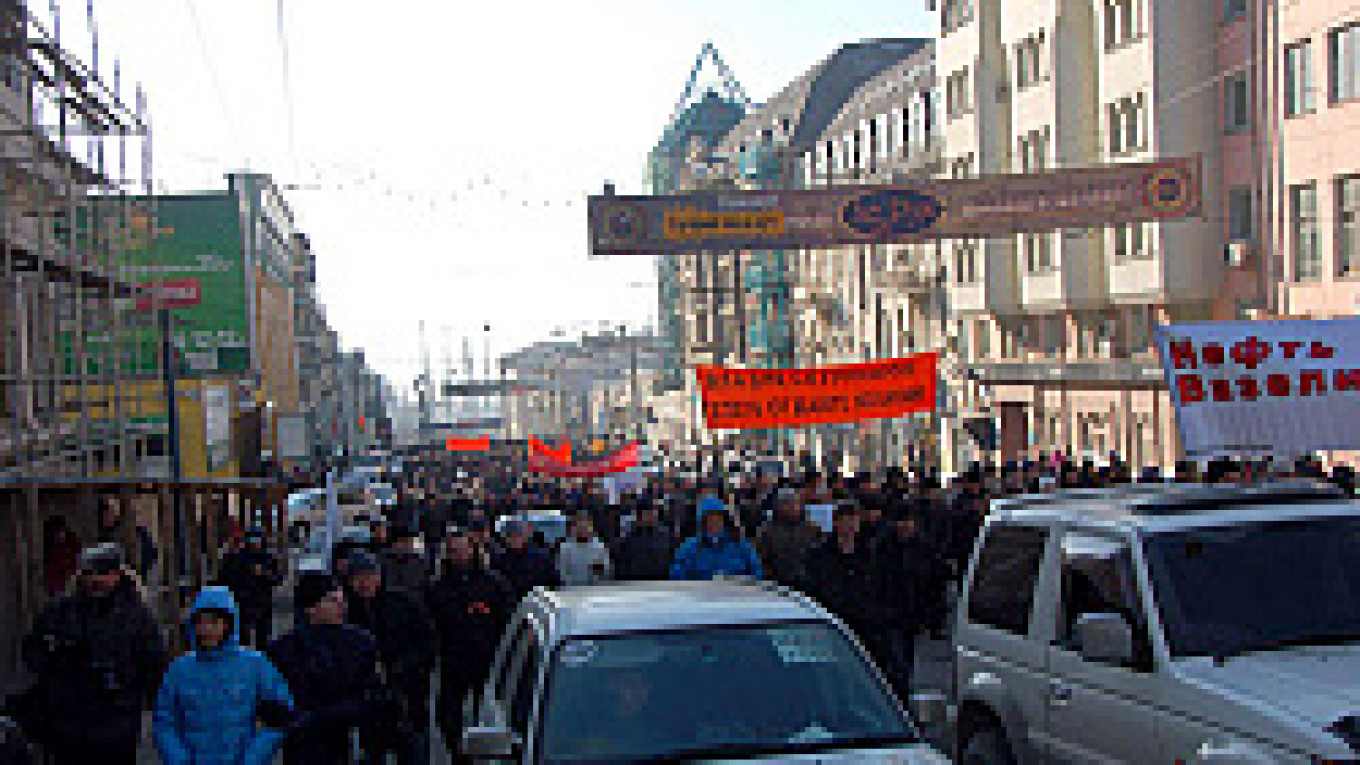
Thousands of drivers took to the streets in several far eastern cities and towns Sunday to protest the tariffs, blocking traffic, clashing with police, openly insulting Putin and Medvedev and even calling on Putin to resign.
Putin's decree would increase the prices for imported cars by between 10 and 20 percent, a move the government has defended as a way of protecting domestic auto makers during the growing financial crisis.
The Primorye region's representative in the Federation Council, hockey legend Vyacheslav Fetisov, met with regional car dealers in Vladivostok on Monday and promised to pass on their request to the government to call off the tariffs, which they say would ravage their business.
Fetisov also promised to pass the dealers' request to the Prosecutor General's Office to examine the legality of Putin's decree, Interfax reported.
Grassroots protests have been few and far between since Putin was elected president in 2000. The most prominent example was the spontaneous nationwide protests in January 2005 after the government scrapped social benefits for millions of pensioners, disabled people, war veterans and others and replaced them with small cash payments.
State-controlled television channels did not cover Sunday's protests, devoting more air-time to Russian model Ksenia Sukhinova's weekend victory in the Miss World pageant.
The protests, however, were one of the most widely discussed topics in the Russian blogosphere on Sunday and Monday, with local bloggers posting photographs and first-hand accounts of the demonstrations.
Political analysts and sociologists said it was unlikely the rallies were the beginning of widespread grassroots protests stemming from the financial crisis.
"This is not the first time that there are protests of this kind in the Far East," said sociologist Yevgeny Gontmakher. "The introduction of the new tax will badly damage many businesses related to used cars. That's all."
Gontmakher last month painted a disturbing picture of what might emerge from the financial crisis, writing in the Vedomosti newspaper that a provincial industrial town will see huge protests after massive layoffs at its main factory next year. The authorities will scramble haphazardly to contain the unrest, violence will spread, ultimately reaching Moscow, he wrote.
The government's media watchdog fired off a warning to Vedomosti that it was inciting extremism. Vedomosti is part of Independent Media Sanoma Magazines, the parent company of The Moscow Times.
While the Kremlin and state-controlled television have managed to effectively demonize and marginalize the liberal opposition in recent years, anti-government sentiment among grassroots drivers movements have proven more difficult to suppress.
After protests from drivers across the country, an Altai court in 2006 overturned the conviction of railroad worker Oleg Shcherbinsky in the accident that killed Altai Governor Mikhail Yevdokimov.
Drivers rallied nationwide not only over Shcherbinsky's conviction but also to protest the use of flashing blue lights and sirens on bureaucrats' cars, which they believe cause many accidents.
"This is not typical Russian behavior -- people don't take the streets when things are going bad," said Mark Urnov, a political analyst with the Higher School of Economics. "People who have lost their jobs are now busy with finding other opportunities, or just making ends meet."
Vyacheslav Lysakov, head of the Free Choice Motorists' Movement, said Far East drivers are predominantly young and middle-age males whose livelihoods depend on imported Japanese cars. This is their motivation for protesting the new tariffs, Lysakov said.
The businessmen working in the Japanese car market are active entrepreneurs rather than complacent factory workers, often shuttling back and forth between Japan and Russia and dealing with considerable amounts of money, said Sergei Aslanyan, an independent car industry analyst.
"And unlike most workers around Russia, these people in the Far East don't have illusions about the federal government in Moscow being ready to help them out in a crisis," Aslanyan said. "They were abandoned to survive for themselves in the early 1990s, and they did, largely by dealing in Japanese cars."
Aslanyan doubted that the protests would manage to convince the government to call off the new import duties. Because car dealers and related businesses are a small percentage of the population, protracted nationwide protests are unlikely, he said.
Alexei Mukhin, an analyst with the Center for Political Information, said the anti-Putin and anti-United Russia signs protesters held during the demonstrations represented economic, rather than political, demands.
Thirty-nine percent of Russians are increasingly unhappy with the government, while 26 percent believe the economic crisis is getting worse in their region, according to a poll released last week by the Kremlin-friendly Public Opinion Foundation.
The level of disapproval was the same among all social groups, regardless of income, education and profession, according to the poll, conducted Nov. 14 to 25 among 34,000 people in 68 regions.
A Message from The Moscow Times:
Dear readers,
We are facing unprecedented challenges. Russia's Prosecutor General's Office has designated The Moscow Times as an "undesirable" organization, criminalizing our work and putting our staff at risk of prosecution. This follows our earlier unjust labeling as a "foreign agent."
These actions are direct attempts to silence independent journalism in Russia. The authorities claim our work "discredits the decisions of the Russian leadership." We see things differently: we strive to provide accurate, unbiased reporting on Russia.
We, the journalists of The Moscow Times, refuse to be silenced. But to continue our work, we need your help.
Your support, no matter how small, makes a world of difference. If you can, please support us monthly starting from just $2. It's quick to set up, and every contribution makes a significant impact.
By supporting The Moscow Times, you're defending open, independent journalism in the face of repression. Thank you for standing with us.

Remind me later.