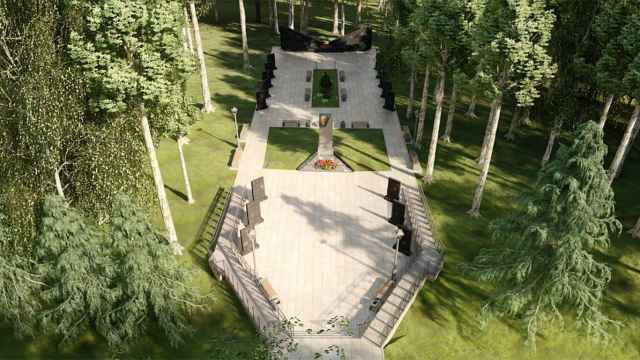

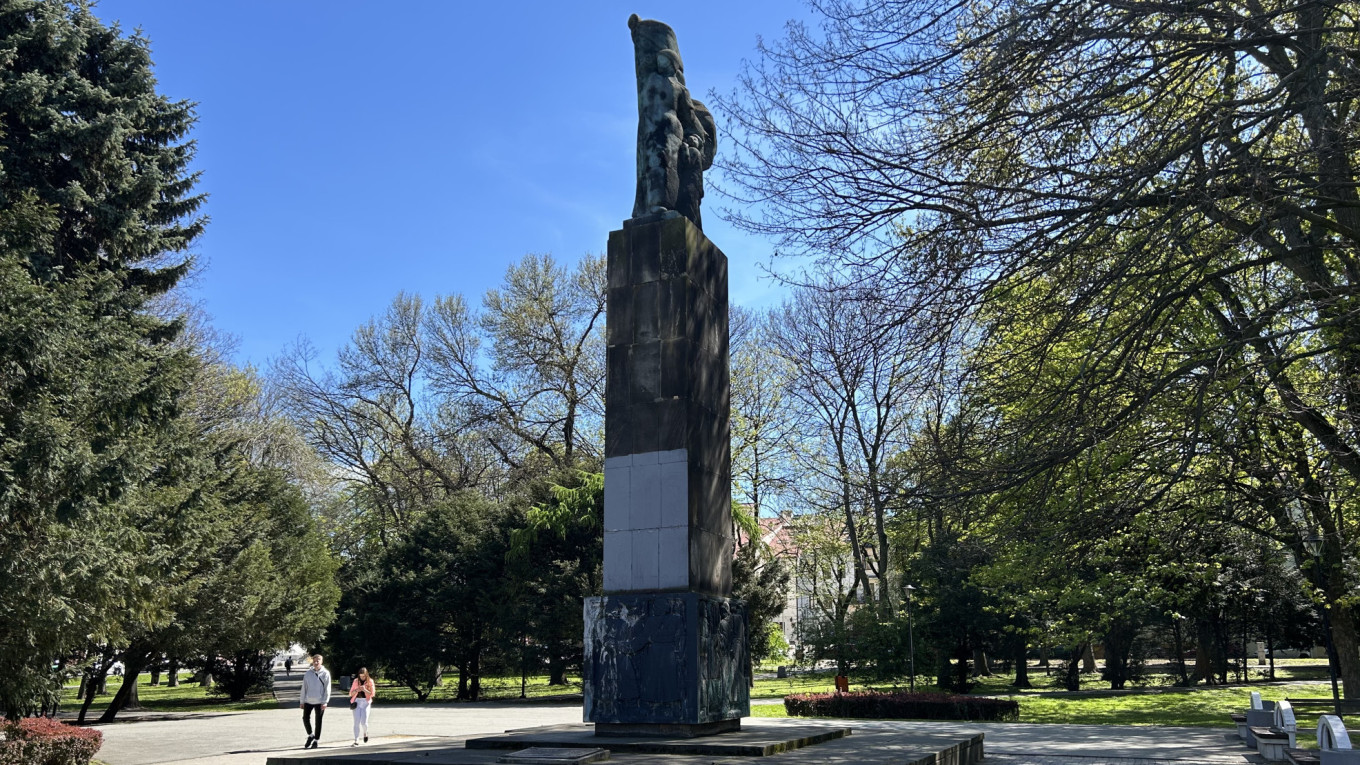
RZESZÓW, Poland — In a quiet park in the center of this southern Polish city, tourists stop to read a plaque commemorating the lives lost in a “1,000-year struggle for freedom” and gaze at the communist-era monument it’s attached to.
In a few months, the monument — an obelisk depicting soldiers frozen in the valor of battle — might be gone. Authorities want to either demolish it or disassemble it and move the parts to a museum and military cemetery.
The relevance of these things to Poland’s relations with its greatest adversary, Russia, is completely invisible until you realize two things: the memorial commemorates the Red Army, and it’s part of a larger Polish effort to reframe Russia’s place in the country’s history.
More than 80 years after they occurred, the events of World War II are still hotly debated in Russia and Poland. For all their bitter differences, the countries can’t seem to escape the fact that they are locked in the same struggle over who gets to define the past.
In Poland, former Soviet liberators have for years been seen as oppressors. In Russia, Poles are made out to be a longstanding enemy.
It’s a largely abstract battle involving academic concepts like memory, historical trauma and patriotism, but on a recent trip to Poland, experts told a Moscow Times reporter that it matters greatly.
History “is very important in the broader Polish culture,” said Floris van Berckel Smit, an expert on applied history who has conducted field work in Poland. “It’s very deeply written in the society, and so therefore Polish politicians have to take those historical sentiments into account.”
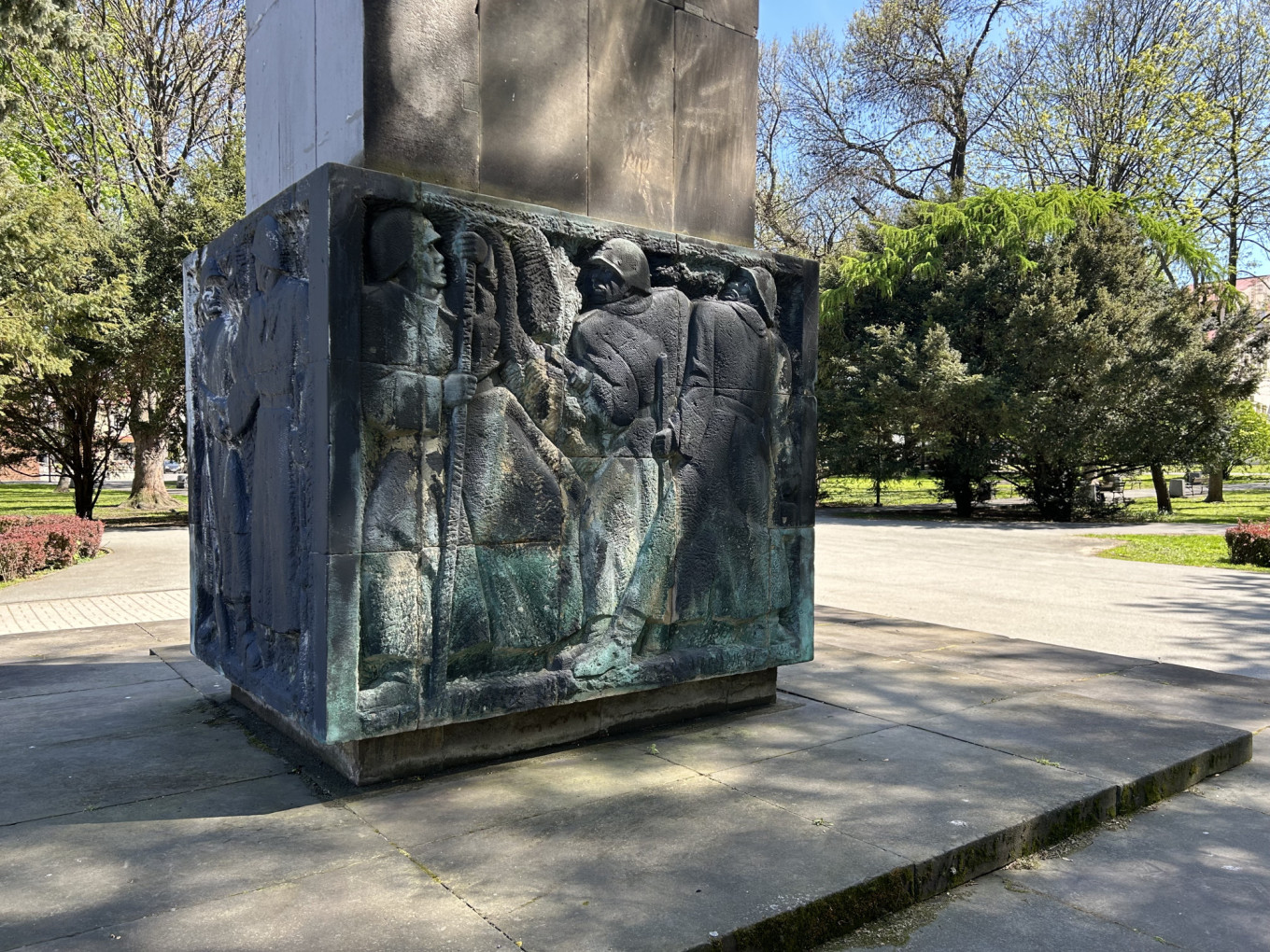
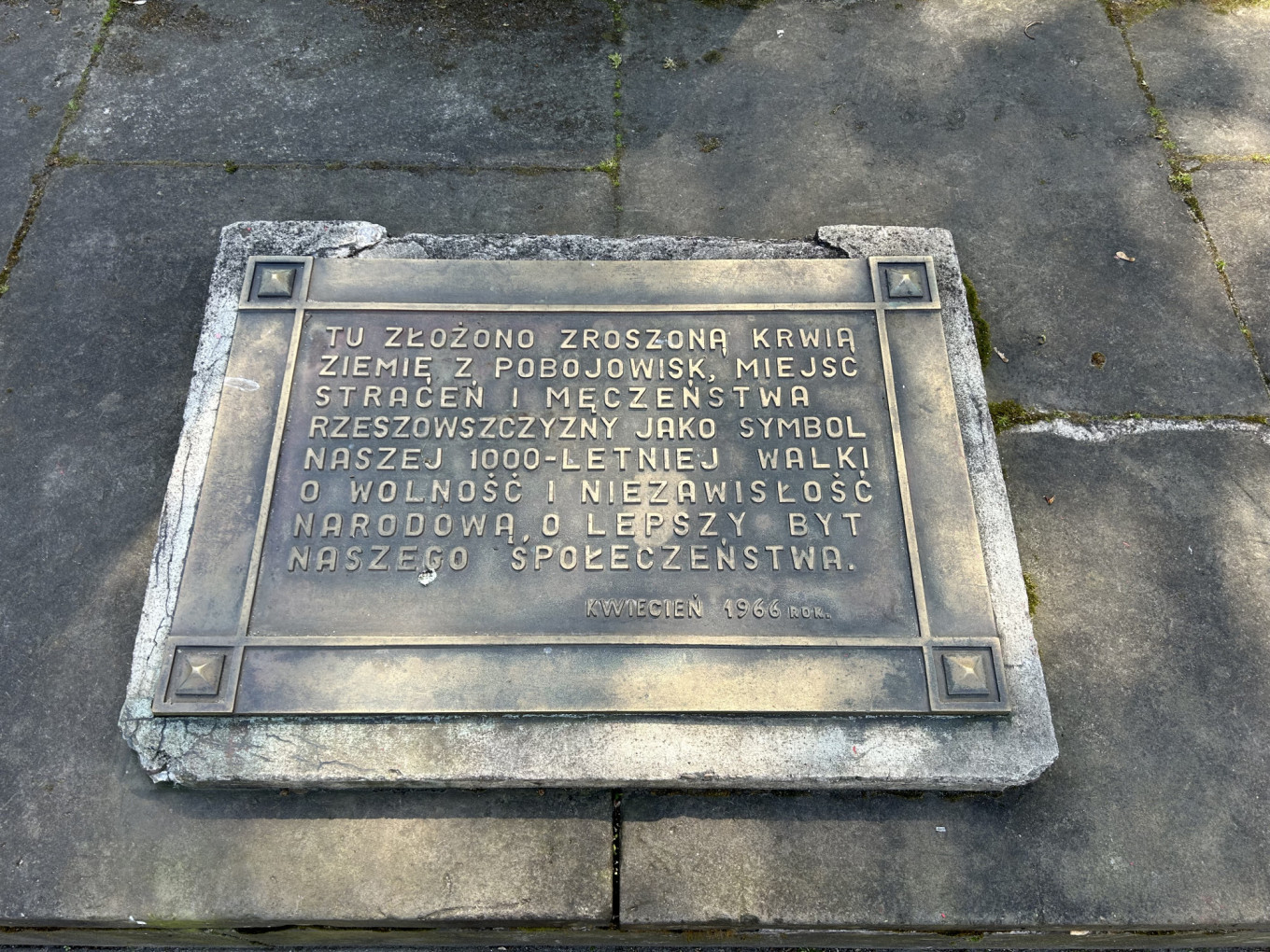
The dismantling of Red Army monuments in Poland is one of the more visible examples. It began in the 1990s, the early years of the country’s shift from communism, when the country was also changing Soviet street names. A decade ago, a law on decommunization of public spaces was passed which codified a process for removing public objects that promote a “totalitarian system.”
And then Russia invaded Ukraine.
That sent already poor perceptions of Russia among Poles plummeting, and reinvigorated efforts to correct the historical record. Poland has taken down more than 40 Soviet-era memorials since 2022. A poll taken shortly after the war began showed that 97% of Poles have an unfavorable opinion of Russia.
“In our memory in Poland, in our activities, we are concentrated on the history of the 20th century,” said Piotr Długołęcki, a historian at the Polish Institute of International Affairs (PISM), in an interview at the organization’s office in central Warsaw.
For over a century, he said, Poland’s relationship with Russia has been one of its most important — and sensitive — alongside relations with Germany and with Jewish peoples.
“Those areas of history are connected with emotions in Poland and are very important for Poles, for Poland the country, for our society and our nation,” he said.
This relationship wasn’t always a toxic one. Before the invasion of Ukraine, Długołęcki recalled, Polish and Russian historians used to have substantial links. While interpretations of history diverged greatly, there was at least dialogue. As an example, he gestured to the next room over, a large conference hall where PISM used to host Russian scholars.
Asked whether he could envision that happening again, Długołęcki was cautious.
“After the end of the war, in the future, it will be possible to do something new,” he said. “But at this moment, I don’t suppose so.”
Russia has interpreted historical reexamination in Poland and the Baltics as an assault on its reputation as a liberator of Europe, a profound source of national pride. A report from the Russian Foreign Ministry issued last year condemned the destruction of memorials and claimed that Poland is spreading a myth of “double occupation” by Nazi Germany and the Soviet Union.
Russia has previously placed European leaders on wanted lists for allegedly desecrating memorials.
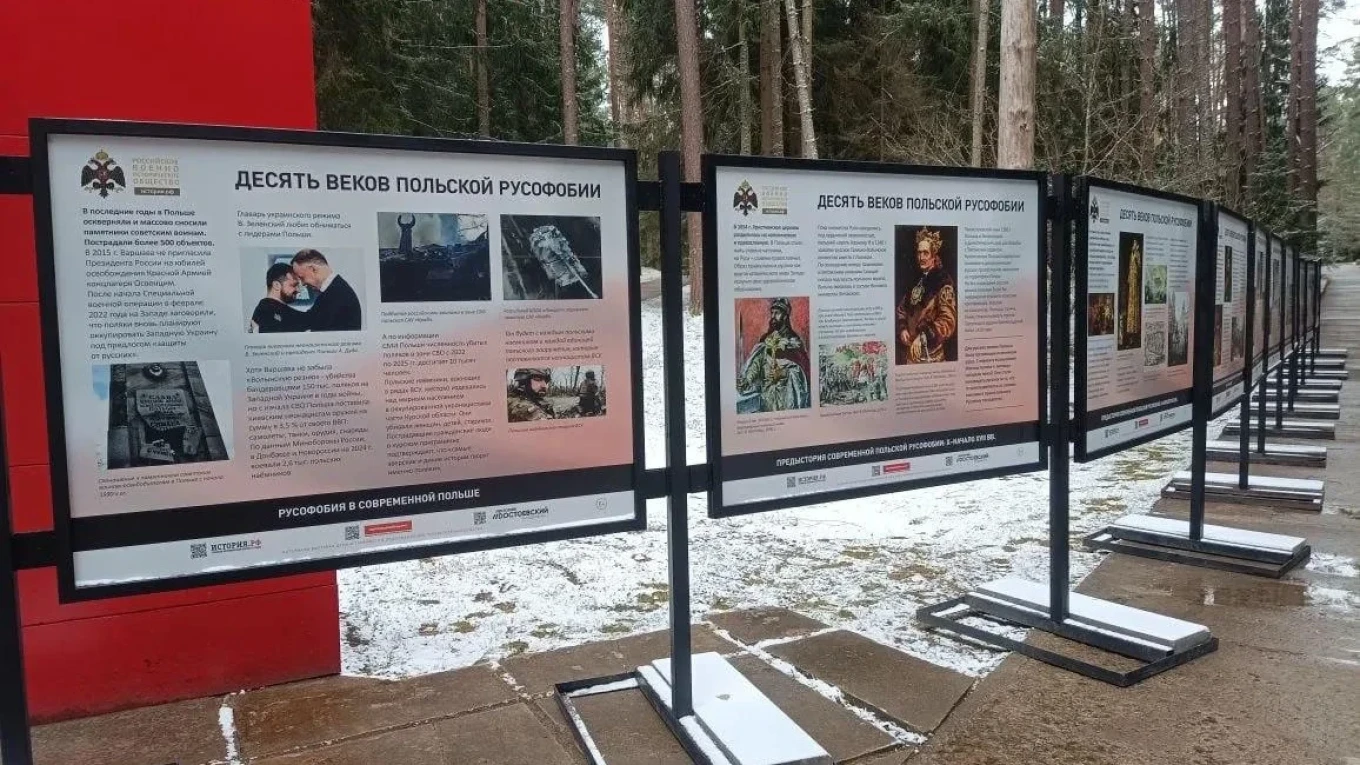
At the same time, Russian authorities have themselves moved in recent years to remove Polish memorials and diminish the Soviet Union’s role in perpetrating crimes against Poles, officials say.
In one recent example that was seen as particularly egregious, officials installed an exhibition to “Polish Russophobia” at the Katyn massacre memorial complex in the Smolensk region.
The massacre, in which the Soviets executed 22,000 Poles in 1940, is for Poles one of the war’s most solemn episodes. For years it has poisoned relations between the countries. In a highly symbolic move, the State Duma officially acknowledged in 2010 that Josef Stalin personally handed down the order.
According to Sergey Medvedev, a historian and professor at Charles University in Prague, the goal of a stunt as brazenly antagonistic as the Katyn exhibition is multifaceted.
On one hand, it allows Russia to propagate a view of WWII in which “Russia was the sole victim and the combined forces of Europe, including Poland, led to this war,” as well as “whitewashing the crimes” of the Soviet Union’s secret police.
But it’s also a rallying point for a domestic audience.
“Putin’s battle is a battle over history, over minds, over the interpretation of history,” Medvedev said.
“Poland in the Russian public discourse has been one of the arch enemies for the past few decades,” he added, “and this exhibition stresses it once again.”
Bartłomiej Gajos, a historian and expert on Polish-Russian relations, gave an even more severe assessment, calling these public displays “mental preparation of the Russian society in case of any war with Poland.”
“I'm looking at it from more of a security perspective rather than a strictly historical one,” Gajos told The Moscow Times. “I do believe that history in the public sphere — not as an academic discipline — is a very powerful influencing tool, telling people who they are and how they should behave in certain circumstances.”
That line of thinking reflects growing Polish fears about an attack from Russia. The war in Ukraine, a spate of acts of sabotage and a shocking episode last fall when Russian drones entered Polish airspace have left many people believing that scenario is a real possibility.
It doesn’t help to cool tempers that Polish authorities deliberately blur the lines between Russia and the Soviet Union, with the removal of monuments framed as both a mending of past mistakes and an assertion of sovereignty directed at Russia.
Standing in a park in the northern town of Maszewo last December, Karol Polejowski, the deputy director of the Institute for National Remembrance (IPN), said that “there is no place for Soviet objects in a free Poland.” Then an excavator toppled an old pillar into the dirt. It was a monument that had been erected in 1947 to honor the Red Army’s liberation of the town.
“To the Soviets, to propaganda objects, to Russians who believe that these lands somehow belong to their sphere of influence, we say ‘no’,” Polejowski said.
The IPN, a controversial government agency dedicated to researching Polish history, is leading decommunization efforts. The organization declined to make any of its experts available for an interview. In a statement, spokesperson Rafał Kościański said that the decommunization drive is about “confronting historical lies and false images of a system based on violence and terror.”
When it comes to addressing Russia’s legacy, it has a clear policy: Soviet monuments need to be destroyed.
“It must be clearly stressed that these actions do not include war cemeteries or burial sites, which are protected by law and remain under the care of the Polish state,” Kościański said.
While the underlying sentiment is something most Poles can get behind, not everyone agrees with an uncompromising approach — especially toward such a sensitive issue.
“Such debates have taken place in Poland, that we should present [the memorials], regardless of the past, regardless of the values that they carry,” said Gajos. “There are different perspectives on this.”
The monument in Rzeszów is a case in point. The IPN wants to tear it down, but city officials have planned to simply remove it from a public space while preserving some of its parts elsewhere, according to local media.
Recently, after years of back and forth, the IPN and the city seemed to come to an impasse. The IPN released a lengthy statement in February outlining its position.
“Placing its elements in a war cemetery maintained by the Polish state would contradict the idea of decommunization, as it would make them inviolable under the law,” the IPN said.
Some people argue that there are better answers to the question of how to acknowledge the past without glorifying it. In Lithuania, for instance, many Soviet memorials that used to dominate public spaces have been gathered in one place, a sculpture garden.
Gajos said that this is a model he is more supportive of.
“I would remove them from the public space, but I wouldn't destroy them,” he said. “It’s a part of history.”
This article was updated on May 12, 2026, to add a statement from the IPN.
A Message from The Moscow Times:
Dear readers,
We are facing unprecedented challenges. Russia's Prosecutor General's Office has designated The Moscow Times as an "undesirable" organization, criminalizing our work and putting our staff at risk of prosecution. This follows our earlier unjust labeling as a "foreign agent."
These actions are direct attempts to silence independent journalism in Russia. The authorities claim our work "discredits the decisions of the Russian leadership." We see things differently: we strive to provide accurate, unbiased reporting on Russia.
We, the journalists of The Moscow Times, refuse to be silenced. But to continue our work, we need your help.
Your support, no matter how small, makes a world of difference. If you can, please support us monthly starting from just $2. It's quick to set up, and every contribution makes a significant impact.
By supporting The Moscow Times, you're defending open, independent journalism in the face of repression. Thank you for standing with us.

Remind me later.