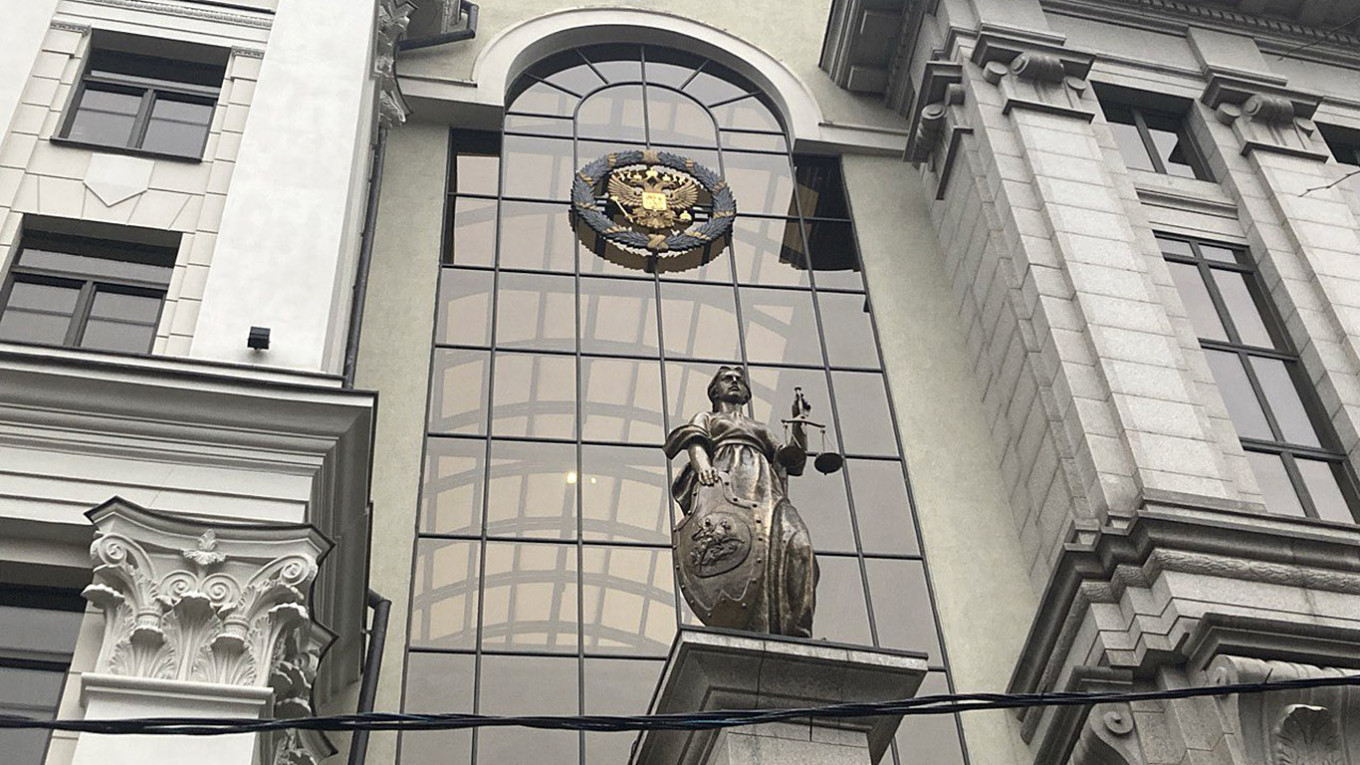
Russia has taken down two decades’ worth of judicial statistics from public access, removing data that had been widely used by journalists and rights groups to track prosecutions and broader legal trends.
The section containing statistics on criminal, civil and administrative cases on the website of the Judicial Department at the Supreme Court is now empty when accessed via a direct link, the exiled outlet Vyorstka reported.
Attempts to open the page from the homepage produce a message saying the information is “temporarily unavailable.”
The data had still been fully accessible as of the previous day.
Russian authorities have increasingly restricted access to official data since the 2022 invasion of Ukraine, limiting independent scrutiny of politically sensitive prosecutions, wartime losses and economic performance.
The Supreme Court was due to publish data for the second half of 2025 by April 20 under existing regulations but had not done so, according to the Sever.Realii news outlet.
A link to the statistical archive has also disappeared from the department’s page on the VKontakte social network.
The court statistics had been used to analyze trends in cases such as treason, the dissemination of “fake news” about the army, “discrediting” the military, sabotage and the justification of terrorism — charges that have been widely applied since Russia’s full-scale invasion of Ukraine.
They also provided insight into crimes involving Russian military personnel. In 2025, the Judicial Department for the first time published data on how many people who signed contracts with the Defense Ministry avoided criminal punishment.
Separately, courts last year began removing information about lawsuits seeking to declare individuals dead or missing, complicating efforts to assess wartime losses.
Russian authorities have curtailed access to state statistics across multiple sectors since 2022. Data from at least 14 government bodies have been partially or fully classified, according to media reports.
The Prosecutor General’s Office has stopped updating crime statistics, while the Federal Penitentiary Service no longer publishes data on inmate mortality and illness.
Detailed figures on the number of people with disabilities have also been withdrawn from public access amid a sharp rise in wartime injuries.
Around 400,000 Russian soldiers have been severely wounded, according to estimates cited by the International Institute for Strategic Studies and a senior Russian source cited by The New York Times.
Amid Western sanctions and economic pressures, the government has also closed off customs statistics, data on the composition of the central bank’s foreign reserves, and allowed large companies to withhold financial disclosures.
Data on oil and gas production were classified in 2023, followed by statistics on gasoline and diesel output the following year after a series of Ukrainian drone attacks.
Authorities removed data on life expectancy and detailed demographic statistics from public access in 2025, after the birth rate fell to its lowest level since the 18th-19th centuries and natural population decline approached 600,000 people.
Read this article in Russian at The Moscow Times' Russian service.
A Message from The Moscow Times:
Dear readers,
We are facing unprecedented challenges. Russia's Prosecutor General's Office has designated The Moscow Times as an "undesirable" organization, criminalizing our work and putting our staff at risk of prosecution. This follows our earlier unjust labeling as a "foreign agent."
These actions are direct attempts to silence independent journalism in Russia. The authorities claim our work "discredits the decisions of the Russian leadership." We see things differently: we strive to provide accurate, unbiased reporting on Russia.
We, the journalists of The Moscow Times, refuse to be silenced. But to continue our work, we need your help.
Your support, no matter how small, makes a world of difference. If you can, please support us monthly starting from just $2. It's quick to set up, and every contribution makes a significant impact.
By supporting The Moscow Times, you're defending open, independent journalism in the face of repression. Thank you for standing with us.

Remind me later.