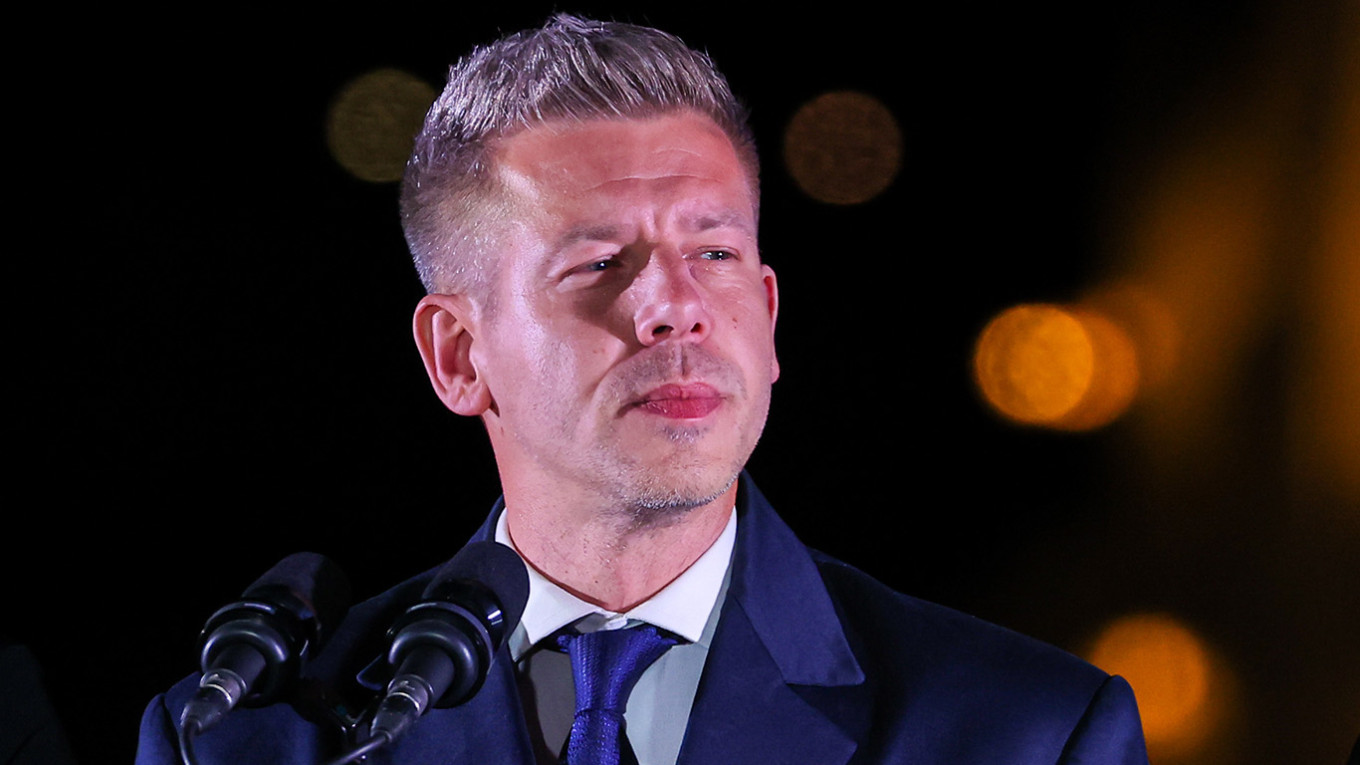
Péter Magyar, Hungary’s center-right leader who unseated Viktor Orbán as prime minister in a landslide election victory on Sunday, said he is willing to talk to President Vladimir Putin “but will not be friends” with the Russian leader.
“Naturally, if the situation arises, one must sit down with the Russian president,” Magyar said in an interview with the newspaper Nepszava published on Saturday, just ahead of his election win. “If necessary, we will negotiate, but we will not be friends.”
Magyar’s Tisza party secured a two-thirds majority in Hungary’s parliament amid record voter turnout. The defeat of Orbán’s Fidesz party is widely viewed as a setback for his international allies, including Putin and U.S. President Donald Trump.
The Kremlin said Monday it “respected the choice” Hungarians made in Sunday’s election.
“We hope to maintain pragmatic relations with Hungary’s new leadership,” spokesman Dmitry Peskov told reporters. “We’ve heard that it is open to dialogue. Of course, that would be useful for both Moscow and Budapest.”
Meanwhile, Magyar’s victory was met with immediate approval from other EU members and Ukraine.
France and Germany urged the Magyar to strengthen ties with the European Union. Under Orbán, Hungary frequently clashed with Brussels over rule-of-law concerns and military aid to Ukraine.
Ukrainian President Volodymyr Zelensky pledged to work with Magyar “for the benefit of both nations, as well as peace, security and stability in Europe.”
Hungary, along with neighboring Slovakia, relies heavily on oil imports from Russia, a dependency that Magyar acknowledged in the Nepszava interview.
“Neither Russia’s nor Hungary’s geographical position is going to change. Our energy dependency will also be here for a while yet,” the incoming prime minister said. “We must strengthen diversification, but that doesn’t happen overnight.”
Magyar, a former government insider, rose to prominence just two years ago, promising to fight corruption and offer better public services. He capitalized on a period of economic stagnation to overcome an electoral system skewed in favor of Orbán’s Fidesz party.
AFP contributed reporting.
A Message from The Moscow Times:
Dear readers,
We are facing unprecedented challenges. Russia's Prosecutor General's Office has designated The Moscow Times as an "undesirable" organization, criminalizing our work and putting our staff at risk of prosecution. This follows our earlier unjust labeling as a "foreign agent."
These actions are direct attempts to silence independent journalism in Russia. The authorities claim our work "discredits the decisions of the Russian leadership." We see things differently: we strive to provide accurate, unbiased reporting on Russia.
We, the journalists of The Moscow Times, refuse to be silenced. But to continue our work, we need your help.
Your support, no matter how small, makes a world of difference. If you can, please support us monthly starting from just $2. It's quick to set up, and every contribution makes a significant impact.
By supporting The Moscow Times, you're defending open, independent journalism in the face of repression. Thank you for standing with us.

Remind me later.