
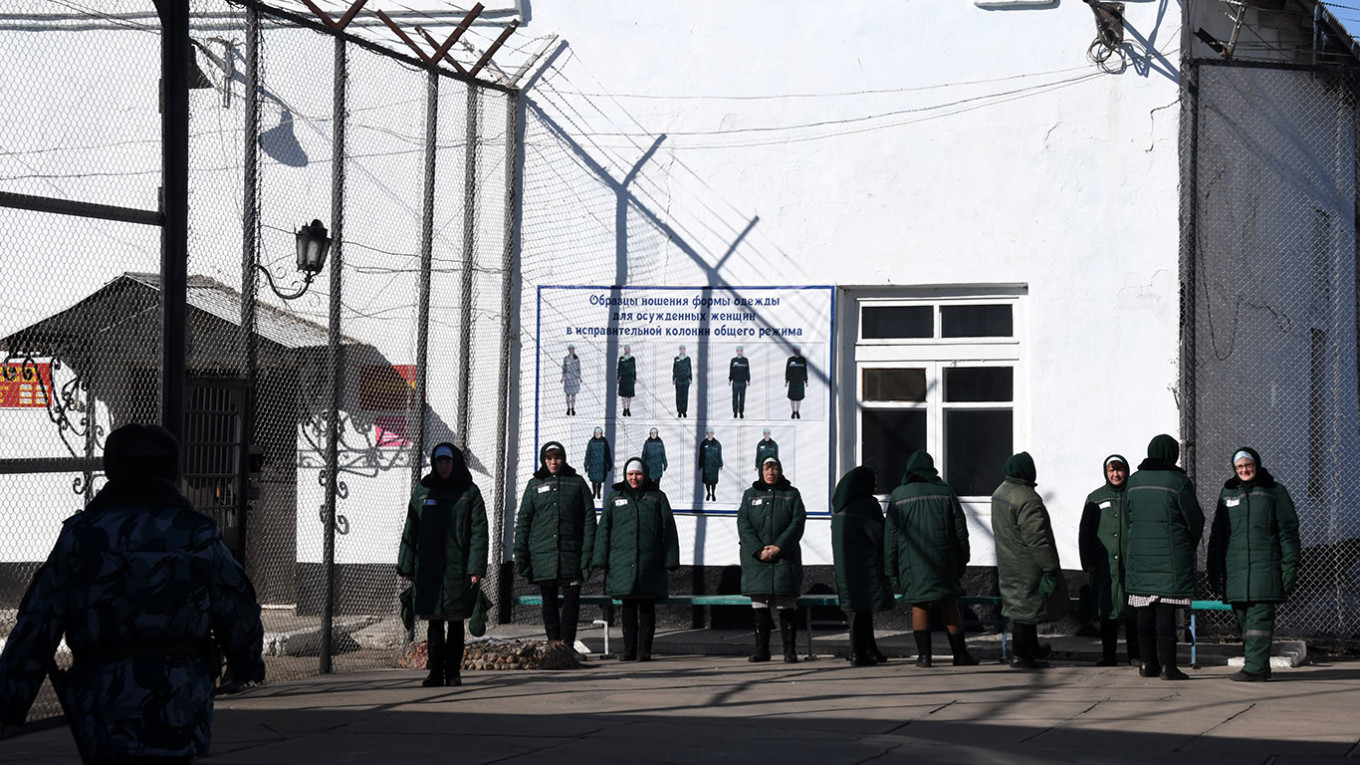
Women are now among the thousands of migrants from Central Asia serving in Russia’s military, including on the front lines in Ukraine. The Uzbek human rights organization Ezgylik has received letters from the parents of young women from the region serving prison sentences in Russia who say that their daughters are being offered 2 million rubles ($26,000) for one year of military service in Ukraine.
Russia’s Defense Ministry has been sending women to Ukraine to fill a range of military roles for the past four years. Some were among the tens of thousands of women already serving in the Armed Forces when full-scale war began in February 2022, while a small number of women with medical training were called up in the partial mobilization that September.
In 2023 reports began to emerge of efforts actively to recruit women for the war. These included seeking women for support roles such as cooks and medics, as well as attempts by the Borz Battalion of Redut, a mercenary group under the control of the Defense Ministry, to attract women to serve as snipers and drone operators. That same year, Russia began recruiting soldiers from women’s prisons — a practice that is now bringing not only Russians but also women from other countries into the armed forces.
So far Russia has not sought to draw attention to the participation of women in military roles in its war in Ukraine. This is in sharp contrast to the attitude shown by the Ukrainians, who quickly opened all military roles to women, including combat roles, and proudly point to the presence and contribution of women soldiers as a symbol of the country’s commitment to gender equality.
In Russia, though, the reality that there are women in the military serving side by side with men contradicts the image that President Vladimir Putin wants to present of Russia as a bastion of conservative values, where men and women perform traditional gender roles. In his ideal Russia, military service, especially in wartime, is the experience that creates real men.
This gap between image and reality reflects the complicated and often contradictory relationship that Russia has had with the presence of women in its armed forces.
During World War II, it was the U.S.S.R. that made the most extensive use of women in military roles among all the combatant countries. In addition to serving in more feminized support positions such as nurses, cooks and clerks, Soviet women drove tanks, fired machine guns, became snipers and flew aircraft, as well as working in occupied territory as members of partisan groups.
But despite the valuable contributions that more than 1 million women in uniform made to the Soviet victory against the Nazis, they were swiftly demobilized as soon as the war. Women veterans were told to return to civilian life, marry and have babies, and not to embarrass their husbands by bragging about their wartime achievements.
Throughout the Cold War, the Soviet Armed Forces were almost exclusively male and staffed largely by conscripting young men. Women were permitted to join as volunteers, but the few who did had very limited opportunities for advancement and faced compulsory retirement at the age of 45.
Women only returned to the Soviet Armed Forces in large numbers after conscription collapsed during the Gorbachev period. Once glasnost revealed deep-seated structural problems in the military, including a brutal system of institutionalized bullying (dedovshchina), young men began evading conscription in large numbers. The introduction of voluntary or contract service was intended to fill these gaping holes with men who had already had some experience in the military. Instead it created an opportunity for women who were struggling to find stable employment in the new market economy.
During the 1990s and early 2000s, more than 100,000 women joined Russia’s Armed Forces, making up around 10% of personnel. The Defense Ministry was puzzled by this influx of women and did nothing to create attractive working conditions or career paths to encourage their retention, let alone recruitment campaigns to ensure a supply of new females to fill the ranks. By the early 2020s, numbers of women had dwindled to a few tens of thousands.
The current, modest, increase in the numbers of women in uniform, including the women from Central Asia looking for a way to avoid lengthy prison sentences, is just one aspect of Russia’s efforts to ensure a steady flow of new soldiers for the war effort. The approach that Russia has taken to the war in Ukraine treats soldiers as disposable, low-value assets. It is widely believed that Russian casualties (deaths, missing soldiers and serious injuries) in Ukraine reached 1 million in the summer of 2025.
Even the high salaries, recruitment bonuses and generous benefits on offer for new recruits and their families no longer seem to attract enough men to fill the ranks faster than they are depleted. To avoid the unpopular introduction of mass mobilization at home, Moscow now sources soldiers from more than 120 countries, including Ghana and Kenya, as well as allies such as Cuba, North Korea and China. It is clear from news reports that many of these foreign soldiers joined Russia’s fight under false pretences after traveling to the country in the expectation of undertaking well-paid work in the civilian economy.
The appearance of Central Asian women among the ranks of Russia’s soldiers is a sign of the complex balancing act that Moscow performs every day to continue its war in Ukraine. Russia’s leaders work very hard to sustain the impression that they can easily continue the war effort for as long as it takes to achieve victory. Judging from U.S. President Donald Trump’s repeated remarks that Ukraine “does not have the cards” to win the war, Putin and his colleagues have succeeded in convincing him.
The reality, though, is very different. Russia’s war is not being fought, by and large, by young Russian men motivated by patriotism. Instead, it is being fought by a mixture of foreigners, former prisoners and older Russian men who have so few viable alternatives in the civilian economy that they are willing to risk their lives for a reliable salary and a package of benefits that will ensure their families’ prosperity. Russia’s reliance on women serving in uniform is also increasing, although the numbers continue to be relatively small.
Those small numbers, together with the fact that they include former prisoners and foreigners, helps Moscow to maintain the appearance of its desired gender order for Russian society. The behavior of foreign women does not reflect badly upon the women of Russia, while women who have served time in prison are not regarded as any kind of a role model.
So far Russia continues to paper over the cracks in the façade that it presents of a state that promotes and cherishes traditional family values. But the sharp rhetorical distinction that Putin’s Russia makes between suitable wartime roles for men and women risks being undermined by the reality of women’s presence on the front lines, whether that presence is acknowledged and celebrated or kept hidden away.

A Message from The Moscow Times:
Dear readers,
We are facing unprecedented challenges. Russia's Prosecutor General's Office has designated The Moscow Times as an "undesirable" organization, criminalizing our work and putting our staff at risk of prosecution. This follows our earlier unjust labeling as a "foreign agent."
These actions are direct attempts to silence independent journalism in Russia. The authorities claim our work "discredits the decisions of the Russian leadership." We see things differently: we strive to provide accurate, unbiased reporting on Russia.
We, the journalists of The Moscow Times, refuse to be silenced. But to continue our work, we need your help.
Your support, no matter how small, makes a world of difference. If you can, please support us monthly starting from just $2. It's quick to set up, and every contribution makes a significant impact.
By supporting The Moscow Times, you're defending open, independent journalism in the face of repression. Thank you for standing with us.

Remind me later.