Rosatom Resuming Nuclear Fuel Shipments via Ukraine
Rosatom said Saturday that it would resume nuclear fuel shipments to Europe via Ukraine after Kiev lifted a ban imposed during anti-government protests earlier this year on transporting the hazardous material.
The ban was introduced on Jan. 28 by the government of now-deposed President Viktor Yanukovych, who fled the country last month after a popular uprising.
Rosatom said the ban ended Thursday and the first rail shipment of nuclear fuel in 2014 via Ukraine to Eastern Europe was expected next week.
"Rosatom is committed to the secure supply and removal of nuclear fuel to and from our customers across Europe. If there are any further issues with rail transport by Ukraine, we will ensure that deliveries are made on time by air," Rosatom spokesman Vladislav Bochkov said. (Reuters)
Cenral Bank Preventing Privatbank Bankruptcy
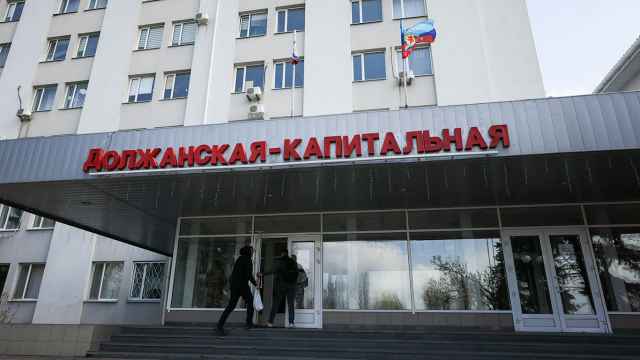
The Central Bank is taking steps to prevent the bankruptcy of Moskomprivatbank, the Moscow subsidiary of Ukraine's Privatbank, the regulator said.
The Central Bank said Friday it was taking the measures under a law on banking system stability which enables the state-run Deposit Insurance Agency to provide financial assistance to banks, acquire their property and liabilities, acquire shares, and sell collateral.
"Moskomprivatbank continues to work in a normal regime, all clients, including depositors of the bank, can use its services," the Central Bank said.
Late last week it announced that it had placed Moskomprivatbank, Russia's 95th biggest by assets, under temporary administration, but that it would not revoke the bank's license.
Privatbank is a part of Ukraine's Privat group, co-founded and co-owned by Igor Kolomoisky, who was appointed by Ukraine's Acting President Oleksandr Turchynov as governor of Dnipropetrovsk region. (Reuters)
KamAZ 2013 Net Down 31%
Truck maker Kamaz's 2013 net income fell 31 percent to 4 billion rubles ($110.7 million), hurt in part by a decline in sales.
KamAZ, which is 11 percent owned by German auto group Daimler, has faced headwinds as key customers in construction and heavy industry have been forced to scale back production and cancel projects.
Sales fell 5 percent in 2013 to 110.7 billion rubles, figures provided Friday by the company showed.
But the truck maker also said that its share of the domestic truck market, where Belarussian MAZ is one of its main competitors, rose to 45 percent from 33 percent a year earlier. (Retuers)
Kazakhstan Will Sue Foreign Oil Majors
ASTANA — Kazakhstan is suing foreign oil majors developing its huge Kashagan oilfield in the Caspian Sea, a tactic similar to those that secured the government large stakes in two of the three multinational energy projects on its territory.
Repeated delays at the 13-year-old project, targeted to produce as much oil as OPEC member Angola from a reserve almost as big as Brazil's, have infuriated the Kazakh government.
The consortium, led by Exxon, Royal Dutch Shell, Total and Eni as well as Kazakh state oil firm KazMunaiGas, may face Kazakhstan seizing a bigger stake in Kashagan or refusing to reimburse a big chunk of the $50 billion spent on bringing it onstream.
The latter option is written into the Kashagan contracts.
Production at Kashagan, the world's biggest oil discovery in 35 years, began in September but was stopped just weeks later after gas was found to be leaking from its pipelines. (Reuters)
Alcohol Prices to Jump
Prices on hard alcohol set to rise yet again Tuesday as anti-alcoholism legislation continues to take effect.
The cost of vodka will increase to a minimum of 199 rubles ($5.50) per 0.5 liters, almost 30 rubles more than the current price, BFM reported.
The minimum price of cognac will rise a full 52 rubles, to 322 rubles a bottle.
Prices will climb even higher later this year, with a bottle of vodka to cost a minimum of 220 rubles beginning in August. (MT)
VEB Gets Compensated for Sochi
State-run VEB bank is to receive 10 billion rubles ($270 million) in government funds to compensate losses on loans the bank provided for the construction of Olympic facilities in Sochi.
Prime Minister Dmitry Medvedev signed an order on March 5 funneling the funds to VEB, Interfax reported.
The bank helped finance 20 infrastructure projects in Sochi, providing 249 billion rubles ($6.83 billion) of their total cost of 321 billion rubles, according to a prospectus issued in November.
"Quite a few of the Sochi projects have not yet begun to operate at full strength," VEB chairman Vladimir Dmitriyev said at the time, adding that the bank would take no funds from its borrowers through the end of 2015.
VEB has issued 400 billion rubles ($11 billion) in loans at nonmarket conditions for "special projects" such as the Sochi facilities, consulting firm McKinsey estimated. (MT)
RusAl Refinancing $5Bln
RusAl, the world's largest aluminum producer, has agreed with Sberbank to refinance loans totaling about $5 billion, a RusAl spokesman told Vedomosti.
In 2010, Sberbank gave RusAl a 3-year, $4.6-billion loan to refinance an earlier loan from state-run VEB bank, which RusAl had taken to purchase a blocking stake in mining company Norilsk Nickel.
RusAl paid back $620 million of its debt to Sberbank in 2013 with funds received from the sale of a 2 percent stake in Norilsk Nickel to billionaire Roman Abramovich's Millhouse.
The company still needs to negotiate terms for repayments of a $4.75 billion loan that it received in 2011 from a syndicate of foreign banks.
RusAl's net debt totaled more than $10 billion at the end of the third quarter last year. (MT)
40% of Workers Unmotivated, Study Finds
Forty percent of Russian employees feel unmotivated, compared to only 28 percent in the world's most successful companies, research conducted by consulting firm Hay Group showed.
A total of 21 percent of Russian employees do not understand their company's business strategy and only 42 percent see a connection between their work and their employer's overall strategy, according to the study released late last week. Slightly more than half of Russian employees believe that they will be promoted to their desired career level.
Only 18 percent of Russian employees plan to leave their company in the course of the next two years and 62 percent see no barriers to effective work.
Hay Group interviewed over 140,000 employees from 60 Russian companies representing a diverse group of industries. Globally, the survey polled 6 million workers at more than 400 companies. No margin of error was given. (MT)
A Message from The Moscow Times:
Dear readers,
We are facing unprecedented challenges. Russia's Prosecutor General's Office has designated The Moscow Times as an "undesirable" organization, criminalizing our work and putting our staff at risk of prosecution. This follows our earlier unjust labeling as a "foreign agent."
These actions are direct attempts to silence independent journalism in Russia. The authorities claim our work "discredits the decisions of the Russian leadership." We see things differently: we strive to provide accurate, unbiased reporting on Russia.
We, the journalists of The Moscow Times, refuse to be silenced. But to continue our work, we need your help.
Your support, no matter how small, makes a world of difference. If you can, please support us monthly starting from just $2. It's quick to set up, and every contribution makes a significant impact.
By supporting The Moscow Times, you're defending open, independent journalism in the face of repression. Thank you for standing with us.

Remind me later.