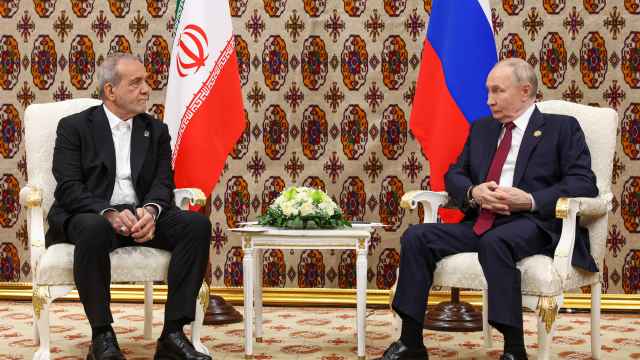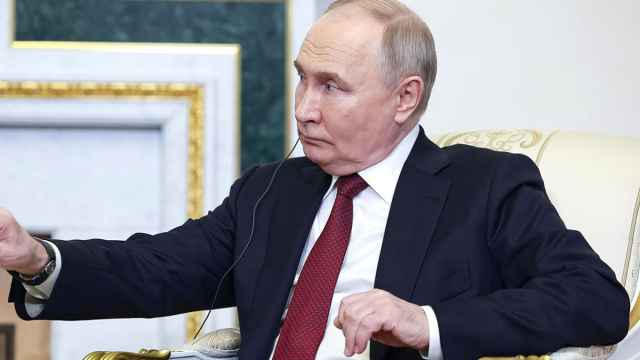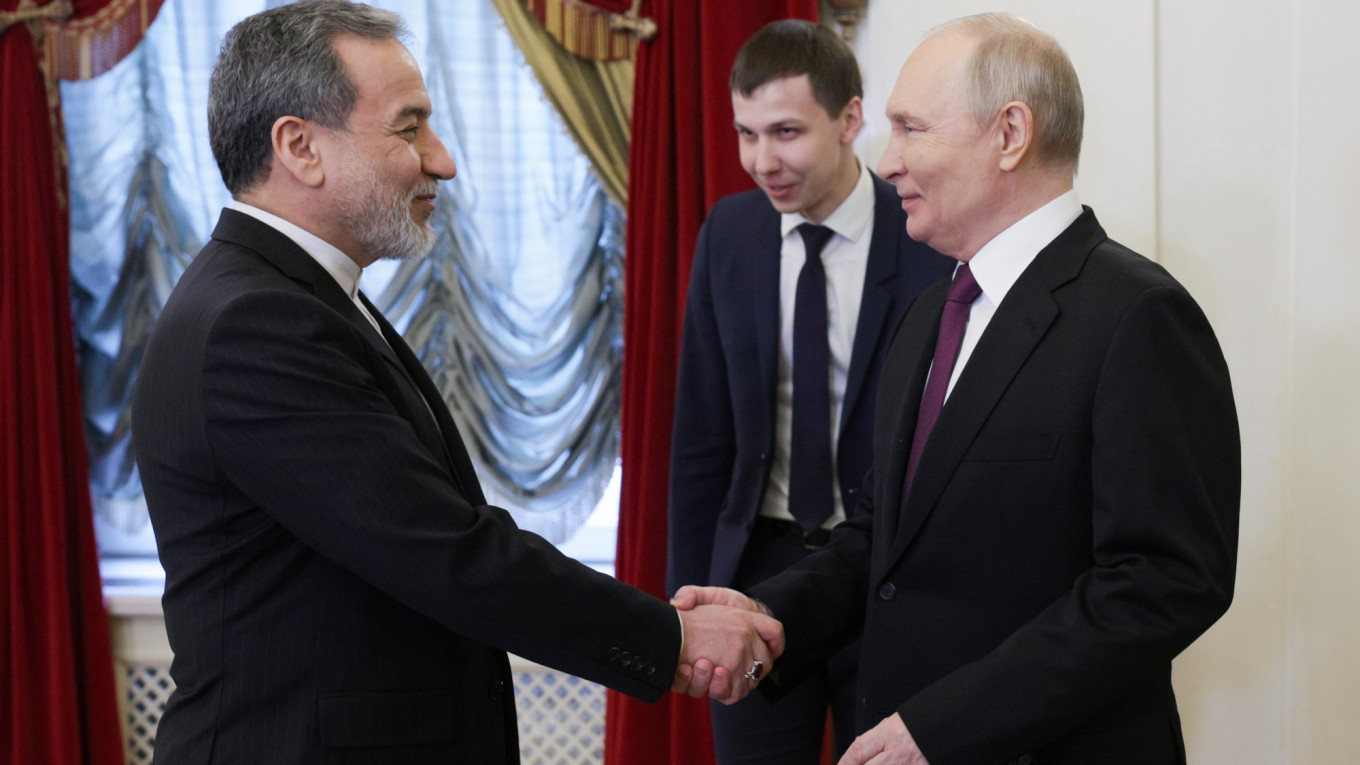
Iranian Foreign Minister Abbas Araghchi met with President Vladimir Putin in St. Petersburg on Monday as he seeks support from Moscow amid a flurry of diplomacy aimed at bringing an end to the war with the United States and Israel.
Putin told Araghchi, who arrived from Oman earlier in the day, that Russia was ready to do "everything that serves your interests, the interests of all the people of the region, so that peace can be achieved as soon as possible."
The Kremlin leader also praised the Iranian people for "fighting for their independence and sovereignty" in the face of U.S.-Israeli attacks, which have killed more than 3,000 people in Iran.
"Russia, just like Iran, intends to continue our strategic relationship," Putin said in comments carried by Russian state media.
Foreign Minister Sergei Lavrov, Kremlin foreign policy adviser Yury Ushakov and the head of Russia's GRU military intelligence agency, Igor Kostyukov, were also present at the sitdown.
Upon his arrival in St. Petersburg earlier in the day, Araghchi had told Iranian media he was "confident" that his meeting with Putin would be a good opportunity to discuss developments in the war and review the latest situation," according to Al Jazeera.
Kremlin spokesman Dmitry Peskov, meanwhile, said it would be "difficult to overestimate" the importance of the visit "in light of the evolving situation around Iran and in the Middle East."
Araghchi's sitdown with Putin comes after his trips to Oman and Pakistan, where he met with officials trying to mediate an end to the conflict.
Hopes of reviving peace efforts were dashed this weekend when U.S. President Trump called off a trip to Pakistan by special envoy Steve Witkoff and his son-in-law Jared Kushner.
Yet, in a sign that informal backchannels remain active, Iran's Fars news agency reported that Tehran had sent "written messages" to the United States through Pakistani mediators detailing its red lines, including nuclear issues and the Strait of Hormuz.
On Sunday, Axios reported that Iran had floated a new proposal to end the war and reopen the Strait of Hormuz by decoupling the maritime crisis from nuclear negotiations, which would be postponed.
Russia is one of Iran's closest partners. It has repeatedly condemned U.S.-Israeli attacks on the Islamic republic, calling them an "unprovoked act of armed aggression," and has insisted that the sides resolve the conflict through diplomacy.
In 2025, Iran and Russia signed a strategic partnership agreement that includes provisions for countering shared threats. However, the pact stops short of mutual defense obligations.
Russia has reportedly provided Iran with intelligence and advice on drone tactics since the outbreak of war in late February. The Kremlin has denied those reports.
While a ceasefire between Iran and the United States has held si far, the global economic shockwaves of the conflict show little sign of receding. Iran's closure of the Strait of Hormuz continues to paralyze the flow of oil and gas, sending prices skyrocketing and stoking fears of food insecurity in developing nations.
AFP contributed reporting.
A Message from The Moscow Times:
Dear readers,
We are facing unprecedented challenges. Russia's Prosecutor General's Office has designated The Moscow Times as an "undesirable" organization, criminalizing our work and putting our staff at risk of prosecution. This follows our earlier unjust labeling as a "foreign agent."
These actions are direct attempts to silence independent journalism in Russia. The authorities claim our work "discredits the decisions of the Russian leadership." We see things differently: we strive to provide accurate, unbiased reporting on Russia.
We, the journalists of The Moscow Times, refuse to be silenced. But to continue our work, we need your help.
Your support, no matter how small, makes a world of difference. If you can, please support us monthly starting from just $2. It's quick to set up, and every contribution makes a significant impact.
By supporting The Moscow Times, you're defending open, independent journalism in the face of repression. Thank you for standing with us.

Remind me later.