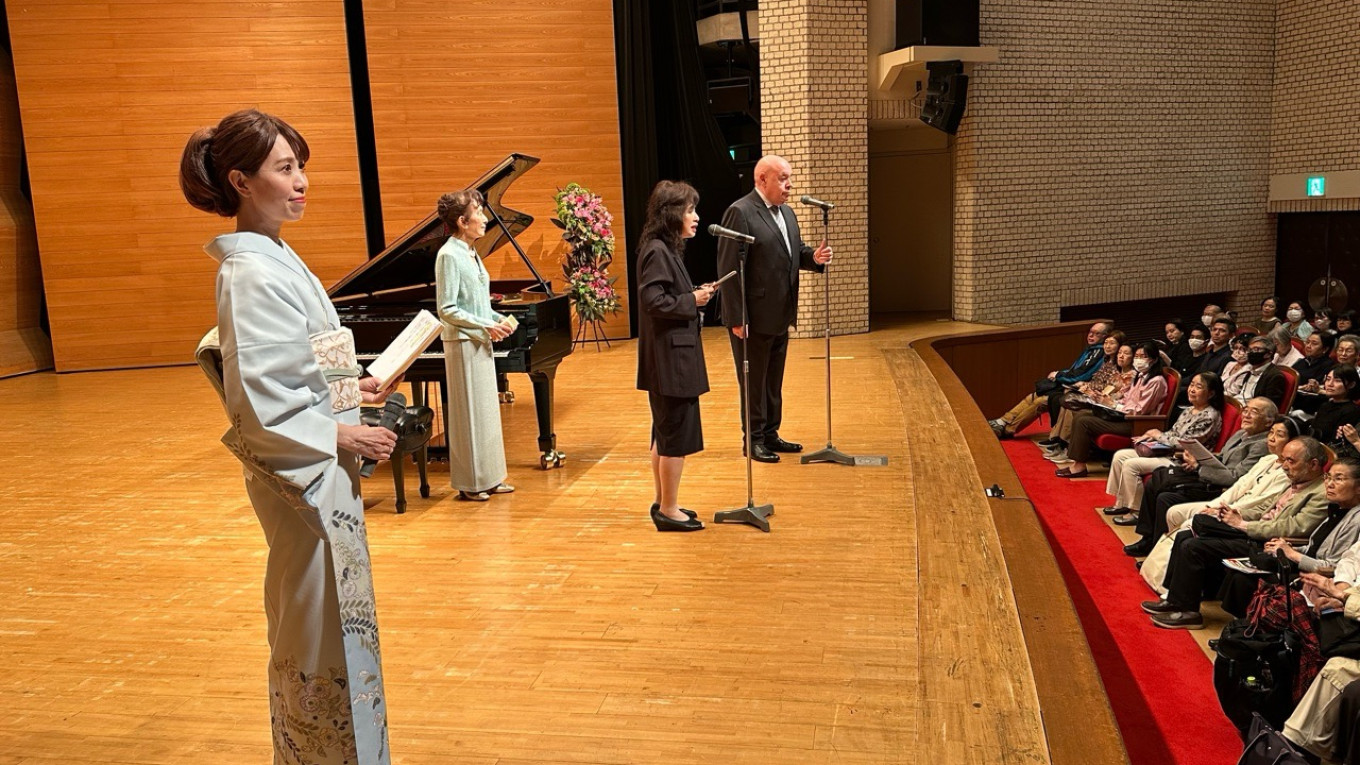
On May 11, Mikhail Shvydkoy, President Vladimir Putin’s special representative for international cultural cooperation, took to the stage at Tokyo’s Ginza Blossom Hall to preside over the opening ceremony of the year-long Festival of Russian Culture in Japan. Audience members, who included Abe Akie, widow of former Prime Minister Abe Shinzo, were treated to a gala concert featuring Nikita Lyutikov, principal clarinetist at the St. Petersburg Philharmonic Orchestra.
That same day, the regime that Shvydkoy represents unleashed a barrage of more than 100 drones against Ukrainian targets, ending the three-day pause that Moscow had introduced around Victory Day.
The Japanese government’s continued willingness to host this annual event has caused bafflement among Japan’s Western partners. Since the start of the full-scale invasion of Ukraine in 2022, European countries have generally refused to give the Russian state a platform for cultural events that can be used for propaganda.
Russia did controversially participate in this year’s Venice Biennale. Yet it took part against the wishes of the Italian government and prompted the European Union to cut 2 million euros ($2.3 million) in funding. Ultimately, amid protest, the Russian pavilion opened only for a brief preview and will remain shuttered to the public for the rest of the Biennale.
Japan’s readiness to give the Kremlin a platform is especially surprising because Tokyo has generally been robust in condemning Russia’s aggression and in supporting Ukraine. Japan has joined G-7 partners in introducing multiple rounds of sanctions against Russian officials, including against Putin himself.
Added to this, Japan has provided Ukraine with $15.7 billion of bilateral aid. Moreover, on May 29, the Foreign Ministry in Tokyo announced that Japan had contributed around $15 million to the Prioritized Ukraine Requirements List (PURL), a NATO mechanism to fund the purchase of United States-made military equipment for Ukraine.
The decision to permit the Russian festival is not a concession to public demand. As in most countries, classical music is a niche interest in Japan. Furthermore, public attitudes to Russia, never especially warm, have become decidedly chilly since 2022. According to a survey conducted by Japan’s Cabinet Office in September 2025, a total of 93% of respondents reported not feeling affection for Russia.
So what accounts for this anomaly as much of the world shuns Kremlin cultural projects?
The answer is that Japan’s government is guided by the principle that its quarrel is not with the Russian people nor even with the Kremlin in general, but more narrowly with Russia’s war against Ukraine. As such, apolitical activities, such as cultural events, should be allowed.
This thinking also applies to educational exchanges. The official Diplomatic Bluebook for 2025 makes clear that Japan continues to promote people-to-people exchange, including by providing government-funded scholarships to Russian students. It explains that the purpose is “to maintain contact with Russian civil society, especially the younger generation, and to provide Russian citizens with opportunities to gain international perspectives.”
This is noble stuff. Yet it is naive about the ramifications of the cultural festival.
There would be no issue if the festival comprised a series of events in which artists with no connection to the Russian state showcased their talent. However, the Festival of Russian Culture in Japan is anything but independent.
It is organised by Russia’s Ministry of Culture and Shvydkoy chairs the organizing committee. As a former Minister of Culture under Putin’s leadership, Shvydkoy is unquestionably a political figure. He arrived in the Japanese capital flanked by a senior Russian diplomat and held meetings that extended well beyond the cultural realm.
On 12 May, he visited the Japanese parliament to meet Suzuki Muneo, a Japanese parliamentarian known for both corruption — he served a prison sentence for taking bribes — and for his pro-Russian views. Shvydkoy took the opportunity to argue for resuming direct talks at the vice-ministerial level. He also lobbied for bilateral energy cooperation and a restart of direct flights.
The festival therefore serves as a backdoor through which Kremlin representatives can enter Japan to exert political influence. It is also an example of artwashing, the practice through which authoritarian governments fund cultural events to soften their image and distract from their abuses. The Kremlin would much rather that the Japanese public associate the Russian state with the Mariinsky and Bolshoi than Mariupol and Bucha.
A further problem for Japan is that the Kremlin does not reciprocate. In 2025, the Russian authorities unilaterally terminated the operation of Japan Centres in Russia. Established in 1994 and funded by the Japanese state, these cultural institutions provided business training and Japanese-language classes to residents of six Russian cities. In the case of the Sakhalin Japan Centre, the director was prosecuted for the heinous crime of conducting Japanese-language courses without the necessary licence.
The Russian authorities have also refused to permit Japanese former residents to visit ancestral graves on the disputed Southern Kuril Islands. These individuals were forcibly deported after the islands, which Japan claims as its Northern Territories, were occupied by Soviet forces at the end of World War II.
An annual scheme used to permit the former residents to make short, visa-free visits during the summer months. However, the Kremlin ended it to punish Tokyo for its support of Ukraine and has remained deaf to Japanese entreaties to resume the visits on humanitarian grounds. With the average age of former residents now over 90, few seem likely ever to set foot on their homeland again.
Aside from the Festival of Russian Culture, Japan’s remarkably permissive attitude is discernible in its visa policy. While many European countries have made it much more difficult for Russians to receive tourist visas since 2022, Japan has made it easier, including by opening two new visa centres in Moscow and St. Petersburg in February 2026.
This liberality has contributed to a surge in Russian tourists, with 195,000 visiting in 2025, an increase of 96.3% from 2024.
This understandably causes unease. Many find it uncomfortable to see Russians luxuriating abroad while their government bombards Ukrainian cities.
Yet, in contrast to allowing the Festival of Russian Culture, Japan’s policy in this regard is exactly right. It makes no sense to hold the Russian people collectively responsible for the crimes of the Putin regime when the repressive nature of the Russian state deprives them of the ability to select their leaders.
Undoubtedly, some Russian tourists visiting Japan will be supporters of the war, but even they should be permitted entry. Spending time outside Russia’s propaganda bubble may open their eyes to the false reality in which they have been living. It is even possible that, by seeing how Japan’s once militarist state has been transformed into a peaceful and prosperous society, they may realise that a post-imperialist future is possible for Russia too.
As Shvydkoy prepared to leave Japan on May 15, he was already making plans for the Festival of Russian Culture in 2027. In an interview with Russian state media, he raised the prospect of Valery Gergiev, a conductor famed for both his musical talent and closeness to Putin, joining the programme.
It is time to stop this embarrassment. While ordinary Russians should continue to be welcome, Japan should stop giving the Putin regime a public platform for its propaganda.
A Message from The Moscow Times:
Dear readers,
We are facing unprecedented challenges. Russia's Prosecutor General's Office has designated The Moscow Times as an "undesirable" organization, criminalizing our work and putting our staff at risk of prosecution. This follows our earlier unjust labeling as a "foreign agent."
These actions are direct attempts to silence independent journalism in Russia. The authorities claim our work "discredits the decisions of the Russian leadership." We see things differently: we strive to provide accurate, unbiased reporting on Russia.
We, the journalists of The Moscow Times, refuse to be silenced. But to continue our work, we need your help.
Your support, no matter how small, makes a world of difference. If you can, please support us monthly starting from just $2. It's quick to set up, and every contribution makes a significant impact.
By supporting The Moscow Times, you're defending open, independent journalism in the face of repression. Thank you for standing with us.

Remind me later.