

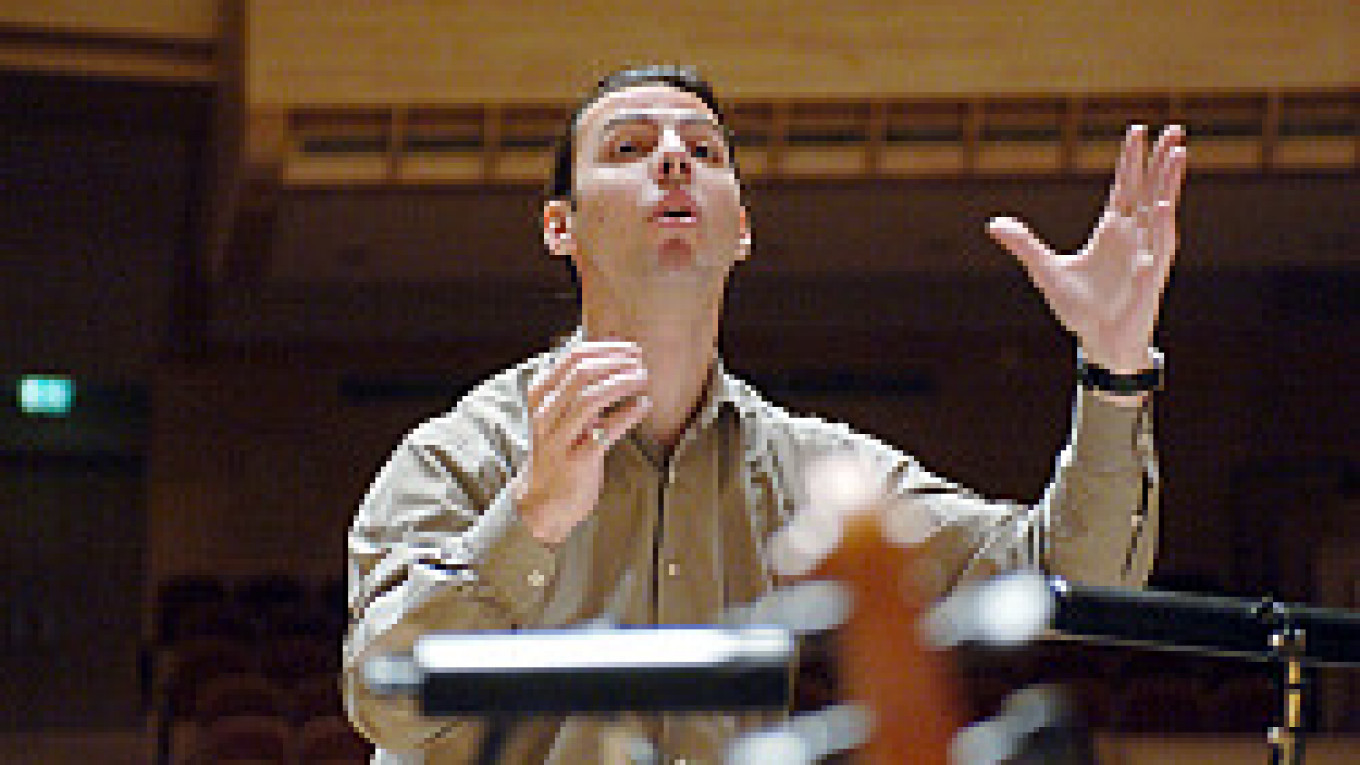
Not that Currentzis, who is music director of the Novosibirsk Opera and Ballet Theater and a rising star on the Russian classical scene, made light of it. But he did seem to hold it out as a reward. "Some may have come for the Mahler, some may have come to see me," he said in an interview at the Smolenskaya Naberezhnaya apartment where he stays during his increasingly frequent Moscow appearances. "But when they see me, they will find my program." The concert was part of the Territoriya Festival, of which Currentzis was an organizer, and he made it clear that he took seriously the cross-disciplinary festival's objective of bringing avant-garde works to Russia. It was just one instance in which Currentzis has shown himself to be a man with a mission.
"When a new movie comes out in America, pirated copies turn up in Moscow two weeks later. This is what happens with pop culture, like junk food. The good stuff may have to wait for 20 years. It is possible to make money on new music, but people don't want to run the risk or educate the audience." Instead, what does come to Russia, Currentzis notes with frustration, are aging opera singers. "Famous singers who lose their voices know to come to Moscow, where their names alone sell out halls. Russians have an intellectual love of culture -- they don't need to create heroes like these."
Russia's contribution to the West is often no better. "It sends touring orchestras that don't play very well. Yekaterina Gubanova [a Russian mezzo-soprano with an active Western career who sang in 'Das Lied'] has just sung for the first time in her own country. Why should it be that way? What is imported and what is exported is a problem -- it's part of the mainstream mess that needs to be straightened out."
Currentzis speaks about his art from so firm a Russian perspective it is easy to overlook that he is Greek. Indeed, he himself is an unusual commodity in the export-import market. Where, at least until the last few years, economic forces have driven top musicians to seek careers in the West, Currentzis is the unusual example of a gifted foreign artist who has elected to forge his career in Russia. Born in Athens in 1972, he came to Russia in the early 1990s to study conducting at the St. Petersburg Conservatory with the legendary Ilya Musin, whose students included Valery Gergiev, Yury Temirkanov and Semyon Bychkov.
"Musin was very important for me. He was a great psychologist but very strict on technical points. He concentrated not on what you wanted to say -- 'Develop your fantasy,' he told us -- but on how to show what you want to say. Most conductors conduct themselves, not the orchestra. Conductors need to share the music and have the fantasy to keep it alive."
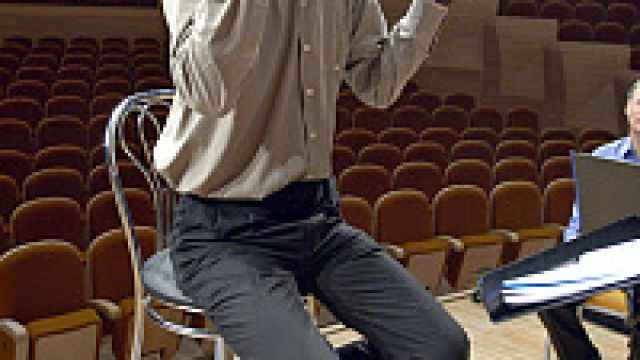 Itar-Tass Born in Athens, Currentzis came to St. Petersburg in the '90s to study under the renowned conducting teacher Ilya Musin. |  |
| |
While continuing in St. Petersburg for post-graduate studies, Currentzis became Temirkanov's assistant at the St. Petersburg Philharmonic. His initial Moscow appearances were at the Helikon Opera in 2001. The widespread interest he has attracted stems not just from his skills on the podium but also from the breadth of his musical pursuits. His devotion to new music is balanced by a flair for the Baroque, and he has shown an aptitude for most styles in between. For Currentzis, familiarity with one style helps inform another. "Human beings live at different times and lead different lives, but they have the same feelings. This is very important. The 'Puritans' who do just early music can't do Debussy. But I can do Debussy." He can also do Mozart, as recent concert performances of the latter's operas have demonstrated. On Nov. 15, he will have a go at Rossini as "Cinderella" is performed in concert form in the Great Hall of the Moscow Conservatory.
One quickly appreciates Currentzis' concern for serious artistic issues and his confidence in addressing them. But his manner is reflective, even soft-spoken, rather than pompous. He seeks to persuade as he looks directly at you, his long hair tied back in a ponytail, just as it was in Tchaikovsky Concert Hall for the contemporary works (for the Mahler he allowed it to flow to his shoulders). He tends to frame issues in terms of their Russian implication, for his commitment to Russia seems unshakeable. He even shrugs off with apparent lack of interest questions about future Western engagements, although he did mention "Don Carlo" at the Paris Opera in 2008. "I could have a very good career in the West if I weren't so serious about Russia. But one beautiful morning, I woke up in Greece and understood that I couldn't live without Russia. I've even said I want to take Russian citizenship, but everybody laughs." With a reputation as one with an eye for women, he is forthright in recognizing Russia's lure in this regard. "Russian women really are something extraordinary."
He also prefers Russian orchestras to foreign ones. "Foreign orchestras have better pitch, better winds and are more precise. But they don't put as much heart into the music; they're more like robots. Russians are lazier and have lower standards of music education, but they're more talented. They can do things that good European orchestras can't. European orchestras may play Tchaikovsky more cleanly, but it's dead. My task is to build an orchestra that plays with better pitch, that plays with precision and is spontaneous at the same time -- an orchestra that can represent Russia with honor in the worldwide market."
He may be well on his way with the Musica Aeterna Ensemble, which he founded in Novosibirsk and speaks about with pride. "The players came from many different places to be part of this orchestra." Not surprisingly, the music they play reflects his own broad tastes, including a preference for period instruments. "In the Mahler we use Viennese trumpets, a reduced amount of vibrato and special bowing techniques." He also relishes having a working atmosphere in which the players don't have their eyes on the clock. "If a piece isn't ready, we will rehearse until it is."
However the ensemble's rendition of that piece turns out, Currentzis is conscious that it will somehow be part of Russia's cultural tradition. "The best things in Russia are often individual adaptations of European ideas. Look at the development of ballet. [The choreographer and balletmaster] Marius Petipa was French, but his presence in Russia led to 'Swan Lake' and the Russian ballet school. Russians take something that is not Russian and transform it into something better. You can't imagine Shostakovich without Mahler -- Soviet composers on their own were not very high class." As an outsider working in Russia, Currentzis stands ready to supply the formula's Western ingredient, and the results could be exciting.
Teodor Currentzis' next conducting engagements in Moscow are Nov. 15 in the Great Hall of the Moscow Conservatory, with a concert performance of Rossini's "Cinderella" (Zolushka), and Nov. 20 in the Svetlanov Hall of MMDM, with performances of works by Strauss and Schubert.
A Message from The Moscow Times:
Dear readers,
We are facing unprecedented challenges. Russia's Prosecutor General's Office has designated The Moscow Times as an "undesirable" organization, criminalizing our work and putting our staff at risk of prosecution. This follows our earlier unjust labeling as a "foreign agent."
These actions are direct attempts to silence independent journalism in Russia. The authorities claim our work "discredits the decisions of the Russian leadership." We see things differently: we strive to provide accurate, unbiased reporting on Russia.
We, the journalists of The Moscow Times, refuse to be silenced. But to continue our work, we need your help.
Your support, no matter how small, makes a world of difference. If you can, please support us monthly starting from just $2. It's quick to set up, and every contribution makes a significant impact.
By supporting The Moscow Times, you're defending open, independent journalism in the face of repression. Thank you for standing with us.

Remind me later.