

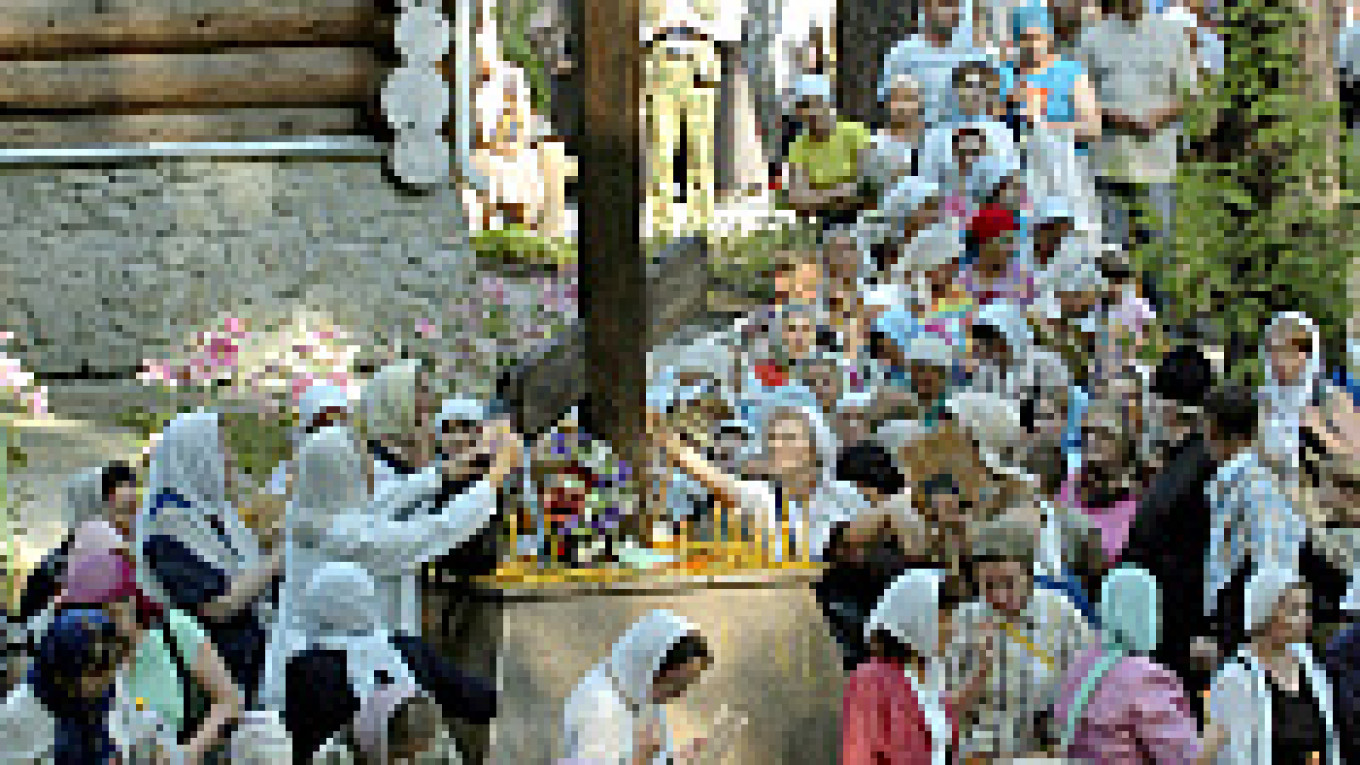
Pilgrims from across the country have flocked to the Ural Mountains city of Yekaterinburg to commemorate the death of the Tsar Nicholas II and his family, whose murder months after the Bolshevik Revolution helped usher in seven decades of Communist rule.
Many made their way from a church built on the site of the house where the family was secretly shot to death by a Bolshevik firing squad in the early hours of July 17, 1918, to a wooded area where their bodies were deposited. It is now home to a church and memorials.
Priests held icons aloft, and women in headscarves carried children or towed them along. Some 30,000 to 50,000 people took part in the procession.
"For me, the feeling is sadness for what happened and nostalgia for what we lost," one pilgrim, Georgy Nekrasov, said on state-run Rossia television. Its news anchor described the killings as "one of the most terrible crimes in the history of our fatherland."
Nicholas II abdicated in 1917 as revolutionary fervor swept Russia, and he and his family were detained and taken to Yekaterinburg and held in the house where they were later shot along with servants. The Russian Orthodox Church made them saints in 2000, amid a continuing church revival following the collapse of the atheist Soviet Union in 1991. The Russian tsars were closely linked to the church in the centuries before the Romanov dynasty's demise.
The remains of Nicholas, Empress Alexandra and three daughters -- Olga, Tatyana and Anastasia -- were unearthed in Yekaterinburg in 1991. In 1998, they were reburied in the imperial capital, St. Petersburg, even though the church has expressed doubts about the identification of the remains made by scientists.
In declarations voiced in June and repeated Wednesday, investigators said DNA tests show that bone and tooth shards found nearby a year ago belonged to the other children: Nicholas II's 13-year-old heir, Crown Prince Alexei, and his sister, Grand Duchess Maria.
In rulings that human rights activists say fit in with the Kremlin's reluctance to confront the crimes of Russia's Soviet past, courts have thwarted efforts by descendants of the Romanov dynasty for official recognition of the slain tsar and his family as victims of politically motivated Communist-era oppression.
A Message from The Moscow Times:
Dear readers,
We are facing unprecedented challenges. Russia's Prosecutor General's Office has designated The Moscow Times as an "undesirable" organization, criminalizing our work and putting our staff at risk of prosecution. This follows our earlier unjust labeling as a "foreign agent."
These actions are direct attempts to silence independent journalism in Russia. The authorities claim our work "discredits the decisions of the Russian leadership." We see things differently: we strive to provide accurate, unbiased reporting on Russia.
We, the journalists of The Moscow Times, refuse to be silenced. But to continue our work, we need your help.
Your support, no matter how small, makes a world of difference. If you can, please support us monthly starting from just $2. It's quick to set up, and every contribution makes a significant impact.
By supporting The Moscow Times, you're defending open, independent journalism in the face of repression. Thank you for standing with us.

Remind me later.