


Just where the western tip of the Caucasus range drops into the Black Sea lies a shining new oil terminal like no other. The four crude-oil tanks overlooking the rocky coast are not the biggest in the world, but they are the biggest in Russia. And because of Russians' fear of lightning, 16 giant lightning towers stand guard over the four tanks, giving what oilmen call the tank farm a unique appearance.
The lightning towers, painted in bright red and white and topped with blinking lights, are more than 70 meters tall and cost $250,000 each.
"In Texas, we would never have those things," said Gary Boubel, the project general manager of the Caspian Pipeline Consortium, the company that built the terminal and the pipeline.
"I have never seen a place that, from a regulatory point of view, is so paranoid about lightning," said CPC's Dennis Stuart, who was responsible for the Kazakh segment of the pipeline.
For the Westerners who supervised the 6,000 Russians and Kazakhs who built the pipeline that stretches from the giant Tengiz oil field on the Kazakh shore of the Caspian Sea to this high-tech terminal in Russia's deep south, the towers are a symbol of the waste imposed by Russia's rigid and antiquated building codes.
But for Yevgeny Vlasov, a 27-year-old businessman checking his e-mail on a recent afternoon at an Internet cafe in the nearby city of Novorossiisk, the towers make perfect sense. "Imagine if lightning struck those tanks," he said. "There would be a terrible fire. Of course we need those towers."
Vlasov is right: Most tank fires do come from lightning. But so are the Americans with their Western technology such as conductive-material domes and floating roofs that eliminate spaces where explosive vapors can accumulate.
Different Philosophies
The building of the CPC pipeline, financed mostly by U.S. companies led by ChevronTexaco, has offered a unique prism through which to assess how extraordinarily far apart two philosophies of building oil-related structures evolved in parallel fashion over the 20th century.
One is known as the Western way, which started when the first well drew oil in Titusville, Pennsylvania in 1858. As U.S. and European oil companies grew and spread to Asia, South America and Africa, they brought with them their way of doing things, of building things, of working.
In Russia, the first oil wells were drilled in 1871 in Baku, on the Caspian Sea, by the Swedish Nobel brothers. By the 1917 Bolshevik Revolution, the industry was well developed. The Soviet Union eventually rose to be the world's largest producer of oil, drilling thousands of wells and laying 50,000 kilometers of pipelines -- with no contact whatsoever with its Western counterparts.
"The CPC is the first time the two cultures had to work together," Stuart mused one recent afternoon in Atyrau, the booming oil town complete with Tex-Mex restaurants that are Kazakhstan's answer to Houston.
The Soviet construction philosophy, heir to a tsarist state that already nurtured an oppressive bureaucracy vividly described in Russian literature, took on a shape of its own.
The designer bore no responsibility for cost but was personally responsible for his work and could be sent to jail if the design was blamed for an accident.
This created a tendency to make things bigger and stronger than in the West. Extra bulk was factored in to compensate for the poor workmanship and low-quality materials that were the Soviet norm.
Much of the technology still in practice today and the rules it created date from the 1960s, according to CPC oilmen.
The Americans were driven crazy with frustration by the delays and cost overruns caused by the building codes, the work habits and the uniquely intrusive bureaucracy.
The Russians and Kazakhs were appalled by what they perceived as the Americans' disorganization and their incomprehensible demands and were deeply suspicious about their motives.
With the possible exception of the space program, never had two subspecies of Homo faber -- man the maker -- evolved so differently and then been forced to work together.
A High-Visibility Project
CPC isn't just any pipeline. It's large -- it will eventually be able to carry 1.5 million barrels per day -- and at 1,510 kilometers it's also quite long. Roughly half had been built in the 1980s but required a major overhaul. The other half was built from scratch.
When after years of negotiations, first with the Soviet Union then with the Kazakh government, Chevron Corp. took over the deep, high-pressure Tengiz field -- the world's sixth-largest -- on the northeast Caspian Sea shore in 1992. It gambled it would some day get the oil to an open-sea port.
Negotiations with the Russians to build a pipeline to the Black Sea dragged on. Russia wanted to keep political control over the new fields of the north Caspian Sea by having them run through its territory, but Transneft, the Soviet-era pipeline monopoly, was horrified at the idea of foreign competition on its own turf. Chevron, meanwhile, refused to spend any money on a pipeline it would not control.
Finally, two Russian oil companies, LUKoil and Rosneft, were brought on board, and the project took off in 1997. Russia, Kazakhstan and Oman -- which paid for early feasibility studies -- own half the shares in CPC and contributed an existing pipeline than ran half the route, part of it in Russia and part in Kazakhstan. Eight oil companies, which are paying to build the pipe so they can use it to export their oil, share the other half. Chevron, with 15 percent of CPC and half of the Tengiz field, was the lead company.
Both Washington and Moscow lent their support: Washington, to back Chevron, and Moscow to prove it would be a reliable transporter of Western-lifted oil in the Caspian region, which is expected to produce 4 million barrels per day in 15 years.
The first cultural sparks flew at the top.
The agreement was that for the first five years, the general director would be a Russian from LUKoil and the one in charge of building the pipeline would be his deputy, an American from Chevron. The arrangement would be reversed for the second five years in 2002, by which time the pipeline was due to be fully functional.
But soon after the first pair began working, the Americans took umbrage at what they saw as the Russians' autocratic ways. Work ground to a halt, and the contractors were sent home.
Eventually, another pair of managers was brought in, with the proviso that everything had to be signed by both.
"It's bureaucratic and tedious but that's how we run the business," said Frederick Nelson, the mild-mannered deputy general director for operations whose diplomatic skills are frequently mentioned within the company as having been essential in pulling the project through. (Nelson moved on to Indonesia when his term ended and was replaced with Sergei Gnachenko, the former general director.)
Rigid Building Codes
From the start, it was agreed that the pipeline would be built to Russian or Western standards, whichever were higher. The Americans had expected some over-design -- just not as much as they found.
"If a foundation has to be X by X," said Dennis Cukr, who managed the Russian stretch for CPC, "the designers would put 2X by 2X, running up the cost four times."
In the United States, he said, building codes are guidelines that leave plenty of leeway, with the owner liable for the safety of the structure. In Russia, the codes are highly detailed and have the force of law.
"So we'd find ourselves continually going back to the designers, saying, 'You've got to be kidding, we would never want to build something like that. Do you know how much that would cost?' And they would say, 'Too bad, that's our design and we're not going to change it.'"
Because Russian pipelines do not have computer-linked sensors that can detect a leak instantly and close the relevant valve automatically, building codes stipulate that large retention ditches and reservoirs -- huge, empty swimming pools -- be built near populated areas.
The codes make no provision for the sensors and the computers that CPC imported. So millions of dollars were spent on ditches that are no longer built anywhere else.
"In the original design, they had put in a couple of dozen," said Andrei Novoderezhkin of CPC. "In the end we got them to reduce that to six or seven."
Bob Buell, the lead telecommunications engineer who oversaw the laying of a fiber-optics cable along the pipeline, said CPC discovered one way to deal with the building codes and regulations known as snips.
When CPC engineers were denied permission to do something their way, they were told a snip forbade that.
"We learned that if you asked for the text, nine times out of 10 the issue just went away. They knew that if they had always done something a particular way, there must be a snip somewhere, but there are so many snips they usually couldn't find the right one," Buell said.
"So we had Russians specially employed looking for snips because there were contradictory snips and when they found one that said you had to do it this way, we'd have our people find a snip that said do it the other way."
|
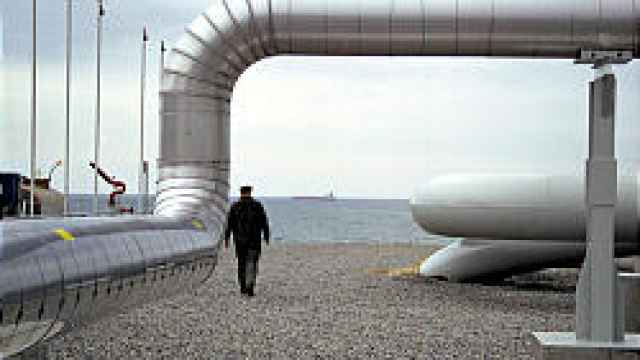
| Christopher Pala / For MT The end of the road for the 1,510 kilometer CPC pipeline, built despite cultural friction and glaringly different approaches between Russians and Westerners. |
The Gears Didn't Mesh
The design of the tank farm and marine terminal was handed to Fluor-Daniel's Houston office and the French company Bouygues, while its construction went to Bouygues' Russian subsidiary Starstroi. But, according to Nelson, who directed the whole project, CPC decided to have the Russian state design bureaus draw up the new pump stations in a bid to save time.
CPC's intent was to build the pipeline in a fast-track mode, where construction starts before the design details are finished. But the Russian system was to first complete the design at a specialized institute, have a ministry do the purchasing and then turn over the project to a building concern, which would execute the project down to the last detail.
In the initial planning, said CPC's Stuart, "there was not enough recognition of the gulf between the two cultures. For instance, first we do a basic drawing and we add the details as we go along. They do a detailed design and do the basic drawing at the end. So we were getting the drawings several months late. We had two gears where the teeth weren't meshing."
The result was that of five pump stations to be built or rebuilt in the first phase of the project by last fall, only two had been completed in March and the other three are not expected to be finished before summer.
"We are going to finish six to nine months late because of the inefficiency of the design institutes, and I don't mind being quoted on that," Cukr, the manager of the Russian portion, said in his office in Krasnodar.
He estimated that the pump stations, budgeted at $240 million, probably will end up costing $265 million. And the pipeline, which was scheduled to operate at its inauguration in mid-2001 with five pump stations at 550,000 bpd, came in last October at 200,000 bpd because only two were working.
By the end of the first phase, the total cost will be $2.65 billion, which CPC executives say is just slightly above the norm.
Asked why CPC elected to have the pipeline's pumping stations designed by the main Russian pipeline design institute Gidrotruboprovod, or GTP, rather than by a Western company, Boubel, the company's No. 3, said on a tour of a much-delayed pumping station in Atyrau, Kazakhstan, "It was an obvious choice. They were the design institute."
But he added the institute turned out to have actually been largely inactive for the past decade, having seen its best engineers go to Western companies, and was busy at the time working on a pipeline in the Baltic that drained a lot of talent from CPC's project.
For Kairgeldy Kabyldin, who runs Kazakhstan's pipeline network, the blame for these delays lie elsewhere.
"The pipeline is behind schedule because the Americans they sent are bad managers," he said in an interview in Astana, Kazakhstan's capital. "They change their minds all the time. They should have just sent a couple of managers and left the construction to local specialists. Here and in Russia we build things much faster."
"Besides," he said, "they have a conflict of interest: Since they make more money here than at home, they're motivated to create delays." Then he smiled sympathetically, shrugged and added, "I understand, they also have families to feed."
Yury Spector, the director of the GTP design institute that drew such ire from the Americans, was more diplomatic. He said he wasn't long on the job, didn't know of any delays, and called the CPC experience beneficial for his institute.
"We got some idea of Western standards, of American experience," he said. "For us, it was the first time.
"However, I think that the design and construction of pipelines in Russia must be carried out by the Russians," he said. "That allows us to reduce costs. This is perfectly exemplified by the fact than the construction of the BTS [Baltic Transport System] cost nearly a tenth less then CPC."
The Fire Department
At the tank farm just above the marine terminal overlooking the Black Sea, the lightning towers were not the only cost that would not have been imposed anywhere else but Russia.
"The fire protection stuff typically is about 10 percent of the cost of a tank farm and terminal. Here it's been 30 percent," said Rudy Nagel, the burly Dutchman who managed the construction project for Bouygues, the main contractor.
"The fire brigades were all over," said Kim La Bauve, who oversaw the marine terminal and tank farm construction for CPC. "Never have I seen outside authorities come in so often and tell us what to do. They made us built a huge dam and giant water towers." At the site, 216 firemen and 10 fire trucks serve on a rotation basis.
"In the U.S., the strategy for a tank fire is you drain it and let it burn. Here they insisted we must put it out, which meant we had to provide for water and foam for 12 hours," Nagel said. "We had to build an extra dam and enormous water towers."
The U.S. oilmen were also surprised to learn that there were skeletons in the closets of the existing components of the pipeline.
When Cukr started work on these elements in the Russian portion of the pipeline, "we found out they were designed by the same people we were working with. They were built by the exact same constructors who are doing the work for us and inspected by exactly the same agencies and even the same individuals that we're working with now. But back then the party bosses would say, 'We want this thing done now,' so they would take shortcuts.
"Many, many times the people who built and inspected it and knew where they had screwed up forced us to dig this stuff all back up and said, 'Look at this, it's screwed up, fix it.' That cost me several million dollars and several months of schedule," Cukr said.
One example in which the Russians were less forthcoming, he said, was a pair of crude-oil tanks at the existing Komsomolskaya pump station, which had to be destroyed and rebuilt.
"We wanted to use those tanks for crude oil, but even though they had never been filled they told us we couldn't," Cukr said.
"We weren't sure why until we found out from the drawings that the foundations of those tanks were supposed to have concrete piles driven underneath to support them. Well, they never drove those piles, they just put concrete ring beams and built the tanks on top of them.
"If they would have been filled, there would have been a lot of settlement because of the soil type," he said. "The tanks or the connecting piping could have failed, and you could have had a leak."
"Before," Bouygues' Nagel said, "they violated the norms for political reasons. Now they do it for money. The Russian companies just pay and the inspectors sign. You take one look at the oil terminal in the Novorossiisk port and it's obvious it violates the Russian norms."
Stuart, speaking a day before ending his assignment in Kazakhstan and heading home to Houston, gave this assessment of the project.
"We all know it costs more than if all the bits and pieces had been compatible. Then again, we are operating, the oil is flowing, and we know we'll have finished the first phase this year, even if it's six or nine months later than we expected. It had never been done, we did it and we proved it could be done, though if we had to do it again, we'd get the Russians more involved much earlier."
A Message from The Moscow Times:
Dear readers,
We are facing unprecedented challenges. Russia's Prosecutor General's Office has designated The Moscow Times as an "undesirable" organization, criminalizing our work and putting our staff at risk of prosecution. This follows our earlier unjust labeling as a "foreign agent."
These actions are direct attempts to silence independent journalism in Russia. The authorities claim our work "discredits the decisions of the Russian leadership." We see things differently: we strive to provide accurate, unbiased reporting on Russia.
We, the journalists of The Moscow Times, refuse to be silenced. But to continue our work, we need your help.
Your support, no matter how small, makes a world of difference. If you can, please support us monthly starting from just $2. It's quick to set up, and every contribution makes a significant impact.
By supporting The Moscow Times, you're defending open, independent journalism in the face of repression. Thank you for standing with us.

Remind me later.