

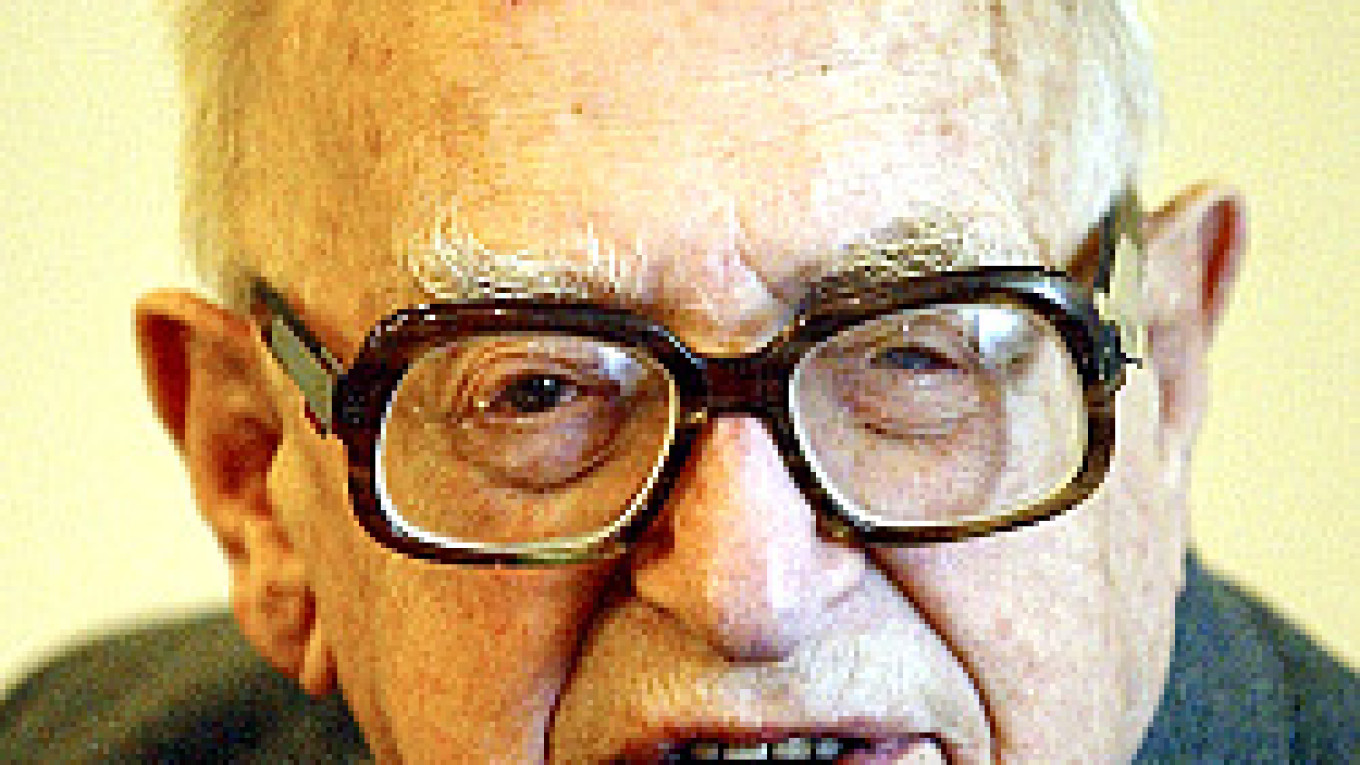
Yefimov, born Fridland in Kiev in 1900, published his first cartoon, a caricature mocking the White Army General Anton Denikin in 1918, after his elder brother, journalist Mikhail Koltsov, suggested that he start drawing.
From 1922, Yefimov regularly published his cartoons in Pravda and Izvestia newspapers and in the satirical magazine Krokodil. Curiously, Yefimov's latest job was with Izvestia: On his 107th birthday, he was appointed the newspaper's chief artist.
Yefimov succeeded in drawing enemies of the Soviet state -- first, the top German Nazi officials and particularly Adolf Hitler, whom he drew with a swastika under a sharp nose, and then, during the Cold War, portraying American and British politicians as plump villains with sagging cheeks.
The Soviet government sent him as a special war correspondent to the Nuremberg trials, where Yefimov sketched the Nazi leaders while standing in front of their cages.
In several interviews given in recent years, Yefimov expressed admiration for Stalin as a political genius unmatched by any of the modern Russian leaders but said he dreaded him as the tyrant who ordered the prosecution of his brother Mikhail, who was shot in prison in 1940 for Trotskyism.
Yefimov -- who said he used to walk Moscow's streets at night to avoid arrest by Stalin's agents, who usually came for people after dark -- often recalled a phone call from Stalin in 1947 that left him in a cold sweat.
Stalin asked him to draw Eisenhower arriving at the North Pole with a large army and saying Russians were? threatening the United States. Yefimov kept this sketch, on which Stalin left his remarks written in red pencil.
After the fall of the Soviet Union, Yefimov lamented that "political cartooning doesn't exist anymore."
"You always honestly and steadfastly defended the interests of our country and its citizens," Medvedev said in a telegram congratulating Yefimov on his 108th birthday on Sept. 28.
A Message from The Moscow Times:
Dear readers,
We are facing unprecedented challenges. Russia's Prosecutor General's Office has designated The Moscow Times as an "undesirable" organization, criminalizing our work and putting our staff at risk of prosecution. This follows our earlier unjust labeling as a "foreign agent."
These actions are direct attempts to silence independent journalism in Russia. The authorities claim our work "discredits the decisions of the Russian leadership." We see things differently: we strive to provide accurate, unbiased reporting on Russia.
We, the journalists of The Moscow Times, refuse to be silenced. But to continue our work, we need your help.
Your support, no matter how small, makes a world of difference. If you can, please support us monthly starting from just $2. It's quick to set up, and every contribution makes a significant impact.
By supporting The Moscow Times, you're defending open, independent journalism in the face of repression. Thank you for standing with us.

Remind me later.