

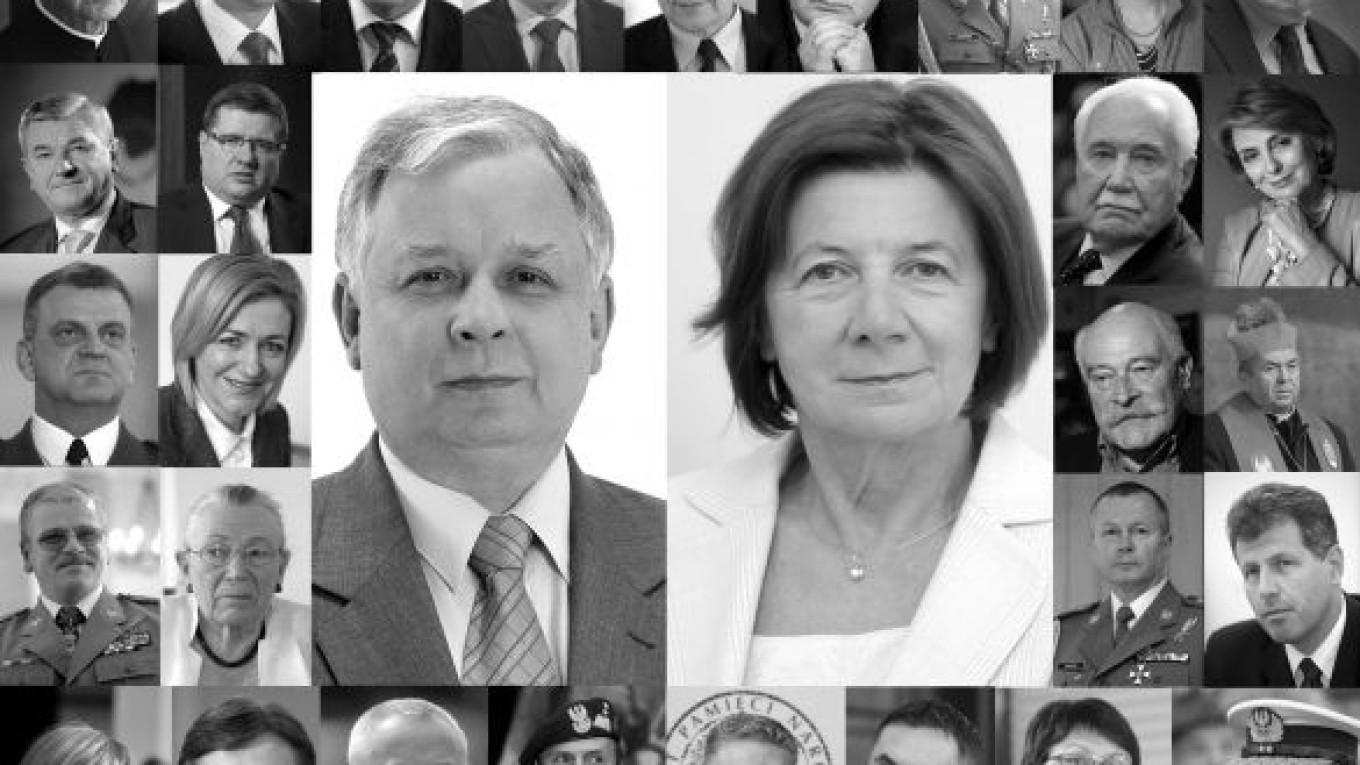
WARSAW — Polish President Lech Kaczynski's coffin returned home to a stunned nation on Sunday, a day after he and much of the country's political and military elite perished in a plane crash in Russia.
Poland's acting President Bronislaw Komorowski, Prime Minister Donald Tusk and Kaczynski's identical twin brother, Jaroslaw, were among those meeting the coffin, draped in the red and white national flag, at Warsaw's military airport.
April 10, 2010: The Polish presidential plane crashes on approach to Smolensk airport, killing all on board.
July 15, 2009: A Caspian Airlines Tu-154 flying fr om Iran to Armenia nosedives into a field, killing 168 people.
Sept. 1, 2006: A Tu-154 jetliner operated by Iran Airtour skids off the runway and catches fire while landing in the northern city of Mashad, Iran, killing 80 of 147 passengers.
Aug. 22, 2006: A Tu-154 with Russia's Pulkovo Airlines with about 170 people aboard crashes during a thunderstorm in Ukraine en route fr om a Black Sea resort to St. Petersburg, killing all aboard.
Aug. 24, 2004: A Tu-154 operated by Sibir Airlines crashes en route from Moscow to the Black Sea resort of Sochi, killing all 46 people aboard. The crash was later determined to be caused by explosives brought on board by a Chechen suicide bomber.
July 1, 2002: A Bashkirian Airlines Tu-154 flying to Barcelona, Spain, from Ufa collides with a cargo plane over Germany, killing 71, including 52 children.
Feb. 12, 2002: A Tu-154 airliner operated by Iran Airtour carrying 119 people smashed into snow-covered mountains near its destination of Khorramabad, Iran, killing all aboard.
Oct. 4, 2001: A Sibir Airlines Tu-154 flying from Tel Aviv, Israel, to Novosibirsk explodes and plunges into the Black Sea, killing 78 people, most of them Israeli citizens. It was later determined that the plane was hit by a Ukrainian missile during military training exercises.
July 3, 2001: A Tu-154 operated by the Vladivostokavia airline en route from Yekaterinburg to Vladivostok crashes in Irkutsk, killing all 145 on board.
Feb. 24, 1999: A China Southwest Airlines Tu-154 on a domestic flight from Chengdu crashes on approach to Wenzhou, killing all 61 people aboard.
Aug. 29, 1998: A Cubana Tu-154 flight from Quito to Havana crashes just after takeoff, killing 79 people, including 10 on the ground when the plane plowed into a soccer field.
Dec. 15, 1997: A Tajikistan Airlines Tu-154 crashes in the United Arab Emirates, killing 85 passengers and crew.
Aug. 29, 1996: A Vnukovo Airlines Tu-154 passenger plane carrying Russian and Ukrainian miners and their families from Moscow to Norway crashes into a mountain, killing all 141 on board.
Dec. 7, 1995: A Tu-154 operated by Aeroflot Khabarovsk Airlines with 97 people on board disappeared flying to Khabarovsk. The remains were found 11 days later by a helicopter pilot in mountains near the Pacific coast.
June 6, 1994: A China Northwest Airlines Tu-154 bound for Guangzhou crashes minutes after takeoff from Xian, a tourist city in northern China, killing all 160 people aboard.
Jan. 3, 1994: All 124 people aboard a Moscow-bound Baikal Airlines Tu-154 are killed when it crashes into a snowy field near the town of Irkutsk. A farmer on the ground was also killed.
— AP
After a short religious ceremony at the airport, the coffin was driven under military escort to the presidential palace, wh ere it will be available for public commemoration.
The bodies of the other victims, who included the top brass of Poland's armed forces and opposition lawmakers, were sent to Moscow for identification and will return home in the coming days.
Millions of mourners in staunchly Roman Catholic Poland packed into churches on Sunday to pray for the dead. Thousands thronged the area in front of the presidential palace in Warsaw, transformed into a shrine festooned with flowers, candles, Polish flags and portraits of the deceased.
Kaczynski's aging Tu-154 plane crashed in thick fog near Smolensk on Saturday, killing all 96 people on board. He had been planning to mark the 70th anniversary of the massacre of Polish officers by Soviet forces in a nearby forest.
Earlier, Komorowski and Tusk laid candles in front of the parliament as sirens rang at noon at the start of two minutes of silence.
Komorowski has declared a week of national mourning and urged Poles to set aside their political differences. Kaczynski, a combative right-wing nationalist, was a polarizing figure who made many enemies.
"We worked together to build Polish democracy," said Lech Walesa, leader of the Solidarity movement that overthrew communism in 1989. Kaczynski was also a prominent Solidarity member.
"Differences later pushed us apart. … But that is a closed chapter now," said Walesa, who often sparred with Kaczynski.
Ordinary Poles said the crash would leave deep scars.
"I thought to myself this is a moment I'll always remember. Our grandparents lived through the war, our parents' generation experienced martial law [from 1981 to 1983], and this is the big shock of today's younger generation," said Agata Malinowska, 22, a sociology student at Warsaw University.
"Perhaps this [tragedy] is a sign to us to stop quarrelling and backbiting among ourselves," said housewife Urszula Rutkowsa, 57.
Despite Poles' deep sense of loss, officials and analysts said the crash should not pose any serious threat to the political and economic stability of Poland, a staunch member of NATO and the European Union.
"We continue to monitor the situation and are ready to take various decisions, but we don't expect anything dangerous for the Polish economy to happen," Michal Boni, an aide to Tusk, told a news conference on Sunday.
Komorowski said he would set the date of a presidential election, which had been due in October, after holding talks with Poland's political parties. Under the constitution, the election must now be held by late June.
The mustachioed, bespectacled Komorowski, 58, is the presidential candidate of Tusk's ruling pro-business, pro-euro Civic Platform. Opinion polls suggest that he would have defeated Kaczynski in the election.
While the Polish president's role is largely symbolic, he can veto government laws. Kaczynski had irked Tusk's government several times by blocking health, media and pension reforms.
World leaders expressed shock and sorrow. Prime Minister Vladimir Putin told Poles: "This is a tragedy for us, too. We feel your pain."
He saw off Kaczynski's coffin from Smolensk on Sunday after earlier paying his respects with Tusk at the site of the crash.
The shock over Kaczynski's death was especially pronounced in Germany, wh ere he had become a household name for his combative stance even though Berlin never tired of trying to convince him that it was one of Poland's closest allies.
Despite the strains, German Chancellor Angela Merkel was one of the first to express her sorrow over the death of Kaczynski, with whom she had some memorable encounters over differing views on European Union developments and Germany's post-war role.
"The only thing I can say now is that I'm in deep shock about the plane crash and the death of the Polish president," a visibly shaken Merkel told reporters in Potsdam, near Berlin, on Saturday.
Merkel later wrote to Tusk, saying: "All of Germany is mourning and standing with you."
Describing Kaczynski's death as "devastating to Poland, to the United States and to the world," U.S. President Barack Obama said in a statement that he had been "a distinguished statesman who played a key role in the Solidarity movement, and he was widely admired in the United States as a leader dedicated to advancing freedom and human dignity."
Italian Prime Minister Silvio Berlusconi expressed his condolences. "I was a personal friend of President Lech Kaczynski," Berlusconi said. "This is a grave moment of mourning for a friendly country, and Italy joins in the mourning with all its heart."
British Prime Minister Gordon Brown paid tribute to Kaczynski's strong leadership and his heartfelt patriotism.
"President Kaczynski was one of the defining actors in Poland's modern political history," Brown said. "From his role in the Solidarity movement to his long and distinguished career in public service.
"He will be mourned across the world and remembered as a passionate patriot and democrat," Brown said.
Dutch Prime Minister Jan Peter Balkenende was quoted as saying on state television: "This is a disaster of unprecedented magnitude. For the families, for all the Polish people. That this happens on such a scale is beyond comprehension."
A Message from The Moscow Times:
Dear readers,
We are facing unprecedented challenges. Russia's Prosecutor General's Office has designated The Moscow Times as an "undesirable" organization, criminalizing our work and putting our staff at risk of prosecution. This follows our earlier unjust labeling as a "foreign agent."
These actions are direct attempts to silence independent journalism in Russia. The authorities claim our work "discredits the decisions of the Russian leadership." We see things differently: we strive to provide accurate, unbiased reporting on Russia.
We, the journalists of The Moscow Times, refuse to be silenced. But to continue our work, we need your help.
Your support, no matter how small, makes a world of difference. If you can, please support us monthly starting from just $2. It's quick to set up, and every contribution makes a significant impact.
By supporting The Moscow Times, you're defending open, independent journalism in the face of repression. Thank you for standing with us.

Remind me later.