

Neighboring Badaria has massed its troops on its western border with Atropia, and with 4,000 ethnic Badarians having formed an illegal militia on the Atropian side of the border, the Atropian government was increasingly nervous about a possible Badarian incursion.
Amid escalating tensions, it was time to call for backup from the United Nations.
On Thursday, U.S. and Russian brigades under UN authority pulled off a joint operation to secure the Atropian border zone and round up members of the illegal Badarian militia.
A real, full-blown international crisis, or a sequel to the Hollywood black comedy "Wag the Dog"?
Well, actually, it is neither. Atropia and Badaria are, of course, fictitious countries, and the operation was held at the Russian Army's well-known Vystrel training center 30 kilometers north of Moscow.
It was part of the first-ever command post exercise by U.S. and Russian officers designed to practice the joint defense of a third country.
The Torgau 2004 exercise, which began Monday and will run through Saturday, involves more than 100 officers from the Russian Ground Forces' Combined Arms Academy, the U. S. Army Southern European Task Force (Airborne) and the U.S. 7th Army Training Command.
The exercise, which has brought the U.S. and Russian personnel under the command of the academy's commandant, Colonel General Vladimir Popov, takes its name from the German city where advancing Soviet and U.S. World War II troops met in April 1945.
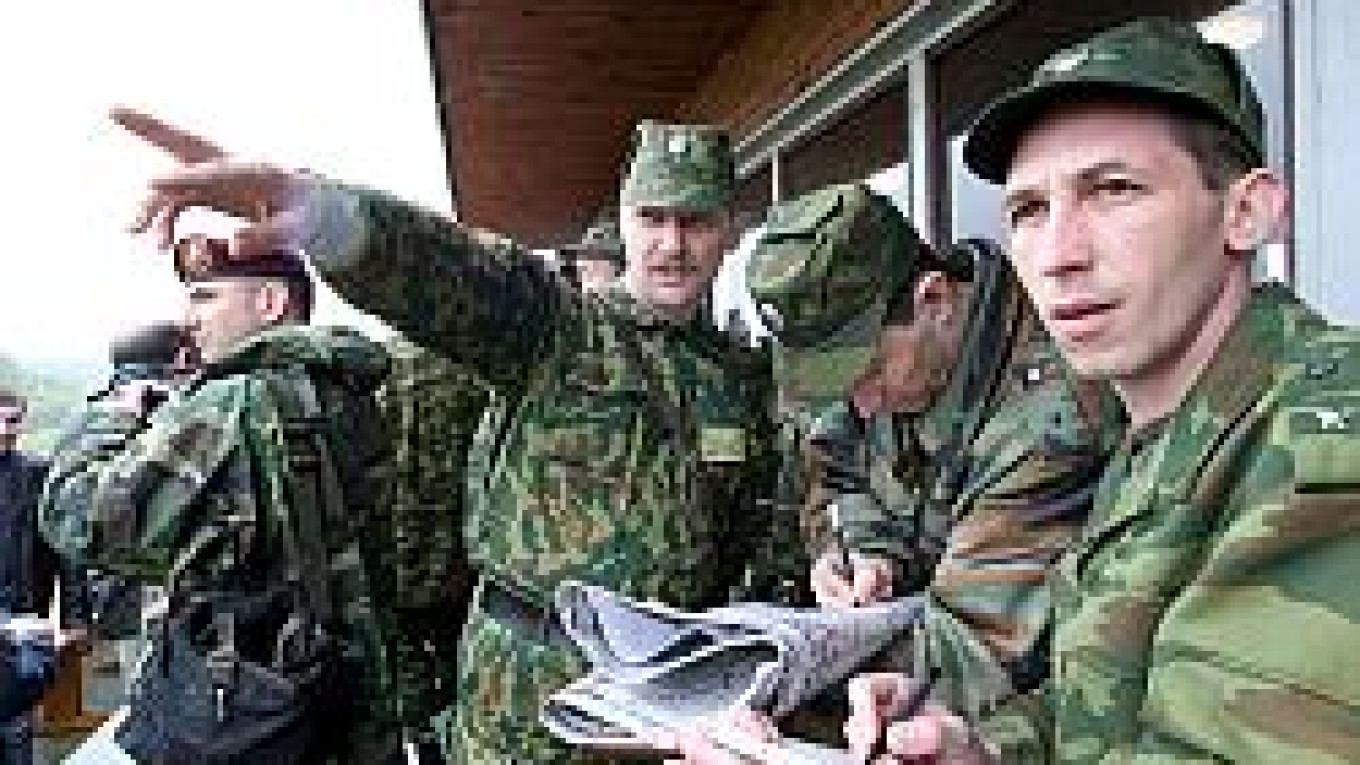
From a watchtower Thursday morning, officers from both brigades looked out over the training center's rain-soaked field as a Russian officer, armed with a pointer, explained the intricacies of the terrain on a model of the grounds.
"We've been back at the academy looking at maps," U.S. Lieutenant Colonel Thomas Collins said. "And now we've come out here to look at the terrain itself to see how we might have to adjust our plan."
U.S. and Russian troops have already conducted real joint peacekeeping operations in the former Yugoslavia, but their interactions have not always been smooth. During the 1999 NATO-led war in Yugoslavia, Russia sent a surprise deployment of 200 troops to Pristina Airport. When the NATO allies found out a day earlier that the Russians were moving men toward Pristina, then-NATO commander General Wesley Clark devised a plan to deploy his own troops to the same Pristina airport, and even ordered British commander General Sir Mike Jackson to send troops to stop the Russian forces.
"I'm not going to start the Third World War for you," Jackson reportedly told Clark.
There was no such apparent tension Thursday, with officers from both sides praising the exercise.
"It's been a complete success," said Major William Harmon, lead planner of the exercise from the U.S. side. "When I joined the Army it was during the Cold War, and I never dreamed that I would be able to do this. I'm very pleased to meet my Russian counterparts and realize that we're not very different after all."
"I think we've learned a lot from each other," Russian Lieutenant Colonel Vladimir Glebov said. "I think we've come to the conclusion that there's no need for us to be divided. We need to fight on the same side, as we did during the Great Patriotic War."
The demonstration of tactical operations was given by 80 Russian soldiers to show how the operation might look, Glebov said.
And while hazing scandals have plagued the Russian Army in recent years, there was only one rather benign example of the practice during the exercise.
Of the 80 Russians, the 50 older academy students were under the joint U.S.-Russian command, while the 30 younger students were stuck with the role of the enemy Badarian militants, or "bandits," as Glebov called them.
"This is the first exercise on such a scale, and it sets a good example" of how the two former Cold War foes should be planning operations together rather than against each other, said Vitaly Shlykov, an independent defense expert and former Russian deputy defense minister.
He said such exercises would enable operational incompatibilities to be identified and avoided during joint actions.
"Differences in training and different cultures would still remain a problem, but at least that would help to avoid tensions," Shlykov said by telephone Thursday.
A Message from The Moscow Times:
Dear readers,
We are facing unprecedented challenges. Russia's Prosecutor General's Office has designated The Moscow Times as an "undesirable" organization, criminalizing our work and putting our staff at risk of prosecution. This follows our earlier unjust labeling as a "foreign agent."
These actions are direct attempts to silence independent journalism in Russia. The authorities claim our work "discredits the decisions of the Russian leadership." We see things differently: we strive to provide accurate, unbiased reporting on Russia.
We, the journalists of The Moscow Times, refuse to be silenced. But to continue our work, we need your help.
Your support, no matter how small, makes a world of difference. If you can, please support us monthly starting from just $2. It's quick to set up, and every contribution makes a significant impact.
By supporting The Moscow Times, you're defending open, independent journalism in the face of repression. Thank you for standing with us.

Remind me later.