

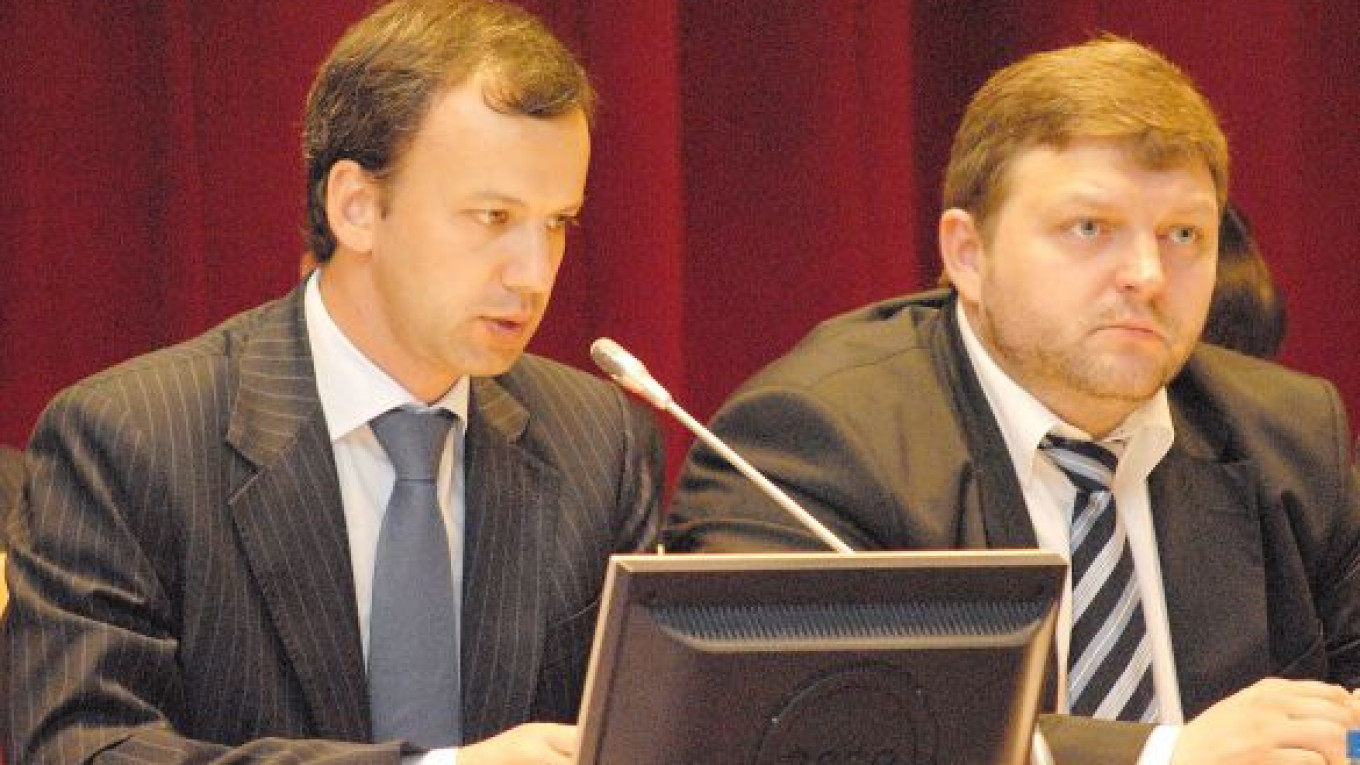
The government should support small energy-generating projects that use biofuel by giving them tax breaks and subsidized interest rates, presidential economic adviser Arkady Dvorkovich said Tuesday.
Dvorkovich has been a key advocate of President Dmitry Medvedev's goal to make Russia 40 percent more energy-efficient by 2020. The government has started pursuing the target by phasing out incandescent bulbs for more energy-efficient lights.
His proposal Tuesday is also the latest effort in a recent Kremlin drive to improve environmental policy. But experts warned that tax breaks might not be the right approach, saying new laws were needed to remove barriers that make small energy projects economically unfeasible.
"Wider use of bio-resources — primarily to develop local, small-capacity energy facilities and to increase the share of bio-resources in energy consumption of certain regions — is one of the key goals," Dvorkovich said during a meeting in the Kirov region on using timber waste and peat.
"We need to determine a legal framework for peat bogs," he said.
Kirov Governor Nikita Belykh applauded biomass-fueled stations as a way to keep heating bills low, calling the region's abundant peat resources "Vyatka gold." Vyatka is the pre-Revolutionary name for Kirov, which Belykh has lobbied to restore.
The Kremlin is "ready" to support such projects with tax breaks, subsidized interest rates on loans and lower customs fees for imported equipment, Dvorkovich said, adding that the issue was considered when the government was drawing up its energy production and consumption estimates.
Last week, the Energy Ministry published a revised general plan for the location of power facilities, which spells out the use of new and existing power capacity through 2030.
Under the updated plan, new low-capacity power plants will make up 1.1 gigawatts in 2021 to 2025, and another 2 gigawatts by 2030, for a total of 3.1 gigawatts. Total new capacity planned before 2030 is 173 gigawatts, according to figures published by the Energy Ministry last week.
A planned 6.1 gigawatts will come from renewable energy sources, equal to less than 2 percent of the total 324-gigawatt capacity by 2030.
But making even such modest increases in the share of renewable energy will be difficult because small generators using the technology have no way to sell energy to the grid.
Grid operators prefer generators with a guaranteed power supply, which small, biomass stations would not be able to provide, said Mikhail Yulkin, director of the Environmental Investment Center, who has served as consultant on several biomass energy projects.
The problem could be resolved if a bill is passed requiring grid operators to first purchase power from generators using renewable resources. The government has until Sept. 1 to "take measures directed at required purchases of power generated from renewable resources," according to a list of Medvedev's orders given at the State Council. The list was published on the Kremlin's web site Monday.
Yulkin said, however, that inadequate waste legislation is also an obstacle.
While paper mills often choose to optimize their own energy usage by installing woodchip-fueled boilers, many timber mills that use less energy end up throwing out 40 percent to 50 percent of their initial product.
"There needs to be a law on waste management that would require these companies to send their waste to a biomass-powered generator, if there is one nearby," he said.
Once it is easy to access biofuel and sell power to the grid, the market will take care of itself without additional state subsidies, he said, warning that "lowering customs duties would kill domestic equipment producers."
A Message from The Moscow Times:
Dear readers,
We are facing unprecedented challenges. Russia's Prosecutor General's Office has designated The Moscow Times as an "undesirable" organization, criminalizing our work and putting our staff at risk of prosecution. This follows our earlier unjust labeling as a "foreign agent."
These actions are direct attempts to silence independent journalism in Russia. The authorities claim our work "discredits the decisions of the Russian leadership." We see things differently: we strive to provide accurate, unbiased reporting on Russia.
We, the journalists of The Moscow Times, refuse to be silenced. But to continue our work, we need your help.
Your support, no matter how small, makes a world of difference. If you can, please support us monthly starting from just $2. It's quick to set up, and every contribution makes a significant impact.
By supporting The Moscow Times, you're defending open, independent journalism in the face of repression. Thank you for standing with us.

Remind me later.