

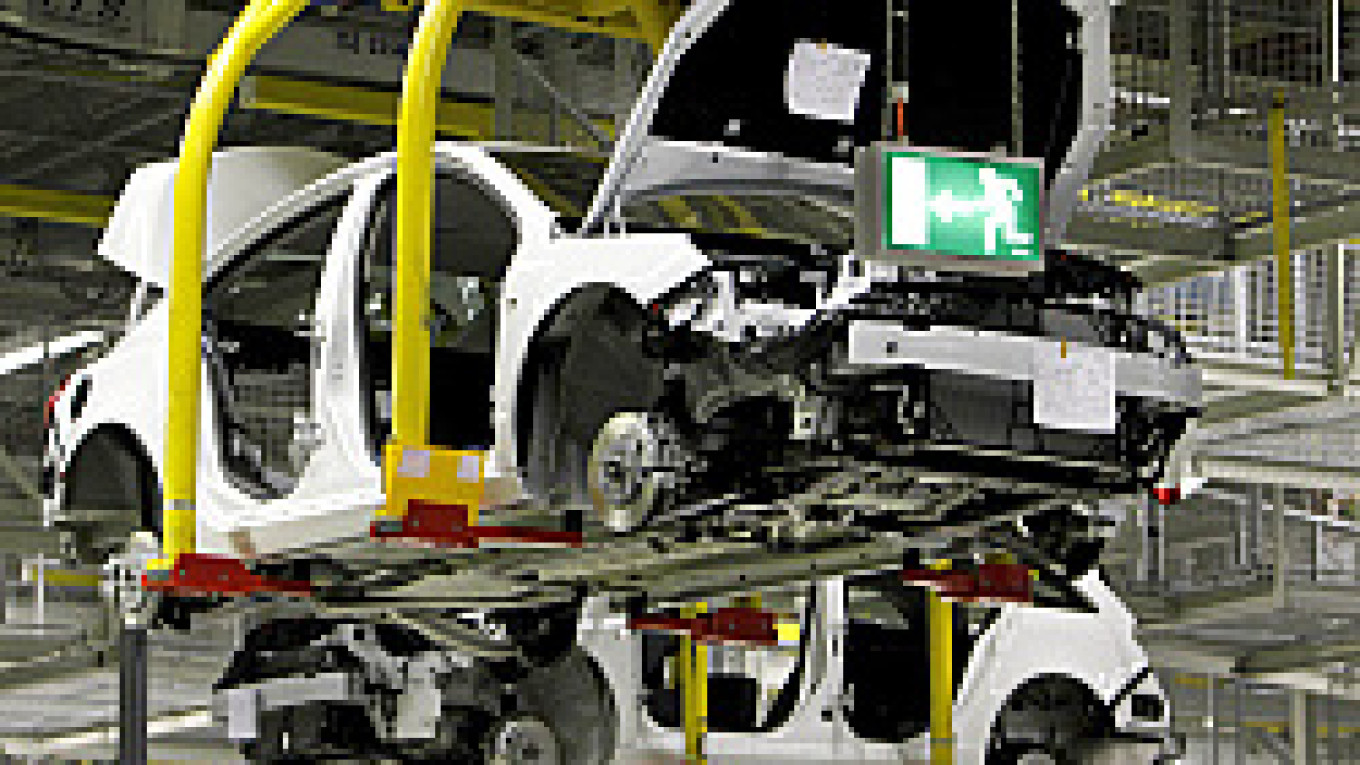
Chancellor Angela Merkel's government picked on May 30 a partnership led by Magna International, a Canadian auto parts supplier, with Sberbank and GAZ as the sole bidder for Opel, the European division of GM, which filed for bankruptcy protection on Monday.
"This will fuel suspicion in East Europe over Germany and Russia and why the biggest economy in Europe has tied up with strange Russian tycoons to please the Kremlin," said Fredrik Erixon, director of the European Center for International Political Economy. "Germany is playing off the Poles and the Baltic states against Russia."
Germany is Russia's biggest trade partner, a relationship underpinned by rising German gas and oil imports. Annual German trade with Russia increased fivefold to 68.2 billion euros ($96.2 billion) last year since 2000. With 6,000 German companies operating in Russia, business leaders in Berlin view the global recession as a speedbump, with manufacturers set to win contracts as Russia diversifies from energy and rebuilds transport and health care.
Under the Magna proposal, the Canadian company would get a 20 percent stake in GM's Opel and Vauxhall divisions in Europe. Sberbank would own 35 percent, matching the remaining holding of GM. Magna co-CEO Siegfried Wolf has described GAZ as its industrial partner.
On Monday, Prime Minister Vladimir Putin said he hoped that the deal would blend in with the general strategy of the Russian auto industry but emphasized that the state didn't play a direct role.
"The existing difficult conditions of the economic crisis will nevertheless create conditions for diversifying our interaction with leading European countries," he said, Interfax reported.
He also expressed a hope that Magna would expand its own operations in the country.
The Polish government fears that Europe's increasing energy dependence on Russian energy via Nord Stream ?€” which will run from Russia directly to Germany under the Baltic Sea ?€” might allow Russia to cut gas supplies to Eastern Europe while still supplying Germany and western Europe.
Poland's opposition leader, Jaroslaw Kaczynski, expressed concern that Opel risks cutting more jobs in his country than at plants in Germany, Belgium, and Britain. "The Polish government should intervene in Germany and with the Russian bank to make sure Polish jobs are guaranteed at the Opel plant," he told reporters Monday. "Why are we treated according to different, worse conditions in Europe than other countries?"
Opel is part of a bigger picture given that Russia views Germany as a key to its global economic policy, said Jan Techau, a European and security expert at the Berlin-based German Council on Foreign Relations.
The move makes sense for Opel because Russia is set to become Europe's largest car market, said Ferdinand Dudenhoeffer, director of the Center for Automotive Research at the University of Duisburg-Essen in Germany.
Russia is almost as crucial for German exports as China, and Merkel ?€” who grew up in communist East Germany ?€” has sometimes adopted policies linked to Russia that are opposed by Eastern Europeans. These range from Nord Stream to her rejection of fast-tracking former Soviet republics Ukraine and Georgia for NATO membership.
For Germany, closer ties to Russia may also mark a bid to ensure a pivotal diplomatic role as the world's center of gravity shifts away from Europe and President Barack Obama focuses on the Middle East and Asia, says Techau.
"U.S.-Russian relations play out at a different level including security, the soft underbelly of Russia in Central Asia and North Korea," he said. "These are areas where Europe is a small player, and it's the Europeans who should be concerned that the new Obama policy will squeeze them out of their old mediator role between Moscow and Washington."
A Message from The Moscow Times:
Dear readers,
We are facing unprecedented challenges. Russia's Prosecutor General's Office has designated The Moscow Times as an "undesirable" organization, criminalizing our work and putting our staff at risk of prosecution. This follows our earlier unjust labeling as a "foreign agent."
These actions are direct attempts to silence independent journalism in Russia. The authorities claim our work "discredits the decisions of the Russian leadership." We see things differently: we strive to provide accurate, unbiased reporting on Russia.
We, the journalists of The Moscow Times, refuse to be silenced. But to continue our work, we need your help.
Your support, no matter how small, makes a world of difference. If you can, please support us monthly starting from just $2. It's quick to set up, and every contribution makes a significant impact.
By supporting The Moscow Times, you're defending open, independent journalism in the face of repression. Thank you for standing with us.

Remind me later.