

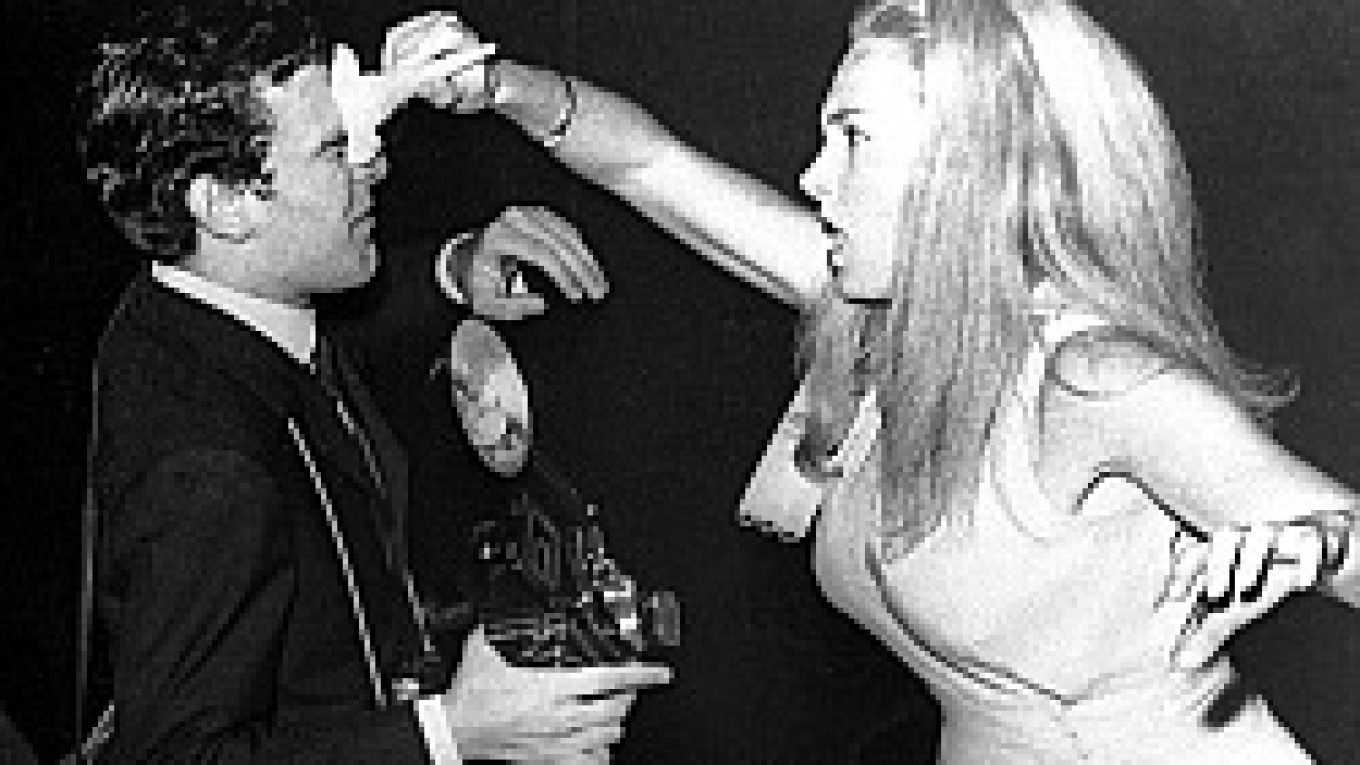
The outdoor display of photographs from Rino Barillari's series "La Dolce Vita" depicts a lifestyle that looks rather sweet indeed: Rome in the 1950s at the height of its popularity as a set for big movie productions.
Barillari has proclaimed himself "King" in a profession with dubious claims to respectability -- that of celebrity photographer. Early photographs of celebrity life on Via Veneto include pictures of the photographer having had an ice cream shoved in his face by Sonia Romanoff. Celebrity wrath has inflicted many wounds on Barillari throughout his long career, including 11 broken ribs and many more broken cameras.
In those early photos, young Barillari, a country boy from provincial Calabria, is shown lugging a camera the size of a small briefcase.
Today, he relies on modern equipment. As the press bombarded him with questions and shutter clicks at the news conference last week, he periodically raised his camera and took a few shots of the audience. With his hair and moustache no longer jet black, and his gait tainted by a broken hip (acquired in the course of rescuing a Tunisian prostitute from a Roman pimp), it was like seeing Marcello Mastroianni reincarnated in a Guy Ritchie film. "The 1960s were the best days of my career," Barillari said. Then, he raced around the Italian capital, directed by a large network of informers, who tipped him off on celebrities' whereabouts. Forty-nine years later, he said, the same people are working for him, only now relying on mobile phones and text messages.
Photos from beyond the "Dolce Vita" period include unflattering shots of Hollywood celebrities like Brad Pitt running from the police, and George Clooney looking awkward and encircled by bodyguards. Barillari himself is shown hiding in the trunk of a car with a telephoto lens. It's a stark contrast with an image from the 1960s in which he's walking alongside Audrey Hepburn, offering her a hand with a package she's holding. Both are smiling, slightly tense, with no bodyguards present.
The modern photos are nothing we haven't seen on the hundreds of Internet fan sites, where digital photos can be funneled straight from mobile phones. "Anyone can become a paparazzi," Barillari said. But the Dolce Vita pictures, made before the era of mobile phones, offer a nostalgic glimpse of the past from perhaps the most famous name in the business.
The open-air exhibit on Stoleshnikov Pereulok runs to Oct. 10.
A Message from The Moscow Times:
Dear readers,
We are facing unprecedented challenges. Russia's Prosecutor General's Office has designated The Moscow Times as an "undesirable" organization, criminalizing our work and putting our staff at risk of prosecution. This follows our earlier unjust labeling as a "foreign agent."
These actions are direct attempts to silence independent journalism in Russia. The authorities claim our work "discredits the decisions of the Russian leadership." We see things differently: we strive to provide accurate, unbiased reporting on Russia.
We, the journalists of The Moscow Times, refuse to be silenced. But to continue our work, we need your help.
Your support, no matter how small, makes a world of difference. If you can, please support us monthly starting from just $2. It's quick to set up, and every contribution makes a significant impact.
By supporting The Moscow Times, you're defending open, independent journalism in the face of repression. Thank you for standing with us.

Remind me later.