
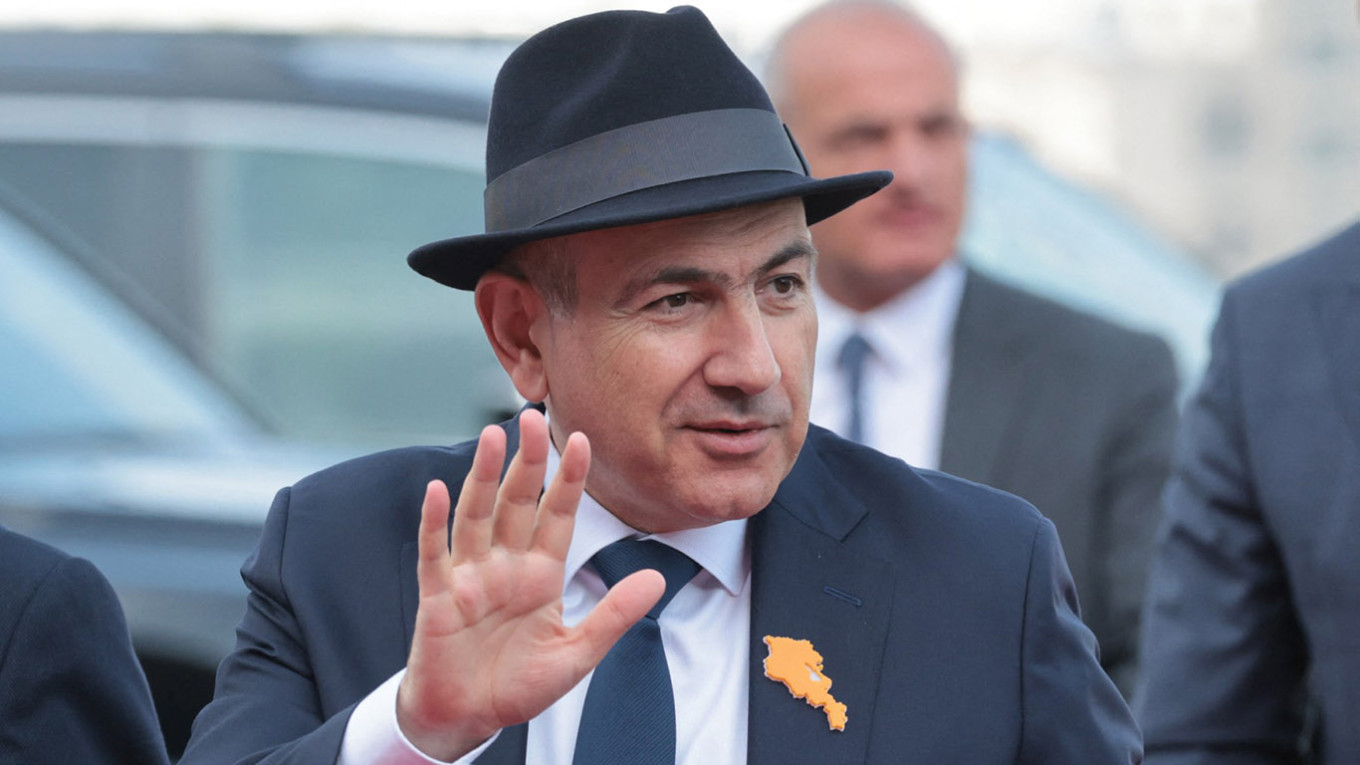
Years of slowly growing tensions between Yerevan and Moscow have crescendoed in recent weeks as Armenia prepares for national elections on June 7. The competition is expected to be riddled with attempts by Moscow to exert its influence.
In April, Armenia hosted the European Political Community (EPC) summit. For comparatively small Armenia, historically aligned with Russia, it is difficult to overstate the importance of a diplomatic event that brought dozens of European leaders to Yerevan. The event was especially memorable as Volodymyr Zelensky became the first Ukrainian president in 24 years to visit Armenia.
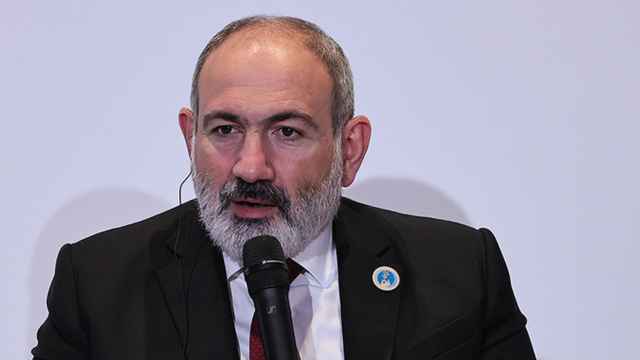
A few days later, Pashinyan skipped his usual trip to Moscow for Russia’s all-important May 9 Victory Day commemoration. Even as Armenia had begun to drift away from Russian influence in recent years, Pashinyan had continued to attend the symbolically important parade.
The next day, statements from Russian officials about Armenia became increasingly hostile. In reference to the EPC, Kremlin spokesman Dmitry Peskov said that the meeting platformed “anti-Russian statements” with no balance provided by Armenia’s leadership. He went on to say the event was “inconsistent with the spirit of relations” between Armenia and Russia.
Separately, Russian President Vladimir Putin commented on Armenia’s fledgling EU aspirations, saying Yerevan should hold a referendum on the issue. But, tellingly, he also remarked, “We all see what's happening with Ukraine now. But where did it all start? With Ukraine's attempt to join the EU.”
Pashinyan and his Civil Contract party will face off against a divided opposition field, where the frontrunners are Russian-Armenian billionaire Samvel Karapetyan (currently under house arrest following anti-government comments) and former President Robert Kocharyan.
Leaked documents and reporting point to extensive Russian efforts aimed at minimizing Pashinyan’s vote share. Sergei Kiriyenko, a top Kremlin official whose portfolio includes policy toward the occupied Ukrainian and Georgian territories, is believed to be heading up the effort from Moscow. In Armenia, activity by a network of Russian FSB and SVR intelligence operatives has grown in recent years. Hostile media campaigns have already been linked to Moscow and Armenian officials have claimed Russia is pressuring the large Armenian diaspora to support the Kremlin’s preferred factions.
For Moscow, there is a clear interest in displacing Pashinyan — or simply sowing chaos in Yerevan on election day.
Under Pashinyan, Armenia has slowly moved out of Russia’s orbit as Moscow failed to deter Azerbaijani advances in Nagorno-Karabakh. Pashinyan has forged better ties with Brussels and Washington, switched from Russian arms purchases to agreements with France and India and even set EU membership as an eventual goal for the country — although an undoubtedly far-off one. His party’s domestic rhetoric has taken a sharply anti-Russian tone, labeling opponents “Russian agents” and blaming the KGB for sowing hatred between Armenians, Azerbaijanis and Turks.
On the other hand, opposition figures like Karapetyan and Kocharyan are viewed as more Russia-friendly. Karapetyan spent much of his career and built much of his fortune in the country. He is a dual citizen of Russia and Armenia, and maintains business interests in Russia. There is also evidence that he remains a member of the pro-Russian Lazarev Club, which aims to strengthen links between Moscow and Yerevan. Meanwhile, Kocharyan has been more explicitly pro-Russian, having stated last year that Armenia “must restore our strategic partnership with Russia.”
For both men, the real threat to Armenia is not Russia, but Azerbaijan and Turkey. They have labeled Pashinyan a lackey of Azerbaijan and said Pashinyan will allow hundreds of thousands of Azerbaijanis to be settled in Armenia in the coming years.
Anticipating Russian influence attempts, Pashinyan has requested that EU monitoring teams be deployed to Armenia, with Brussels obliging his request.
However, recent Russian influence campaigns have a mixed track record. In Moldova, while they helped nearly defeat a referendum to codify aspirations for EU membership in 2024, they failed to prevent a decisive victory for the pro-EU Party of Action and Solidarity in 2025’s parliamentary elections. In the aftermath, Moscow created the Presidential Directorate for Strategic Partnership and Cooperation. Vadim Titov, its Kremlin-appointed leader, traveled to Hungary in the run-up to the 2026 elections. Yet despite any Kremlin influence efforts, Péter Magyar’s party still sailed to a landslide victory.
In Armenia, there is reason to think Russian efforts will meet another difficult environment. Among likely voters, Pashinyan’s bloc decisively tops opinion polling. One recent poll found 33% of likely voters backing Pashinyan’s Civil Contract. Karapetyan’s Strong Armenia came in second at only 11.4% of voters, while Kocharyan’s Armenian Alliance came in third at 4.2%.
Armenia’s opposition is divided, demoralized and constrained by targeted pressure by Pashinyan’s government. Karapetyan and several of his allies have been arrested on a variety of charges, with many viewing their arrests as politically motivated.
Armenian citizens have long reported being disenchanted with politics. However, any exhaustion or skepticism directed toward Pashinyan does not appear to be translating into support for the opposition, itself connected to the governments and projects of the past. Since Pashinyan’s high-profile Washington summit with U.S. President Donald Trump and Azerbaijan’s Ilham Aliyev, an increasing share of Armenians actually have positive expectations for the future. Pashinyan has proved capable of attracting American and European attention and money. His long-stalled normalization program with Turkey and Azerbaijan at long last seems to be bearing fruit.
In such conditions, the extent to which Russian influence efforts can achieve success is unclear. This is not to say the Kremlin has no cards to play in Armenia. The Moldovan referendum of 2024 showed that Russian electoral efforts abroad can be impactful if they actually use local networks to engage in vote-buying, bussing or other mobilization tactics. A decisive choice may be whether Russian officials engage in this kind of direct organizational strategy. If turnout is low in the elections, it will maximize any benefits to this kind of Russian mobilization. Still, with Pashinyan having constrained his adversaries already, it is difficult to picture the prime minister allowing such tactics to unseat him.
From a long-term view, Russia still wields a great deal of economic influence over Yerevan. Russian state companies like Gazprom and Rosatom still have what amounts to a monopoly over Armenian energy and gas. Critical infrastructure, such as railroads, is likewise owned by Russian state firms — although Pashinyan has said he wishes to change this.
At the popular level, a large share of Armenia’s public still views Russia as a critical partner, not an enemy. As with other post-Soviet countries close to Russia, the future of Yerevan’s foreign policy seems more likely to be a mixed approach rather than one that cuts Moscow off totally.
However, the dominant trend in much of the former U.S.S.R. since 2022 is a decline in Russia’s political centrality. Except for Belarus, no former Soviet states have backed Russia’s war in Ukraine. Nearly all have sought better relations with Europe and the United States, and the once symbolically central Victory Day parades and intergovernmental meetings have faded from their past importance. Aliyev skipped the May 9 parade this year for the second year in a row without any great consternation.
The EU has poured hundreds of millions of euros into Armenia since 2020. Russia has not. With Armenia now a member of the International Criminal Court, Putin has not even visited the country since November 2022.
Of all post-Soviet states, arguably only Georgia and Belarus have drawn closer to Russia in recent years. Having made a decisive move away from Moscow, it is difficult to imagine Armenia turning back without some drastic transformation, no matter what tactics are deployed during the upcoming elections.
A Message from The Moscow Times:
Dear readers,
We are facing unprecedented challenges. Russia's Prosecutor General's Office has designated The Moscow Times as an "undesirable" organization, criminalizing our work and putting our staff at risk of prosecution. This follows our earlier unjust labeling as a "foreign agent."
These actions are direct attempts to silence independent journalism in Russia. The authorities claim our work "discredits the decisions of the Russian leadership." We see things differently: we strive to provide accurate, unbiased reporting on Russia.
We, the journalists of The Moscow Times, refuse to be silenced. But to continue our work, we need your help.
Your support, no matter how small, makes a world of difference. If you can, please support us monthly starting from just $2. It's quick to set up, and every contribution makes a significant impact.
By supporting The Moscow Times, you're defending open, independent journalism in the face of repression. Thank you for standing with us.

Remind me later.