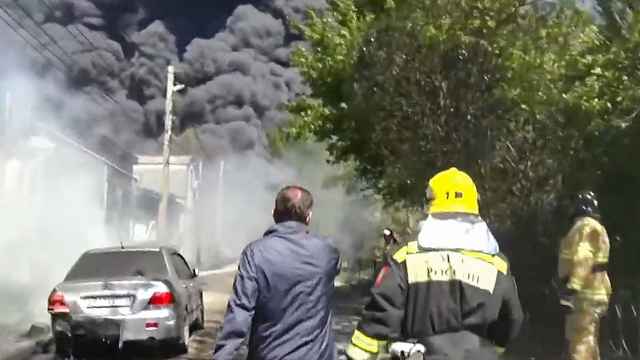

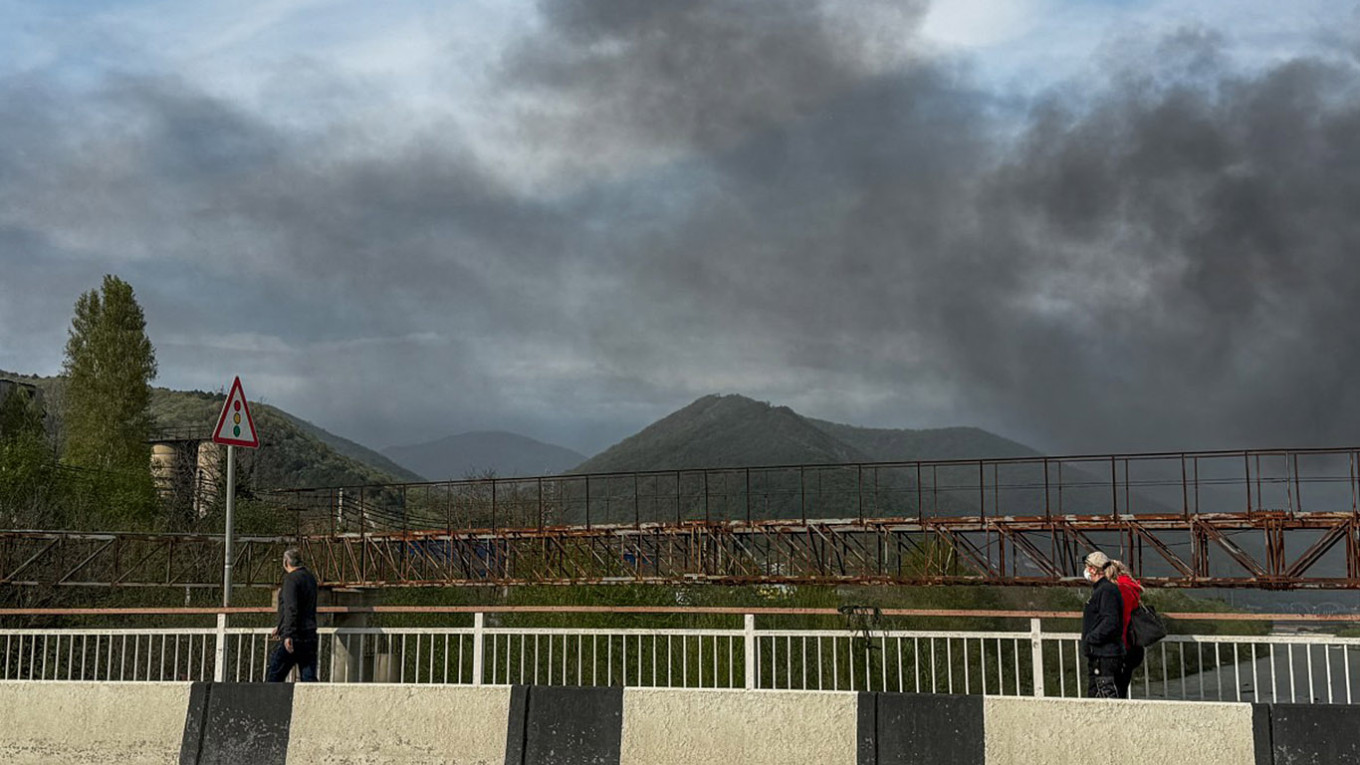
No sooner had local officials declared that they had finally brought under control a fire that raged for days at an oil refinery in Tuapse, a port town on Russia's Black Sea coast, than it flared up again.
The blaze is visible from as far away as Sochi — and even from space. Satellite images show vast oil slicks spreading across the sea. Online, volunteers are posting videos of dead marine life, including dolphins, their bodies coated in crude.
How much oil has already been spilled: hundreds of tons, or thousands? No one seems to know.
President Vladimir Putin said Tuesday that there were “no serious threats in Tuapse, and people are managing to cope with the challenges they face on the ground.” Governor Venyamin Kondratyev told him so, he said.
Putin is no stranger to calamity, or to minimizing it. But it is worth taking a look at what is actually happening.
The inferno first erupted last week. Storage tanks filled with petroleum products burned, sending columns of black smoke visible more than 100 kilometers away.
The volume of combustion byproducts released into the air was so large that Tuapse experienced what residents called “oil rain,” because it felt like the city had been doused with oil. A film resembling an oil slick settled on streets, plants, people and any pets or stray animals that happened to be outside at the wrong time.
That film contains a toxic mix of pollutants, including carcinogens such as benzene. Because the fire is still burning, dangerous concentrations of these substances persist in the air. Black rain may well continue.
Officials say levels of harmful substances are two to three times above what is considered safe.
To paraphrase a Russian proverb, lying is nothing compared to lifting sacks. Talk is cheap.
There is no reliable independent data, but it is hard to imagine that concentrations near the fire are merely double or triple permissible limits. More likely, they are dozens, perhaps hundreds, of times higher.
Last week, roughly 60% of the facility’s storage capacity was on fire. Now the rest is burning.
The resulting clouds of soot and carcinogens are especially dangerous for children, the elderly and those with cardiovascular or respiratory conditions. People with fragile health are already feeling the effects. The rise in cancer rates will come later; that is how such exposures work.
And when the fire finally burns out, the disaster will not end. Toxic residues left behind by the fires and the oily rains will remain in the environment, re-entering human bodies again and again.
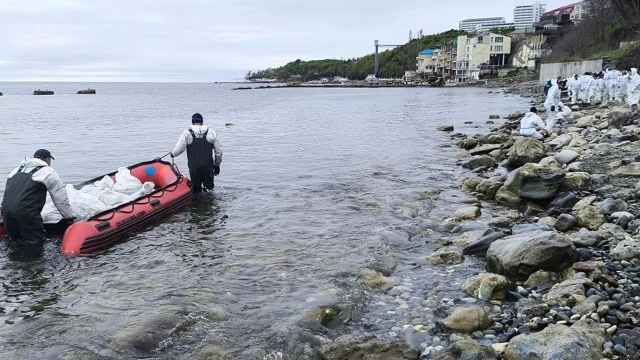
Nor is the damage confined to the air. At least several hundred tons of petroleum products have spilled into the Tuapse River and the Black Sea. Satellite imagery showed large slicks as early as last week; the leakage continued this week. The impact on marine ecosystems and the coastline will be severe. Drinking water contamination is a real risk.
To understand what may come next, one need only recall the spill in the Black Sea at the end of 2024, which saw thousands of tons of oil products released. Fish, mollusks, dolphins and birds died in large numbers.
As then, volunteers are now desperately scrambling to respond while Putin and Governor Kondratyev tell the country that there are no serious problems.
Remember those videos where they’re cleaning oil off the birds? Well, most of them die anyway. I don’t mean to say that washing the birds is pointless — some of them will survive. Just not many.
Even if the visible oil is removed from beaches, the problem will linger for years. Each storm will dredge buried petroleum products back up to the surface. Effective, repeated cleanup requires sustained resources and political will, both of which are in short supply given the war in Ukraine and the crisis in the global oil market.
In my more than 35 years of environmental work, I cannot recall a single instance in which the Russian authorities were prepared for an emergency. They always take a long time to decide what to do at the outset of a crisis, when time is of the essence.
A proper response to a major refinery fire would begin with clear public guidance: stay indoors, close windows, limit exposure. It would include the distribution of effective protective equipment — not surgical masks, but respirators capable of filtering fine particles — and, crucially, early evacuation to areas with clean air.
Reports of evacuations suddenly appeared on Tuesday. In reality, residents of a few streets were moved to a nearby school, still within the zone of contamination, rather than taken somewhere where the air isn’t polluted with carcinogens.
This catastrophe is part of the broader consequences of the senseless and bloody war Putin unleashed more than four years ago. He isn’t bothered by the hundreds of thousands of Russian and Ukrainian military deaths for which he bears direct responsibility, so it’s naive to expect him to care about burning oil tanks and poisoned seas.
And things will only get worse.

A Message from The Moscow Times:
Dear readers,
We are facing unprecedented challenges. Russia's Prosecutor General's Office has designated The Moscow Times as an "undesirable" organization, criminalizing our work and putting our staff at risk of prosecution. This follows our earlier unjust labeling as a "foreign agent."
These actions are direct attempts to silence independent journalism in Russia. The authorities claim our work "discredits the decisions of the Russian leadership." We see things differently: we strive to provide accurate, unbiased reporting on Russia.
We, the journalists of The Moscow Times, refuse to be silenced. But to continue our work, we need your help.
Your support, no matter how small, makes a world of difference. If you can, please support us monthly starting from just $2. It's quick to set up, and every contribution makes a significant impact.
By supporting The Moscow Times, you're defending open, independent journalism in the face of repression. Thank you for standing with us.

Remind me later.