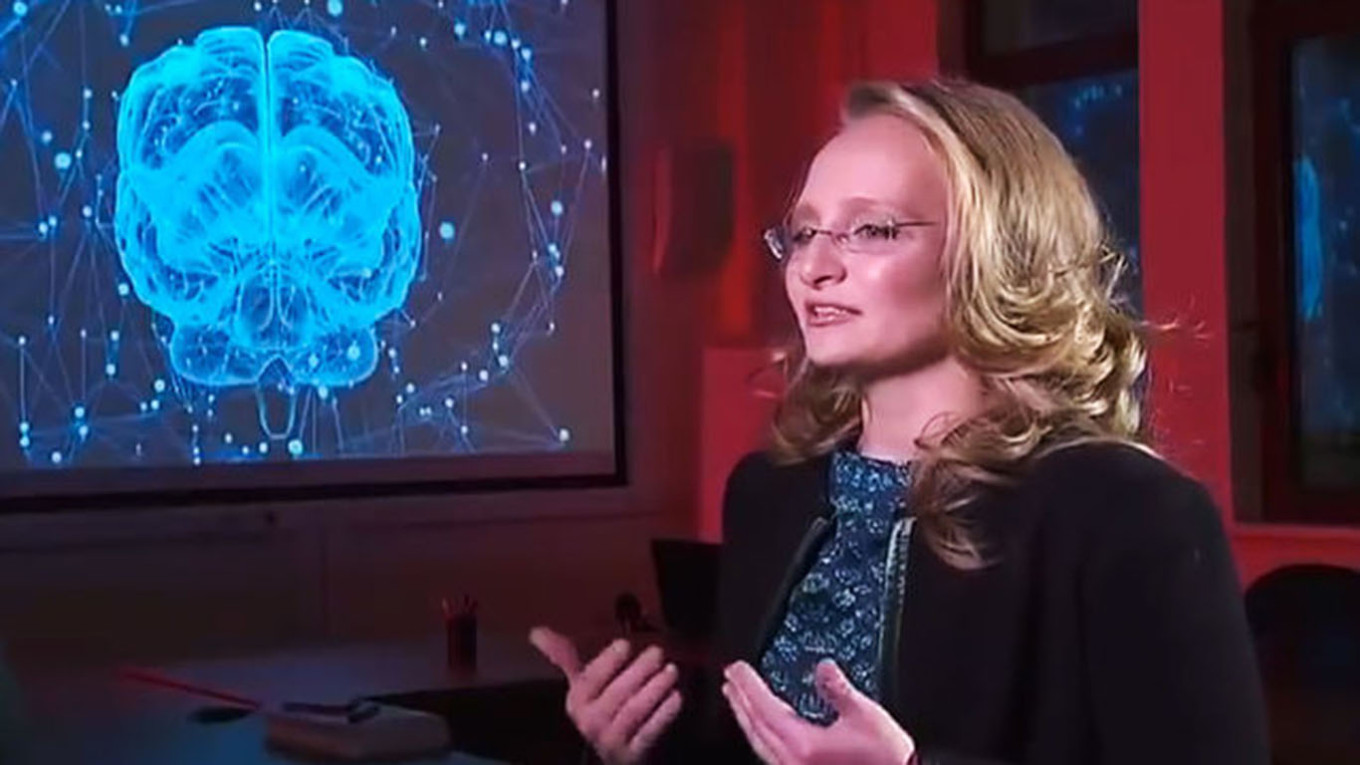
Moscow State University (MGU) has completed the creation of a closed artificial intelligence hub built around Katerina Tikhonova, the director of the university’s Institute of Artificial Intelligence and an alleged daughter of President Vladimir Putin, the independent outlet T-Invariant reported.
The project gives Tikhonova control over one of Russia’s most advanced AI education and research ecosystems, consolidating an institute, a newly launched faculty, a research center and the university’s new MGU-270 supercomputer on the Vorobyovy Gory (Sparrow Hills) campus in Moscow.
The development comes as the Kremlin pushes to expand domestic AI capabilities despite Western sanctions and export controls that have restricted Russia’s access to advanced semiconductors and computing hardware.
It also underscores the prominent role of Putin’s family members in strategically important sectors tied to technology and national development.
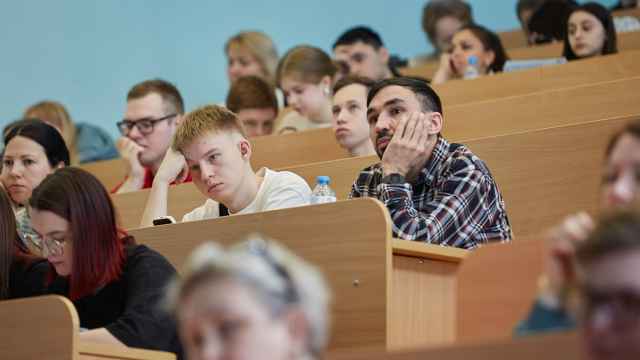
MGU officially announced the launch of its Faculty of Artificial Intelligence on April 21.
The faculty is headed by Ivan Oseledets, a doctor of physical and mathematical sciences, professor at the Russian Academy of Sciences and chief executive of the AI research institute AIRI.
“We are admitting 36 undergraduate students, including 20 state-funded places, and 36 master’s students, also with 20 state-funded places,” Oseledets said.
Annual tuition is set at around 500,000 rubles ($6,650).
One member of the Russian Academy of Sciences questioned the decision to establish a separate faculty rather than integrating AI into existing departments.
“Does AI really need to be separated out? Why is this a new faculty and not a department? I do not understand,” the scientist told T-Invariant. “It reflects a ‘king of the hill’ logic — staking out territory for yourself.”
The project is financially backed by billionaire Oleg Deripaska, founder of aluminum giant Rusal, and state-owned lender VTB Bank.
According to the report, the faculty’s projects rely on foreign-made chips despite Russia’s efforts to localize critical technologies. The MGU-270 supercomputer is built on Nvidia graphics processors acquired through gray imports via Chinese companies and under the fictitious brand Solar Peak.
Access to the system is reportedly restricted even for specialists from MGU’s Research Computing Center.
“If you watch the Channel One news program Vremya, they show the old Lomonosov-2 supercomputer, not MGU-270,” one source in the scientific community told T-Invariant. “That means even the television crew was not allowed in. No one is allowed near the new supercomputer, even inside the university, except for a narrow circle of insiders.”
Another researcher said colleagues at the computing center had been unable to access the project.
“For the second year I have been asking what is happening there under Tikhonova. They just shrug — they are not allowed in,” the researcher said, adding that staff learned about both the new faculty and the launch of the supercomputer from news reports.
Tikhonova’s AI projects are also expected to deepen cooperation with China. Discussions are underway on creating joint laboratories with the Russian-Chinese Shenzhen MGU-BIT University, known in Russian as MGU-PPI University in Shenzhen.
In November 2025, the university announced plans for two new labs: one focused on nanostructured optoelectronic functional materials and devices, and another dedicated to AI algorithms and their applications.
MGU also plans to create a robotics park in the new AI faculty building to support the development of AI-driven control systems.
Read this article in Russian at The Moscow Times' Russian service.
A Message from The Moscow Times:
Dear readers,
We are facing unprecedented challenges. Russia's Prosecutor General's Office has designated The Moscow Times as an "undesirable" organization, criminalizing our work and putting our staff at risk of prosecution. This follows our earlier unjust labeling as a "foreign agent."
These actions are direct attempts to silence independent journalism in Russia. The authorities claim our work "discredits the decisions of the Russian leadership." We see things differently: we strive to provide accurate, unbiased reporting on Russia.
We, the journalists of The Moscow Times, refuse to be silenced. But to continue our work, we need your help.
Your support, no matter how small, makes a world of difference. If you can, please support us monthly starting from just $2. It's quick to set up, and every contribution makes a significant impact.
By supporting The Moscow Times, you're defending open, independent journalism in the face of repression. Thank you for standing with us.

Remind me later.