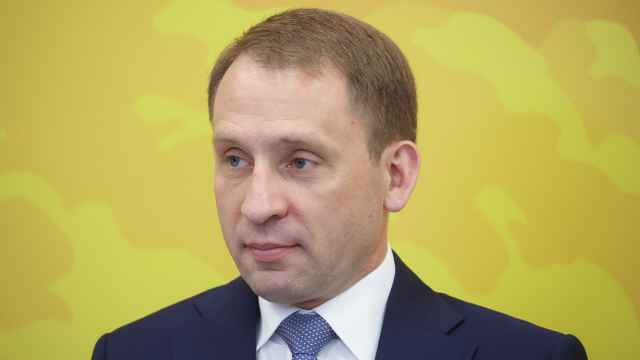
Russia’s government warned it will scale back new support for businesses as mounting fiscal pressures limit its ability to sustain the stimulus that helped drive recent economic growth, Economic Development Minister Maxim Reshetnikov said Friday.
Speaking at an entrepreneurship forum, Reshetnikov said the state would honor existing commitments but offer fewer new subsidies and concessional loans.
“We will never abandon the obligations we have already taken on. But, of course, new disbursements will be much more modest,” he said.
The shift underscores a broader turning point for Russia’s economy, which is slowing after a period of rapid, state-driven expansion that relied heavily on spare labor, industrial capacity and fiscal reserves — many of which are now largely exhausted.
Reshetnikov urged businesses to invest and create jobs but acknowledged that companies would increasingly have to rely on their own resources.
“We have learned to do this, but in conditions of a relatively calm labor market,” he said. “We managed because there were reserves somewhere in the economy. Now these reserves are largely depleted, and the situation is significantly more complex.”
Russia’s economy grew by 4.1% in 2023 and 4.9% in 2024, driven in part by mobilizing idle resources. Officials say those buffers have now been used up.
Deputy Kremlin chief of staff Maxim Oreshkin has pointed to a shrinking labor pool, with unemployment falling to a record low of 2.1% in February.
Central Bank Governor Elvira Nabiullina has said production capacity is also near its limit, while fiscal and financial reserves have been drawn down.
Liquid assets in the National Wealth Fund have dropped to 3.9 trillion rubles ($51.5 billion), from 8.4 trillion rubles ($110.9 billion) before the war.
Banks, too, have less capital headroom, while high oil revenues are increasingly being directed toward debt repayment rather than new lending, she has said.
Without those supports, growth has slowed sharply. The economy expanded by just 1% in 2025, while GDP in January-February was 1.8% lower than a year earlier, though fewer working days may have skewed the comparison.
Budget constraints are tightening. The federal deficit reached 5.6 trillion rubles ($73.9 billion), or 2.6% of GDP, in 2024, and in the first quarter of 2026 alone hit 4.6 trillion rubles ($60.7 billion), or 1.9% of GDP, already exceeding the full-year target.
One of the main pressures on public finances is the cost of subsidizing interest rates. The Central Bank estimates that subsidized loans total around 17 trillion rubles ($224.4 billion), including roughly 4.5 trillion rubles ($59.4 billion) in state-backed lending programs across sectors such as small business and agriculture.
This includes about 1.4 trillion rubles ($18.5 billion) in loans under small and medium-sized enterprise (SME) support programs, more than 2 trillion rubles ($26.4 billion) in concessional loans for agriculture and nearly 1 trillion rubles ($13.2 billion) for borrowers in other sectors.
With interest rates still high, the fiscal burden of these programs has risen sharply. Each additional percentage point in the key rate costs the budget about 280 billion rubles ($3.7 billion), according to Andrei Makarov, head of the State Duma’s Budget and Taxes Committee.
“We continue to implement all existing support measures,” Reshetnikov said. “But the current situation, including the budget, does not mean we will subsidize lending programs or distribute grants at the same scale as during Covid.”
Instead, the government is shifting its focus toward encouraging companies to raise equity financing.
“Our vector is moving away from debt-based support — subsidizing interest rates — toward supporting capital in various forms,” Reshetnikov said. “We will develop programs to help more mature businesses access IPOs.”
The Central Bank has long pushed for such a shift, arguing that widespread subsidized lending reduces the effectiveness of monetary policy by dampening the impact of interest rate changes.
“Why don’t companies go to the capital market?” Nabiullina said previously. “Because there are too many subsidized loans.”
President Vladimir Putin has set a goal of doubling the capitalization of Russia’s stock market to 66% of GDP by 2030, from 33% in 2024. But market capitalization has since fallen by roughly one-third.
Achieving the target would require annual initial public offerings worth at least 1 trillion rubles ($13.2 billion) over several years, said Central Bank First Deputy Governor Vladimir Chistyukhin — roughly equal to the total volume of IPOs over the past decade.
Read this article in Russian at The Moscow Times' Russian service.
A Message from The Moscow Times:
Dear readers,
We are facing unprecedented challenges. Russia's Prosecutor General's Office has designated The Moscow Times as an "undesirable" organization, criminalizing our work and putting our staff at risk of prosecution. This follows our earlier unjust labeling as a "foreign agent."
These actions are direct attempts to silence independent journalism in Russia. The authorities claim our work "discredits the decisions of the Russian leadership." We see things differently: we strive to provide accurate, unbiased reporting on Russia.
We, the journalists of The Moscow Times, refuse to be silenced. But to continue our work, we need your help.
Your support, no matter how small, makes a world of difference. If you can, please support us monthly starting from just $2. It's quick to set up, and every contribution makes a significant impact.
By supporting The Moscow Times, you're defending open, independent journalism in the face of repression. Thank you for standing with us.

Remind me later.