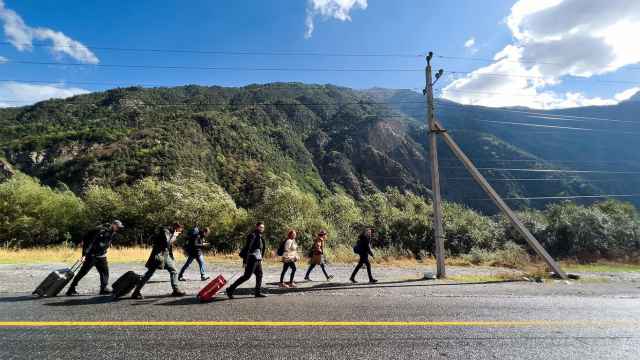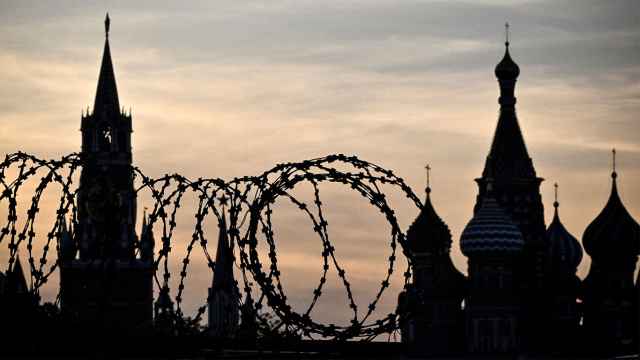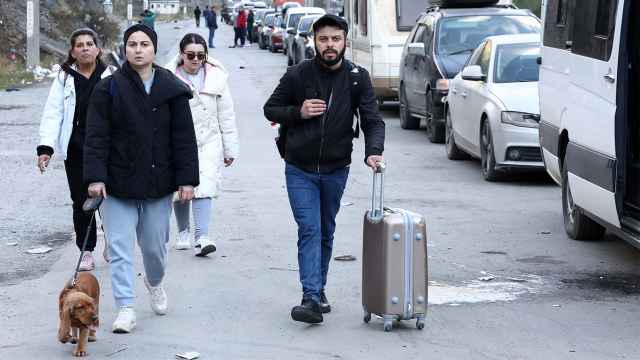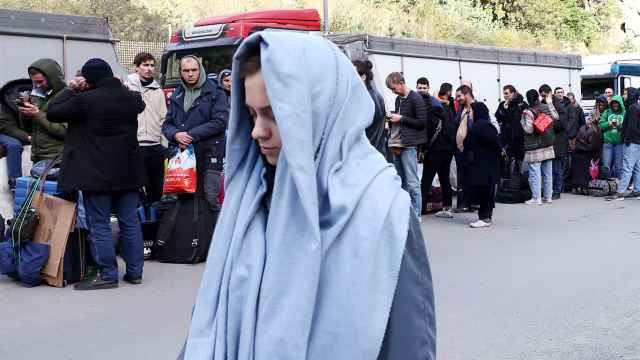

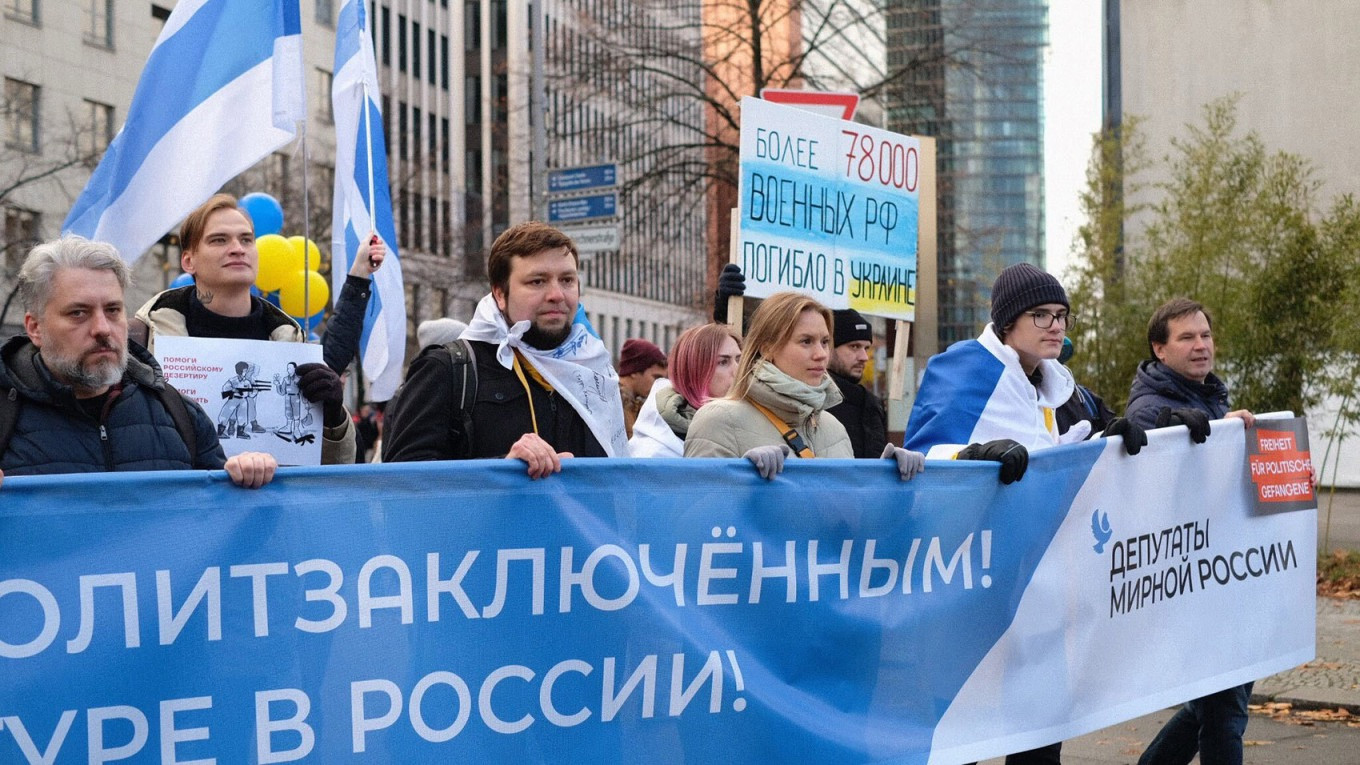
Russian wartime migrants are becoming one of Europe’s favorite bugbears. European policymakers, activists and leaders present them with two contradictory demands. The first is that the exiles must show more overt support for Ukraine. The second is that Russians should become invisible.
These demands are impossible to reconcile. Therefore, the solution for the wartime diaspora lies not in becoming a model minority but in building solidarity with the other migrant diasporas in Europe and around the world. Exiled Russian politicians who try to sit on both chairs will invariably fall on the floor, losing support of both Russian diaspora or European hardliners.
The hundreds of thousands of Russians who fled for Europe sacrificed a lot over the past four years. Many lost income, housing and relationships. Once in Europe, they faced high taxes, lackluster infrastructure and infuriating bureaucracy. Many of these Russians also potentially landed themselves and their loved ones on the Kremlin’s blacklists by merely building new lives in “unfriendly countries.”
Presumably, many of them fled for Europe because they saw themselves as European. Fascinated by their image of European civilization they are so committed to their White European self-image that many are reluctant to identify as migrants, preferring instead to call themselves relocants or expats.
Many of the migrants view President Vladimir Putin’s war on Ukraine as an assault on European civilization, and themselves as a part of that civilization. Therefore in 2022 they expected that Europe would naturally welcome fleeing Russians and integrate them into the pan-European infrastructure helping Ukraine beat back Putin's army. And so they set to work building scores of anti-war initiatives and fundraisers. They did not limit themselves to non-lethal aid either. Russian migrants still fundraise for the Ukrainian military and remotely sign missile shells being fired at Russian soldiers.
This is historically unprecedented for an anti-war movement in the developed world. Westerners might have been willing to fundraise and protest for civilians of Vietnam in the 1960s or Gaza today, but there have been no battalions of anti-war Americans or Israelis fighting against their own governments.
The Russian anti-war movement is unique in its scale and drive. Over the last several decades we have no examples of citizens of a warring great power willing to sacrifice so much while facing such a degree of repression and ostracism. Take the Vietnam War. While the American full-scale invasion did trigger a flight of some 100,000 draft dodgers, over 1 million Russians left their homes in opposition to the war. Note that North Vietnamese leader Ho Chi Minh was not shy to thank anti-war “American friends” in his public communiques. Ukraine's President Volodymyr Zelensky prefers a different style of messaging, insisting that Russians based in the West go the “fuck away” to Russia.
Despite this treatment, anti-war Russians on average still seem to be willing to risk everyday comfort, prison time or even death on the front lines — all to express their opposition to Putin’s invasion.
But if anti-war Russians might still think of themselves as White Europeans and part of European civilization, European bureaucracies do not hold such illusions. European leaders block asylum routes and rescind humanitarian visas, making Russians’ integration more difficult with every step. Berlin, while denouncing Putin’s war, is reliably helping Russia’s president to maintain his military by flat-out refusing Russian draft-dodgers an easy pathway to immigration.
Interestingly, Russians are hated more than even people of color in some EU countries. Poles, for instance, dislike Russians slightly more than the Roma people, a truly surprising statistic for Europe.
In short, Russians are facing similar challenges as Indians, Turks and other migrants from the Global South: xenophobia, inequality and culture shock. This default set of barriers is exacerbated by one additional factor: dehumanization. Russian efforts of presenting themselves as both anti-war and Russian are curtailed by the broad sentiment that they are offensive to Ukrainian refugees or European nationals by nature of their existence.
What does this look like in practice? Russians in Europe are physically attacked for speaking Russian, shunned from solidarity events, kicked out of universities or academic panels and so on.
So, when Russian migrants oppose the Ukraine war in public, they are invariably confronted for centering themselves over Ukrainian voices. They are told to “shut up” lest they upset a nearby European. When Russians take this advice to heart, the second step kicks in: politicians and activists accuse the migrants of not being sufficiently present, and of supporting Putin through their apathy. They are labeled as never-protesting and lazy “Coca-Cola refugees,” often by the very same groups who demand that anti-war Russians turn invisible.
Still, Europe is one of the few places somewhat available for Russian political organizing. Тhe Kremlin is tightening the screws over its domestic politics ever further. The diaspora is rapidly becoming the only political space available to figures like Andrei Pivovarov, a Berlin-based former political prisoner, freed during the 2024 swap facilitated by the U.S. and Germany.
Pivovarov is an undeniably courageous figure. Addressing Europe’s wartime Russian diaspora in his recent Moscow Times op-ed, he called on Russians to follow his own example and be more visible, expressing his hopes that European politicians will become more benevolent toward the migrants who show themselves as more pro-European and pro-Ukraine.
The problem with this notion lies in the aforementioned two-step dehumanization mechanism. To many Ukrainian activists and European politicians, there is no such thing as a good Russian. If a Russian is too visible, that Russian is centering himself over Ukrainian voices. If a Russian is invisible, he is at fault for the war. A Russian’s existence is therefore offensive in itself.
Don’t forget that Russians who visibly protest are taking a massive risk, even if they are abroad. The Kremlin demonstrated time and time again that its security services are ready to hunt people far beyond the national borders, including in Europe. Bewilderingly, many Russians still visibly protest despite being vilified and dehumanized by their supposed allies and threatened at home. Perhaps they are moved by the masochistic drive for suffering, so well-described by Dostoevsky.
It is therefore unlikely that Russians will be able to shape themselves into the model minority Pivovarov and his followers seemingly want the diaspora to become. Additionally, Europe seems to be cooling on its unconditional support for Ukraine: Poles might hate Russians more than the Roma, but the once-loyal Warsaw has also been turning sour on Ukraine and especially Ukrainian refugees, who are now finding themselves dehumanized.
If the trend continues, will European leaders really value Russian anti-war activism, as Pivovarov hopes? It is unlikely that a Europe that has been mulling over scaling back the aid to Ukrainian refugees and re-engagement with Putin will really be interested in anti-war Russians just because they are anti-war.
So, what can exiled political figures do with the diaspora, if not turning their compatriots into a model minority that no one really needs? There are plenty of options — perhaps they should meet their constituents where they are. Focus on food banks, asylum aid, humanitarian visas and other work that might not be as visible and dramatic as a mass march through Berlin, but would help exiles’ material needs. Instead of presenting Russians as uniquely worthy due to their Whiteness, European-ness or undying support for Ukraine, one should try to speak the language of universal human rights.
Europe has been losing this language, but there is no reason it can’t learn to speak it again. If Russian exiles and emigre politicians want to eke out an existence in Europe, they need to learn it too — not through performative activism, but through building solidarity with other migrant groups and appealing to basic human rights.
A Message from The Moscow Times:
Dear readers,
We are facing unprecedented challenges. Russia's Prosecutor General's Office has designated The Moscow Times as an "undesirable" organization, criminalizing our work and putting our staff at risk of prosecution. This follows our earlier unjust labeling as a "foreign agent."
These actions are direct attempts to silence independent journalism in Russia. The authorities claim our work "discredits the decisions of the Russian leadership." We see things differently: we strive to provide accurate, unbiased reporting on Russia.
We, the journalists of The Moscow Times, refuse to be silenced. But to continue our work, we need your help.
Your support, no matter how small, makes a world of difference. If you can, please support us monthly starting from just $2. It's quick to set up, and every contribution makes a significant impact.
By supporting The Moscow Times, you're defending open, independent journalism in the face of repression. Thank you for standing with us.

Remind me later.