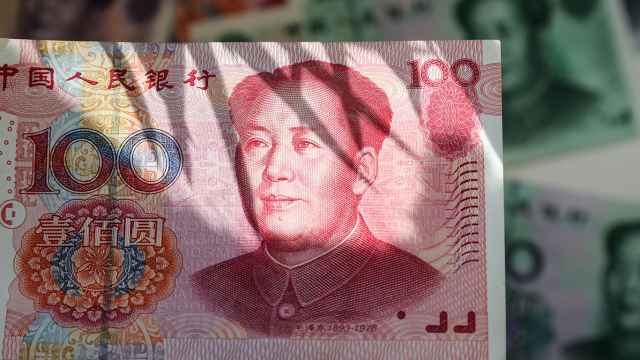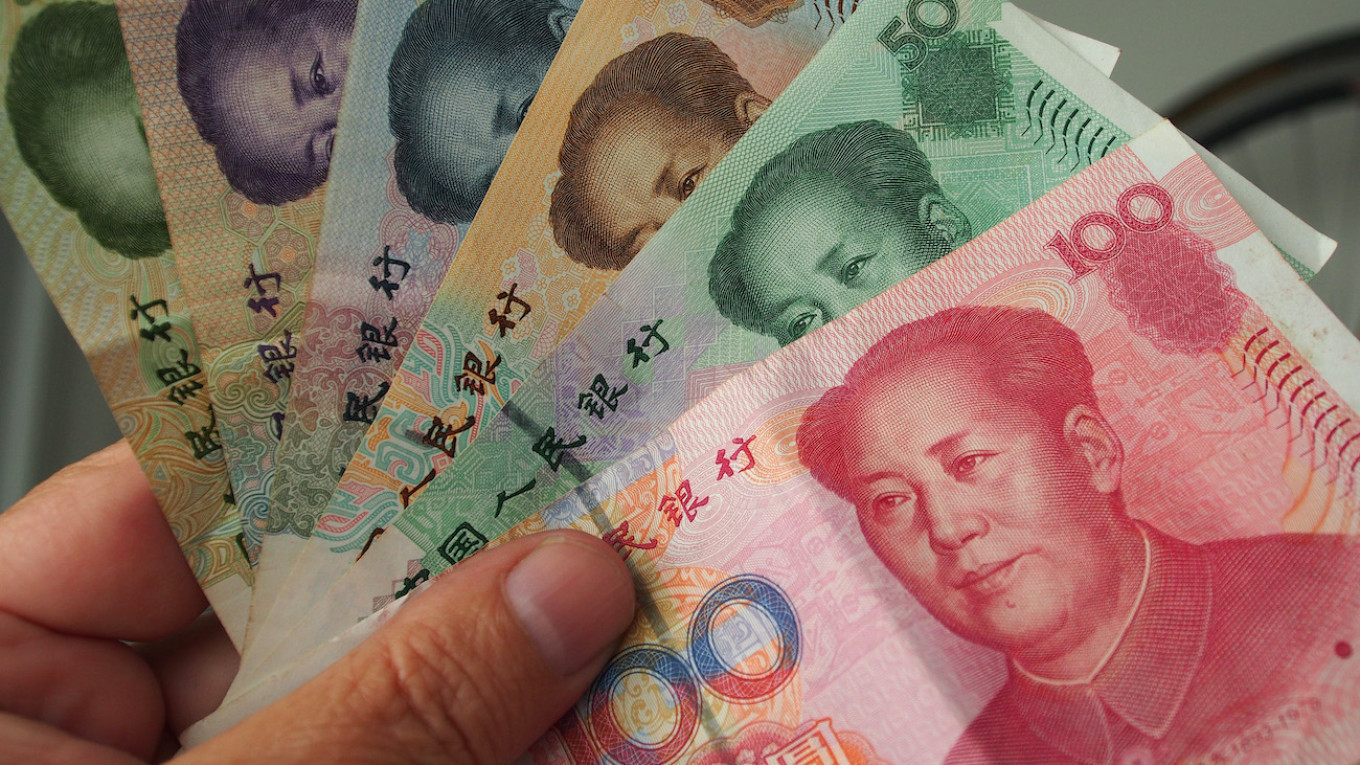
Russia’s banking system is facing a sharp shortage of Chinese yuan, the de facto main foreign currency still available for international trade, driving borrowing costs sharply higher and adding pressure on the ruble, analysts said.
Overnight yuan borrowing rates on the Moscow Exchange surged to 44% on Thursday, reflecting how much banks were willing to pay each other for short-term access to the currency.
Rates had hovered near zero for most of last year and early 2026, before rising to 10% in February, easing to 6% in early March, and then climbing again this week — from 14% on Tuesday to 20% on Wednesday.
The spike underscores Russia’s growing reliance on yuan for cross-border payments and highlights how reduced export revenues and policy shifts have drained foreign currency liquidity, complicating efforts to stabilize the ruble.
The shortage has been driven by a drop in export earnings following a decline in oil prices late last year, as well as the Finance Ministry’s decision to halt yuan sales from the National Wealth Fund (NWF), said economist Yegor Susin.
Banks have increasingly turned to the Central Bank for yuan funding via swap operations, tapping the facility almost daily since early February.
Demand for such loans was effectively zero last year, but by March 18 lenders had exhausted the Central Bank’s 5-billion-yuan limit, according to official data.
“Unlike dollars and euros, which could previously be borrowed freely in Western financial markets, Russian companies mainly obtain yuan through trade flows, as Chinese banks are largely unwilling to lend directly to Russian firms,” said Mikhail Vasilyev, chief analyst at Sovcombank.
But those trade flows have weakened. Major exporters sold just $3.5 billion worth of foreign currency on the domestic market in February, three times less than in the same month a year earlier.
The Finance Ministry’s decision to stop selling yuan from the NWF in order to preserve its remaining liquid assets has further reduced supply, cutting roughly $3 billion a month from the market, according to Finam analyst Alexander Potavin.
The yuan shortage has become a key factor behind the ruble’s recent decline, said Igor Sokolov, an analyst at Alor Broker.
The yuan has risen 7% against the ruble since the start of the week, reaching 12.65 rubles on Thursday — its highest level since February last year.
The dollar briefly traded above 86 rubles for the first time in a year while the euro approached 100 rubles, hitting 99.5 on the interbank market.
“In effect, the market has been functioning for about a month as if oil were priced at around $45 per barrel, implying much weaker export inflows,” Susin said. “Revenues from current prices of $80-100 per barrel will feed into the economy with significant lags, and there are few mechanisms left to balance the market.”
The Central Bank may need to expand its yuan swap operations to stabilize conditions, while the Finance Ministry could consider placing excess yuan liquidity back into the market, analysts said.
Read this story in Russian at The Moscow Times' Russian service.
A Message from The Moscow Times:
Dear readers,
We are facing unprecedented challenges. Russia's Prosecutor General's Office has designated The Moscow Times as an "undesirable" organization, criminalizing our work and putting our staff at risk of prosecution. This follows our earlier unjust labeling as a "foreign agent."
These actions are direct attempts to silence independent journalism in Russia. The authorities claim our work "discredits the decisions of the Russian leadership." We see things differently: we strive to provide accurate, unbiased reporting on Russia.
We, the journalists of The Moscow Times, refuse to be silenced. But to continue our work, we need your help.
Your support, no matter how small, makes a world of difference. If you can, please support us monthly starting from just $2. It's quick to set up, and every contribution makes a significant impact.
By supporting The Moscow Times, you're defending open, independent journalism in the face of repression. Thank you for standing with us.

Remind me later.