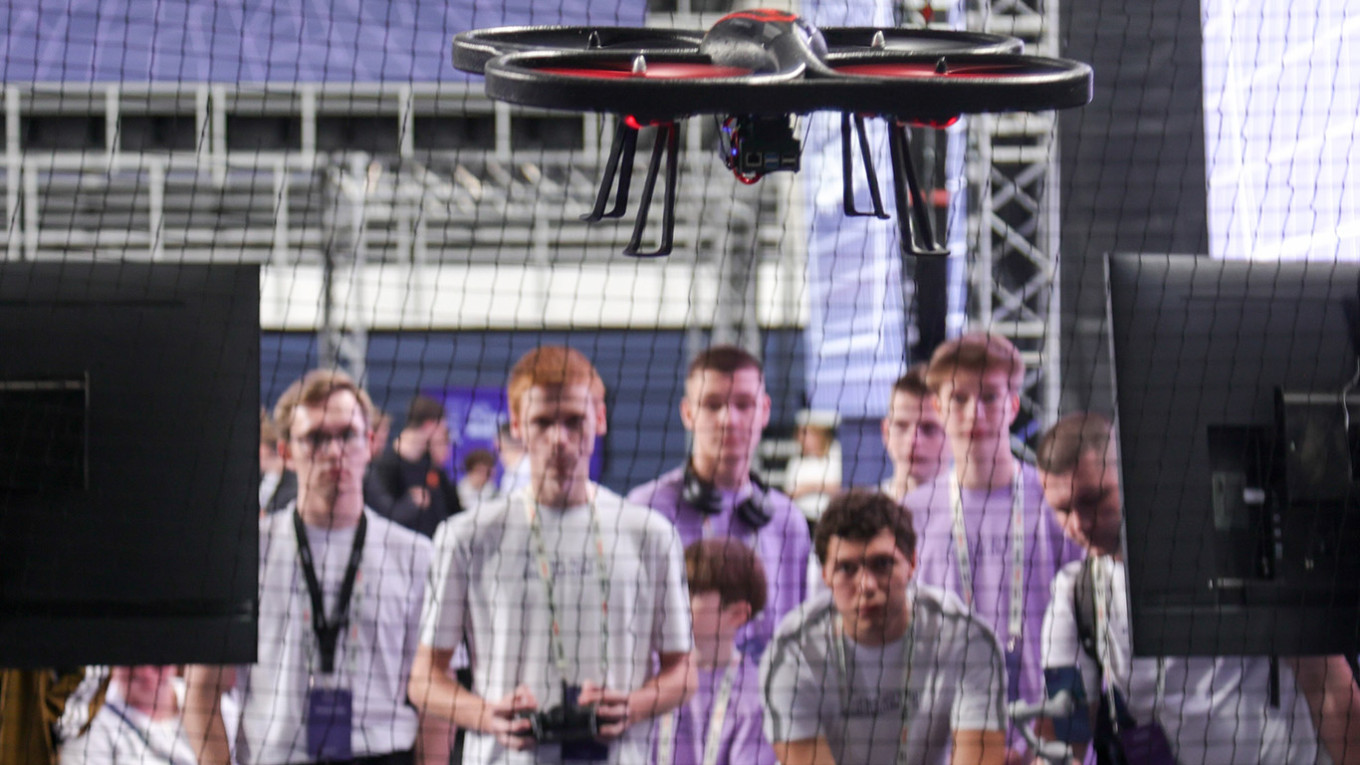
“I’ve tried robotics before, but for some reason I like flying drones more. I feel like I’m flying,” says 14-year-old Dima Nevstruev, a student at a youth center in Russia’s Chelyabinsk region.
“The most interesting part is probably building your own drone, then programming it. And when you fly a drone for the first time, it’s cool," he told regional television.
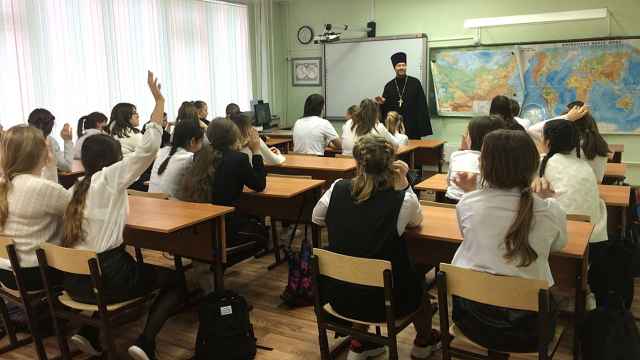
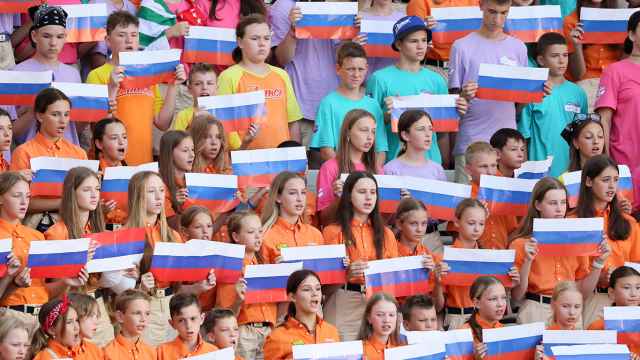
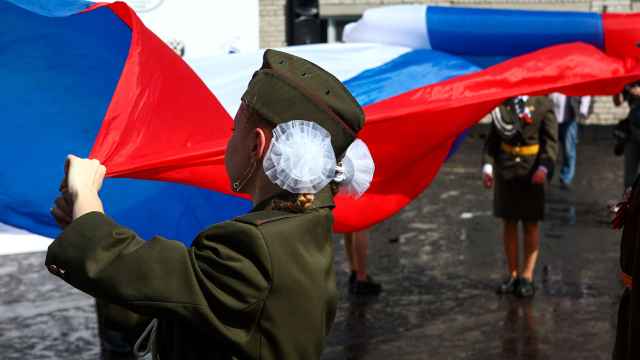
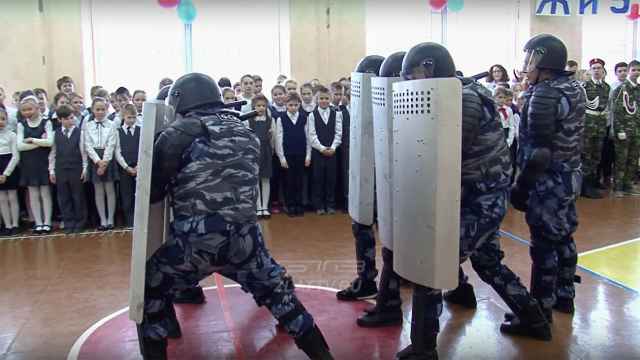
Nevstruev has been studying drones for three years — skills that are now becoming part of Russia’s national school curriculum as Moscow deepens what analysts describe as its militarization of education following its 2022 invasion of Ukraine.
In January, the Russian government formally added drone assembly and operation to lessons taught under the school subject Fundamentals of Homeland Security, known by its Russian acronym OBZR.
The Kremlin has pushed to build up a domestic cadre of specialists as unmanned aerial vehicles have taken on growing importance on the battlefield in Ukraine. In 2024, Science and Higher Education Minister Valery Falkov said the country aims to train 1 million unmanned aerial vehicle (UAV) specialists by 2030.
Efforts to introduce drone instruction in schools date back to 2023, when President Vladimir Putin endorsed their inclusion in the national curriculum.
“This so-called early career guidance will ultimately benefit the country,” Putin said.
Guidance on teaching drone classes was being issued as early as summer 2024, according to documents reviewed by The Moscow Times that were sent by the Institute for Strategic Education to the Education Ministry.
Under the federal OBZR curriculum, students completing the drone module are expected to understand how different types of drones are used in combat, trace their development and explain how unmanned aerial vehicles conduct reconnaissance. The program also includes scenario-based exercises.
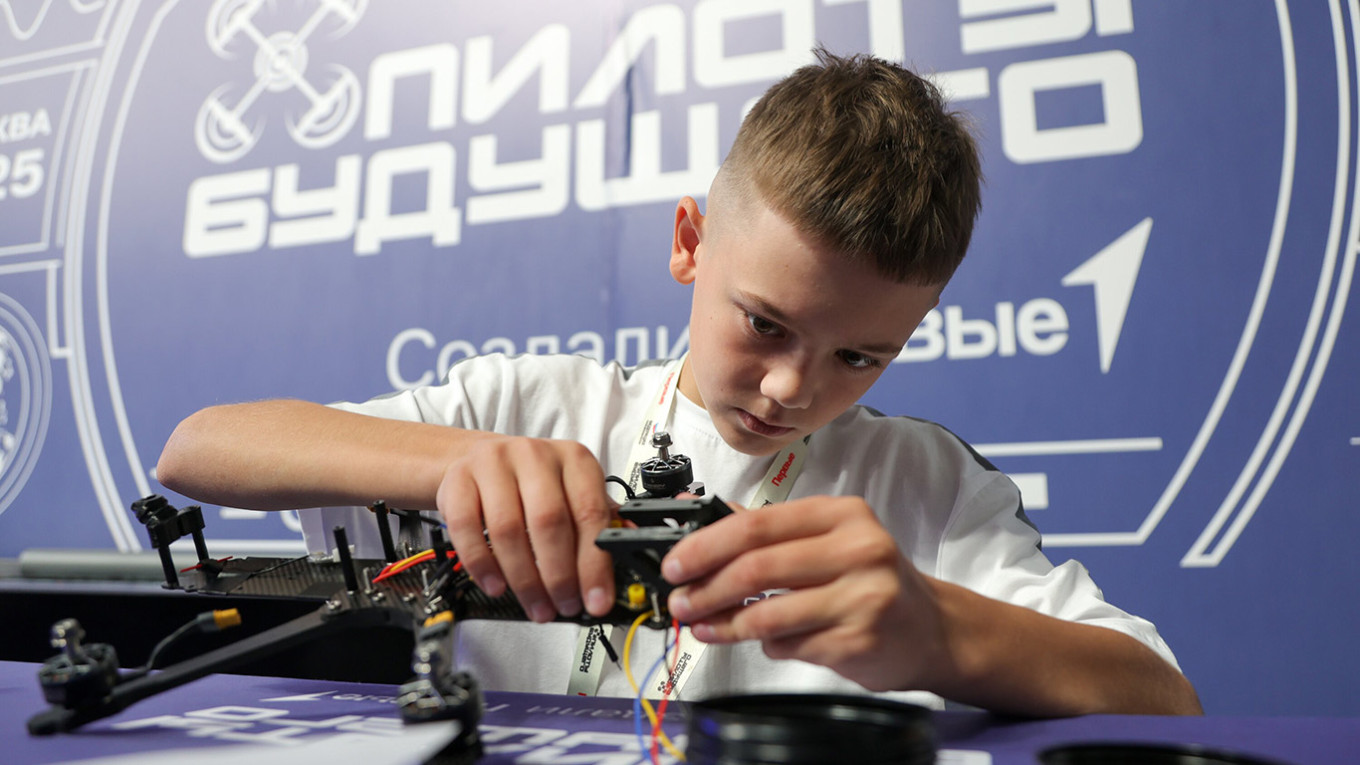
By August 2025, the British Defense Ministry said drone instruction was taking place in over 500 Russian schools.
Teachers have since begun sharing sample lesson materials on social media.
In one presentation, 10th-grade students are asked to name the four main types of drones, describe the advantages of multirotor systems and answer the question: “Which unmanned aircraft are in service with the Russian army?”
Seventh-grade students may be asked what the sound of an incoming drone resembles and what actions to take after hearing a warning signal during a drone attack.
Experts interviewed by The Moscow Times said students are often drawn to drone classes because of their interactive and modern appeal — but warned that the distinction between technical education and military training can become blurred.
‘I Definitely Say “Yes” to These Lessons’
In the Kursk region, which borders Ukraine and has been regularly targeted by cross-border attacks, local officials have openly linked drone training to defense needs.
“Our region, for obvious reasons, has become a hub for professional drone operation, assembly and even the development of new models,” Governor Alexander Khinshtein wrote on Telegram in January.
“Those who have practical experience today will pass it on to our schoolchildren,” he said, adding that members of the volunteer BARS-Kursk brigade and servicemen from Russia’s Sever military grouping could soon take part in school instruction.
Last year, 80 teachers in the Kursk region obtained certification as drone operations specialists after completing training organized by the Russia Workforce Center and regional education authorities.
Participants included computer science, technology, physical education and OBZR teachers.
A similar course was piloted in Kursk in 2024 for unemployed people.
“There will be no shortage of students, as basic drone operation skills could lay the foundation for a promising, well-paid career,” the Kursk Employment Center said on social media. A pinned post on its VKontakte page promotes contract military service.
Schools are now provided equipment for drone classes by the state, and submit procurement requests through the government purchasing system. Tenders include FPV drones, instructional posters, 3D printers, virtual-reality headsets, computers and flight simulators.
A standard unmanned aerial vehicle (UAV) training kit costs about 250,000 rubles ($3,257).
One tender reviewed by The Moscow Times showed School No. 161 in St. Petersburg requesting a computer-based FPV drone simulator featuring 13 scenarios and 80 training tasks, ranging from cargo delivery to free flight.
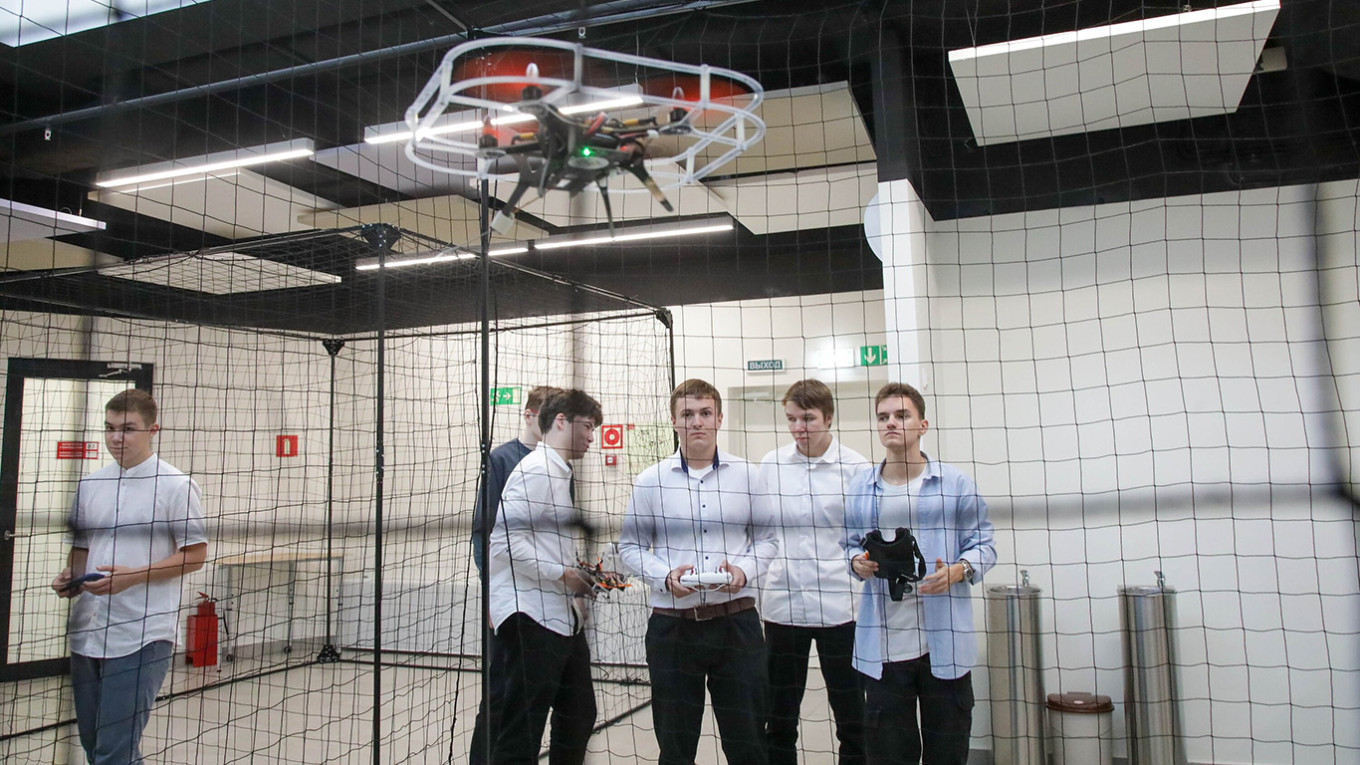
A child psychologist working at a Russian school told The Moscow Times that drone education risks blurring the line between technical learning and warfare for children, making them more vulnerable to militarized messaging.
“Children separate killing — an act that can be carried out by a drone — from the making of that drone as some kind of toy that shows they are skilled builders,” they said, speaking on condition of anonymity for safety reasons. “Unfortunately, attracting children to this kind of activity is becoming more appealing.”
And for middle and high-school students, building drones offers an opportunity to “please their teacher, improve their school’s ranking and feel connected to the country,” they said.
Not all educators share those concerns.
“I definitely say yes to these lessons because the field is developing and kids are interested,” Vitaly, an OBZH teacher in St. Petersburg who plans to teach UAV courses in the new school year, told The Moscow Times.
“I don’t see any conflict [in the UAV course]; it fits within the curriculum. It will soon be in all schools. And as we can see, the Russian military has even introduced special drone units,” he said. “Basically, this is the future.”
A Message from The Moscow Times:
Dear readers,
We are facing unprecedented challenges. Russia's Prosecutor General's Office has designated The Moscow Times as an "undesirable" organization, criminalizing our work and putting our staff at risk of prosecution. This follows our earlier unjust labeling as a "foreign agent."
These actions are direct attempts to silence independent journalism in Russia. The authorities claim our work "discredits the decisions of the Russian leadership." We see things differently: we strive to provide accurate, unbiased reporting on Russia.
We, the journalists of The Moscow Times, refuse to be silenced. But to continue our work, we need your help.
Your support, no matter how small, makes a world of difference. If you can, please support us monthly starting from just $2. It's quick to set up, and every contribution makes a significant impact.
By supporting The Moscow Times, you're defending open, independent journalism in the face of repression. Thank you for standing with us.

Remind me later.