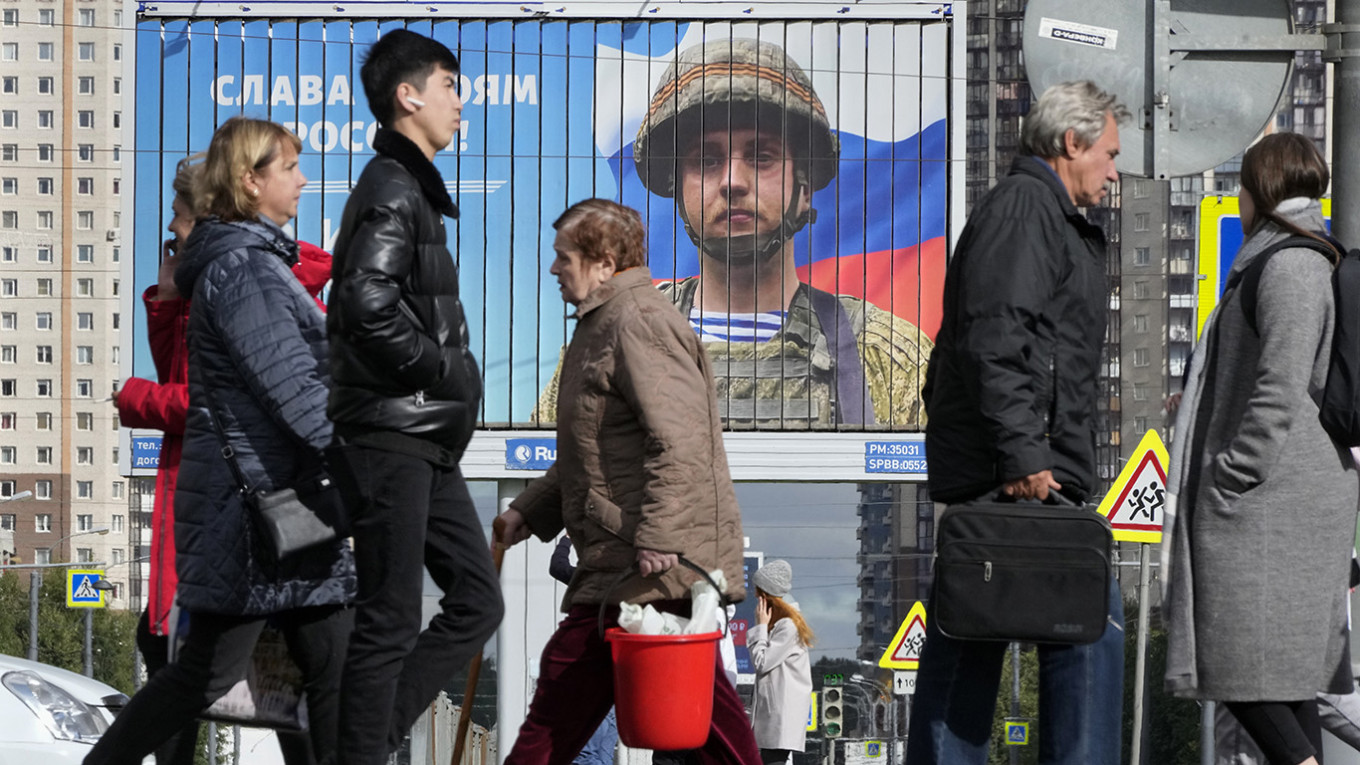
The author of this article asked to remain anonymous because Russian law criminalizes writing for “undesirable” organizations like The Moscow Times. Names in italics have been changed for safety reasons.
I remember that early, frantic morning of Feb. 24, 2022, very well. I was running down the street, already late for work, but I barely noticed. The roar of military bombers hung overhead, and it felt as though the asphalt was slipping away beneath my feet.
I lived in a region bordering Ukraine and was hurrying to the local office of the state television and radio company — the provincial bureau of Rossia, the channel that broadcasts the flagship shows of the Kremlin’s chief propagandists, Dmitry Kiselyov and Vladimir Solovyov. We produced regional news.
I had taken the job straight after graduating from my local university’s journalism department. In Russia’s regions, there is almost no independent media. Young journalists have few options when starting out. A branch of a major federal channel — even a state-owned, openly propagandistic one — is the best many people can hope for.
The war did not come as a surprise to me, but I still couldn't believe what was happening.
Rumors had been swirling in our newsroom since the middle of winter, when military equipment had already been moved to the Ukrainian border. But our general director always said: “Of course there won't be any war. It's just anti-Russian hysteria being whipped up in the Western press.”
I didn’t take the possibility of war seriously either — not until Feb. 18, 2022, when the authorities of the self-proclaimed Donetsk and Luhansk republics announced they were evacuating people to Russia, citing Ukraine’s alleged preparations for an offensive.
A day later, a train carrying some of these evacuees arrived in our region. Our crew went to the station to prepare a report. I was asked to record a few short interviews on my phone.
I approached one woman and asked whether she thought there would be a war.
“We hope not,” she replied.
“We can't publish that,” the editors told me. “The word ‘war’ is banned. Any hints of a possible war must be excluded. We mustn't provoke people.”
It was as if the management was afraid of alarming the audience unnecessarily. A few days before the invasion, there was no sign of patriotic mobilization among the public. Rising prices and ongoing Covid restrictions were fueling discontent in society.
People left angry comments under our stories about the evacuees: “Why are they coming here? We can barely make ends meet ourselves,” or “They’re getting five free meals a day while we pay for our children’s school lunches.”
Many predicted that if war came, the ruble would collapse and prices would soar. At the time, I felt that almost no one in Russia would support an invasion. People were preoccupied with everyday survival.
As it turned out later, I, like many others, underestimated the effect of the very propaganda that had seemed so ridiculous and unconvincing to all of us.
On the eve of the invasion, a local democratic activist hung a Ukrainian flag from a railway viaduct in a gesture of solidarity. A photo quickly spread on social media.
We wrote a short news story about it — just the facts, with neither approval nor condemnation. It seemed like harmless news. But even our general director did not allow it to be published immediately. He was afraid that he would be punished for reporting that there was at least one person in the city who supported Ukraine.
After Feb. 24, publishing such news became unthinkable. Any political or anti-war activity was strictly off limits. It was to be ignored.
I was late for work that day. But no one cared. I remember the puzzled faces of my colleagues in the newsroom. Out of 10 people, only one sincerely supported the invasion. The rest of us either openly declared our anti-war views or whispered in the smoking room: “This is f***ed up.”
That same day, reports emerged that a military aircraft had crashed in the region — whether it was because it was shot down or due to a malfunction, no one knew. The pilot's wife called the editorial office. She asked to find out anything about his fate, as she had not been told anything.
The editor forbade us from writing about the crashed plane. “Russian planes don't crash,” he said. One of our correspondents found out about the pilot's fate through her sources. Charred remains were all that was left of him. But they forbade her from telling his wife about it so as not to cause panic.
To avoid causing panic, we were ordered to ignore other news as well, even things that were much more harmless.
For example, we were ordered not to focus on the depreciation of the ruble, not to write about the lines to exchange foreign currency at banks, to try not to write about price increases or the fact that some manufacturing in the region had temporarily stopped due to sanctions.
Instead, we were advised to write about the usual topics, such as road accidents or the work of utility workers to “create a neutral information background.” Or rather, in other words, an illusion of normalcy.
I sat at my computer with glassy eyes and managed to write only a couple of news stories per working day. The rest of the time, I scrolled through reports about the war.
From the very first day, I knew that I would either be fired or leave myself.
Soon, one of our correspondents produced a report commissioned by the FSB. It claimed that Ukrainian provocateurs were stirring up discontent online — for example, by drawing attention to potholes in local roads in order to “undermine trust in the authorities.”
That was too much.
“What’s the point of holding on to a job I despise when the world is collapsing?” I thought. “It’s shameful to work here now, during a war.”
I wasn’t alone. Soon after, our social media marketing editor, Tasya, resigned. I followed her. Then Yasha left. After him, our deputy editor Anya quit too.
Many spoke of emigration. It felt as though Russia was sliding into the bleak, brutal reality of an Alexei Balabanov film — as if a new 1990s were looming.
I found leaving the state television channel liberating. I had no fear, even though I was left without a job at an uncertain time. “What difference does it make?” I thought. No one knew what would happen in the country in a month's time.
Would Putin's regime survive? It seemed that the consequences of the war for the authorities would be unpredictable – empty shop shelves, mass protests. All this seemed quite real. Our ideas about the future were very alarmist. Now, I realize how naive that was.
“Why are you young people so worried?” my grandfather used to say. “Our guys are about to take Kyiv. In a couple of weeks, the war will be over.”
Four years have passed since then. My grandfather has died. The war is still going on.
I returned to my border town from my emigration. Here, no one is surprised by the arrival of drones and rocket sirens anymore.
In the comments under news stories on regional television, Kremlin bots leave identical pro-war comments: “Zelensky should be hanged by his balls.”
Our general director, who was convinced that there would be no war, still holds his position. He has learned to justify what is happening to himself and happily travels the world — only he is now limited to Southeast Asia instead of Europe.
Public discontent has been replaced by permanent malaise and a feeling of stagnation. No one expects the war to end anytime soon.
A Message from The Moscow Times:
Dear readers,
We are facing unprecedented challenges. Russia's Prosecutor General's Office has designated The Moscow Times as an "undesirable" organization, criminalizing our work and putting our staff at risk of prosecution. This follows our earlier unjust labeling as a "foreign agent."
These actions are direct attempts to silence independent journalism in Russia. The authorities claim our work "discredits the decisions of the Russian leadership." We see things differently: we strive to provide accurate, unbiased reporting on Russia.
We, the journalists of The Moscow Times, refuse to be silenced. But to continue our work, we need your help.
Your support, no matter how small, makes a world of difference. If you can, please support us monthly starting from just $2. It's quick to set up, and every contribution makes a significant impact.
By supporting The Moscow Times, you're defending open, independent journalism in the face of repression. Thank you for standing with us.

Remind me later.