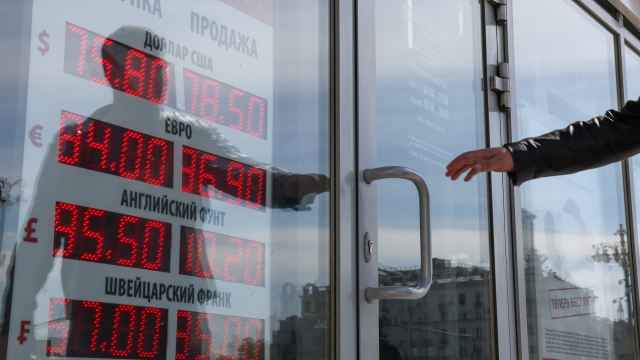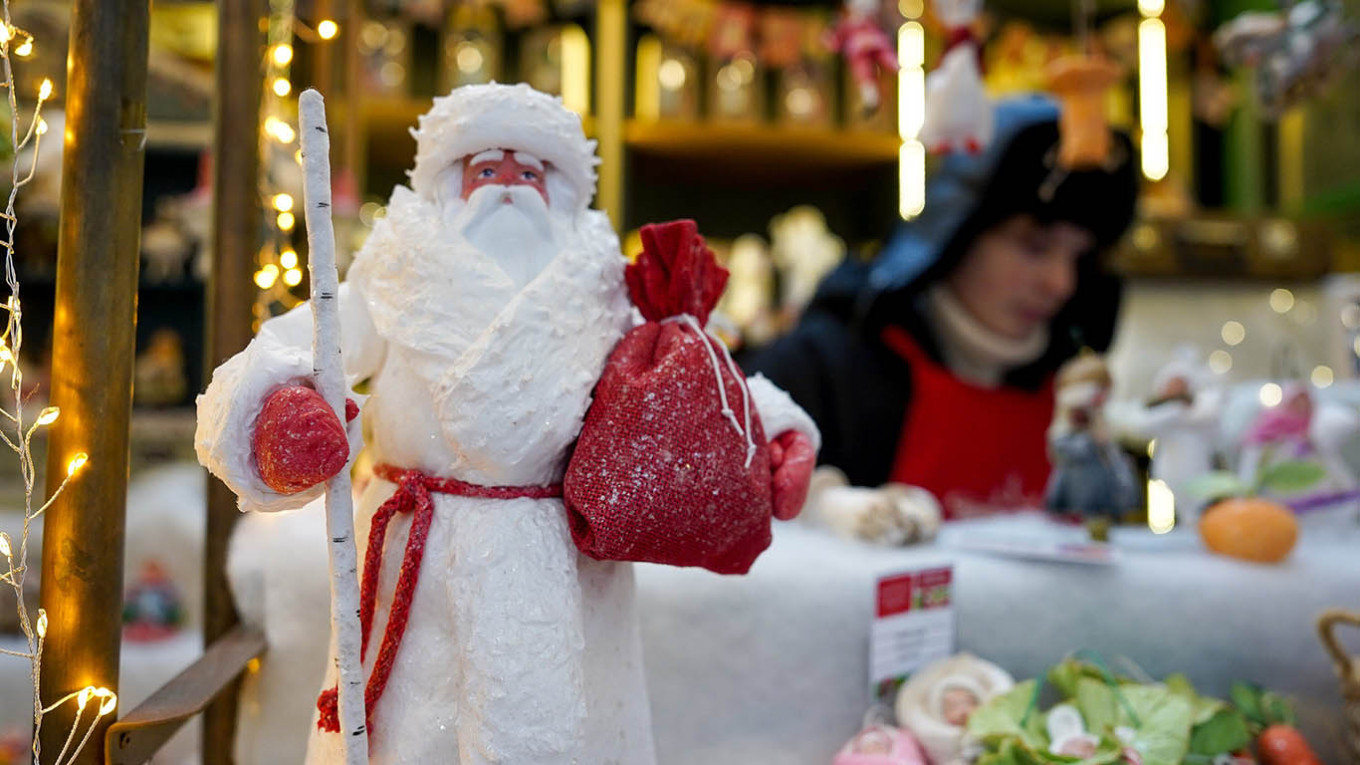
Russians plan to cut their spending on New Year's celebrations in 2025 amid economic pressure, the Kommersant business daily reported Wednesday, citing consumer surveys and analysts.
Households expect to spend an average of 14,000 rubles ($175) on the holiday, according to a poll by online marketplace Avito. The figure covers all preparations, including food and ready-made meals, table decorations, clothing, gifts and venue and equipment rentals.
That would be nearly half the expected amount for New Year's 2024, when Russians planned to spend about 26,000 rubles ($325), including 17,500 rubles ($219) on food and 8,500 rubles ($106) on gifts, according to a study by market research firm Nielsen.
Rising inflation and higher prices for food, utilities and clothing have pushed consumers into a savings mindset, Alexander Safonov, a professor at the Financial University under the Russian government, told Kommersant.
“People have restricted their purchases and spending, including on New Year's celebrations. No matter how much one earns, the general trend is to reduce one's spending,” Safonov said.
Food remains the biggest cost, though consumers are opting for cheaper products and abandoning delicacies.
Red caviar, priced at an average of 10,200 rubles ($128) per kilogram, has become a luxury item for most households and will appear on tables only “symbolically,” Safonov said, adding that few are willing to spend more than 2,000 rubles ($25) on it.
Exotic fruits are also disappearing from festive menus in favor of mandarins, which 56% of respondents consider an essential New Year staple.
For many families, holiday meals will be limited to traditional dishes such as Olivier salad, a small selection of drinks, and inexpensive vegetables and fruit, Safonov said.
Even the iconic Olivier salad has grown more expensive. The minimum cost of ingredients for four servings rose 2.1% over the year to 363 rubles ($4.50), according to the Association of Retail Trade Companies (AKORT).
At the same time, interest in domestic countryside holidays is rising. Bookings of rental houses for the New Year period jumped 89% year on year, with popular destinations including the republics of Karelia and Karachay-Cherkessia, the Krasnodar region and the Kemerovo and Yaroslavl regions.
Renting a house with a large group is often cheaper than staying in hotels or traveling abroad, Safonov said.
“In previous years people took expensive foreign trips. Now they are choosing more affordable destinations within Russia, which allows for significant savings,” he added.
Restaurants are also seeing restrained demand. Industry representatives say bookings for corporate parties and New Year events remained steady, but without costly programs or excessive entertainment.
Event hosts report that while service prices have risen by around 20%, demand has fallen by a similar amount.
“We are not seeing ultra-expensive requests — people are trying to save,” Igor Bukharov, president of the Federation of Restaurateurs and Hoteliers, told Kommersant.
A Message from The Moscow Times:
Dear readers,
We are facing unprecedented challenges. Russia's Prosecutor General's Office has designated The Moscow Times as an "undesirable" organization, criminalizing our work and putting our staff at risk of prosecution. This follows our earlier unjust labeling as a "foreign agent."
These actions are direct attempts to silence independent journalism in Russia. The authorities claim our work "discredits the decisions of the Russian leadership." We see things differently: we strive to provide accurate, unbiased reporting on Russia.
We, the journalists of The Moscow Times, refuse to be silenced. But to continue our work, we need your help.
Your support, no matter how small, makes a world of difference. If you can, please support us monthly starting from just $2. It's quick to set up, and every contribution makes a significant impact.
By supporting The Moscow Times, you're defending open, independent journalism in the face of repression. Thank you for standing with us.

Remind me later.