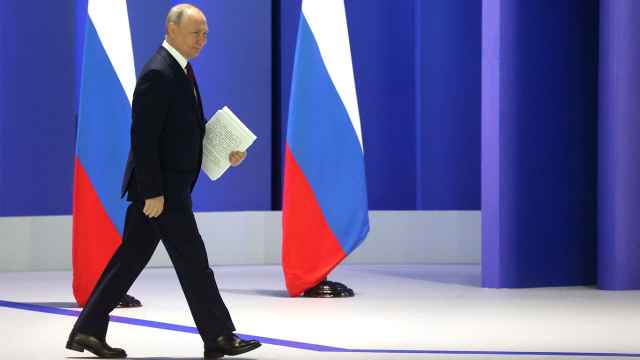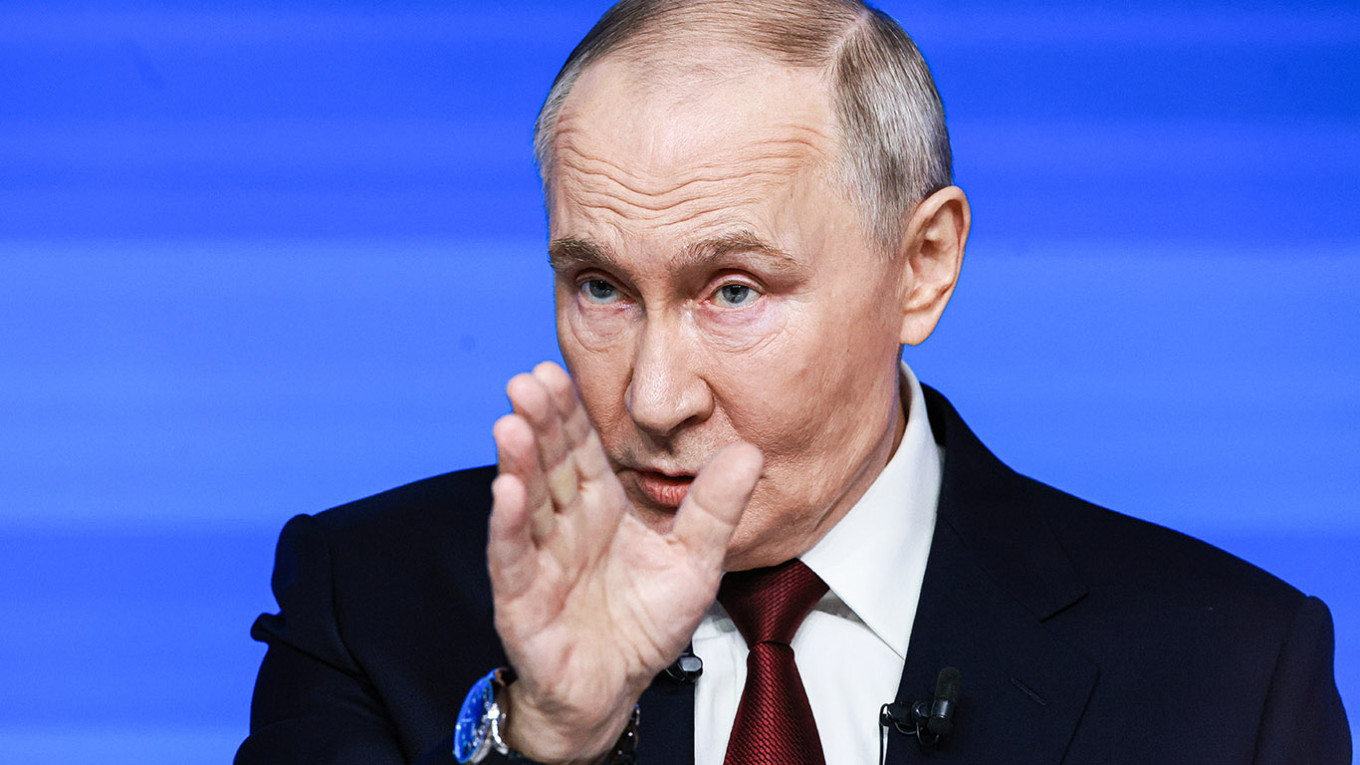
President Vladimir Putin is holding his annual news conference on Friday, once again folded into his televised “Direct Line” call-in show, fielding a wide range of questions, from road repairs and tax increases to reports of fraud, drones for Russian troops, birthrates and even the possibility of contact with extraterrestrial life.
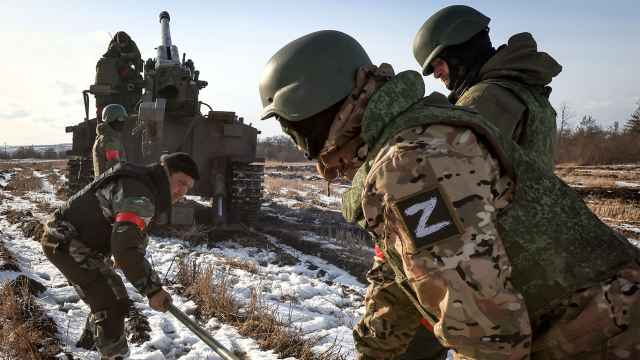
Putin immediately dived into questions about the Ukraine war at the start of the press conference portion of the highly choreographed event, repeating accusations that authorities in Kyiv are not interested in signing a deal to end the fighting as the conflict approaches its four-year mark.
“Still, we see, feel and know that there are certain signals, including those coming from the Kyiv regime, indicating that they are prepared to engage in some form of dialogue,” Putin told the large gathering of journalists, suggesting that ongoing peace negotiations led by the Trump administration could lead to some kind of breakthrough in the near future.
However, Putin was unwavering in his committment to address what he and other Russian officials routinely call the “root causes” of the war in Ukraine, shorthand for the Kremlin’s justifications for its full-scale invasion. He also insisted that Russia’s armed forces were making significant gains across the battlefield in eastern Ukraine, including the claimed capture of the city of Kupiansk.
Asked by an NBC news correspondent whether he would personally bear responsibility for the deaths of Ukrainians and Russians if the war continued into next year because he rejected a U.S.-brokered peace agreement with Ukraine, Putin said the blame would lie solely on the authorities in Kyiv.
“This war began after the unconstitutional armed coup in Ukraine in 2014, followed by the launch of hostilities by the leaders of the Kyiv regime against their own citizens in southeastern Ukraine,” the Kremlin leader said.
Ahead of the broadcast, state media reported nearly 3 million messages had been submitted from across Russia and beyond for Putin to address during the call-in segment, which is designed to showcase the president as personally engaged with the everyday concerns of ordinary Russians.
Many of those questions focused on areas where Russians view the government as failing to deliver, including state pensions, payments to soldiers fighting in Ukraine, medical prescription discounts, regular internet disruptions and prices at the supermarket.
Putin’s answers this year broke little new ground and followed familiar lines. Asked about Russia’s long-running demographic crisis, marked by persistently low birthrates, he pointed to countries like Japan that face similar challenges. The message: Russia is not unique, nor is the situation in the country as dire as some might believe.
In one of the more unusual moments of the press conference, a journalist from Western Siberia’s Tyumen region asked Putin whether the Russian government suspected that the comet known as 3I/ATLAS was an intergalactic spaceship being piloted by extraterrestrials.
“I’ll tell you, of course, but this should remain a secret. It’s top secret information. It’s our secret weapon, and we’ll use it only if absolutely necessary,” the Russian president joked, but then assured the journalist that the comet, which passed by the Earth on Friday, posed no threat to human life.
This is a developing news story.
A Message from The Moscow Times:
Dear readers,
We are facing unprecedented challenges. Russia's Prosecutor General's Office has designated The Moscow Times as an "undesirable" organization, criminalizing our work and putting our staff at risk of prosecution. This follows our earlier unjust labeling as a "foreign agent."
These actions are direct attempts to silence independent journalism in Russia. The authorities claim our work "discredits the decisions of the Russian leadership." We see things differently: we strive to provide accurate, unbiased reporting on Russia.
We, the journalists of The Moscow Times, refuse to be silenced. But to continue our work, we need your help.
Your support, no matter how small, makes a world of difference. If you can, please support us monthly starting from just $2. It's quick to set up, and every contribution makes a significant impact.
By supporting The Moscow Times, you're defending open, independent journalism in the face of repression. Thank you for standing with us.

Remind me later.