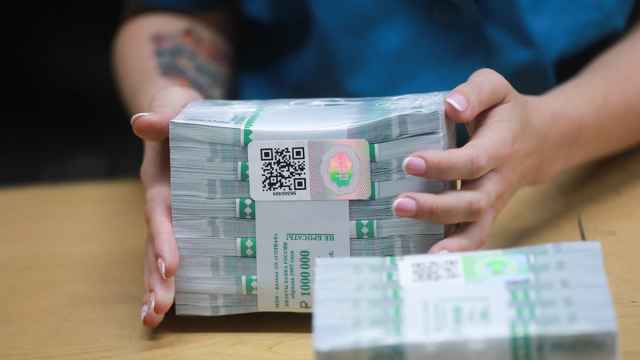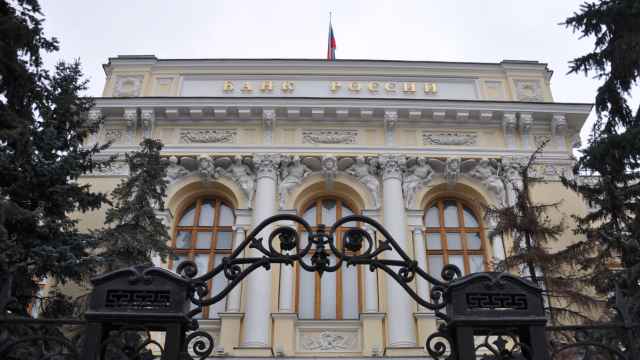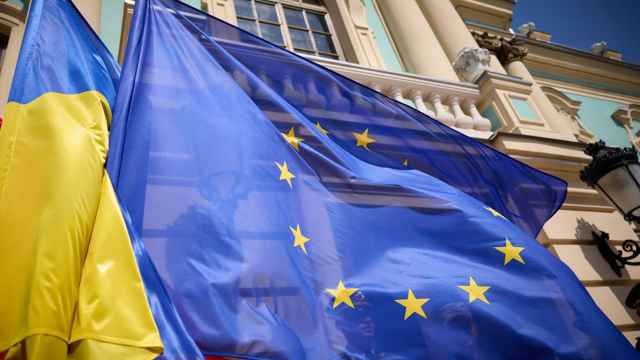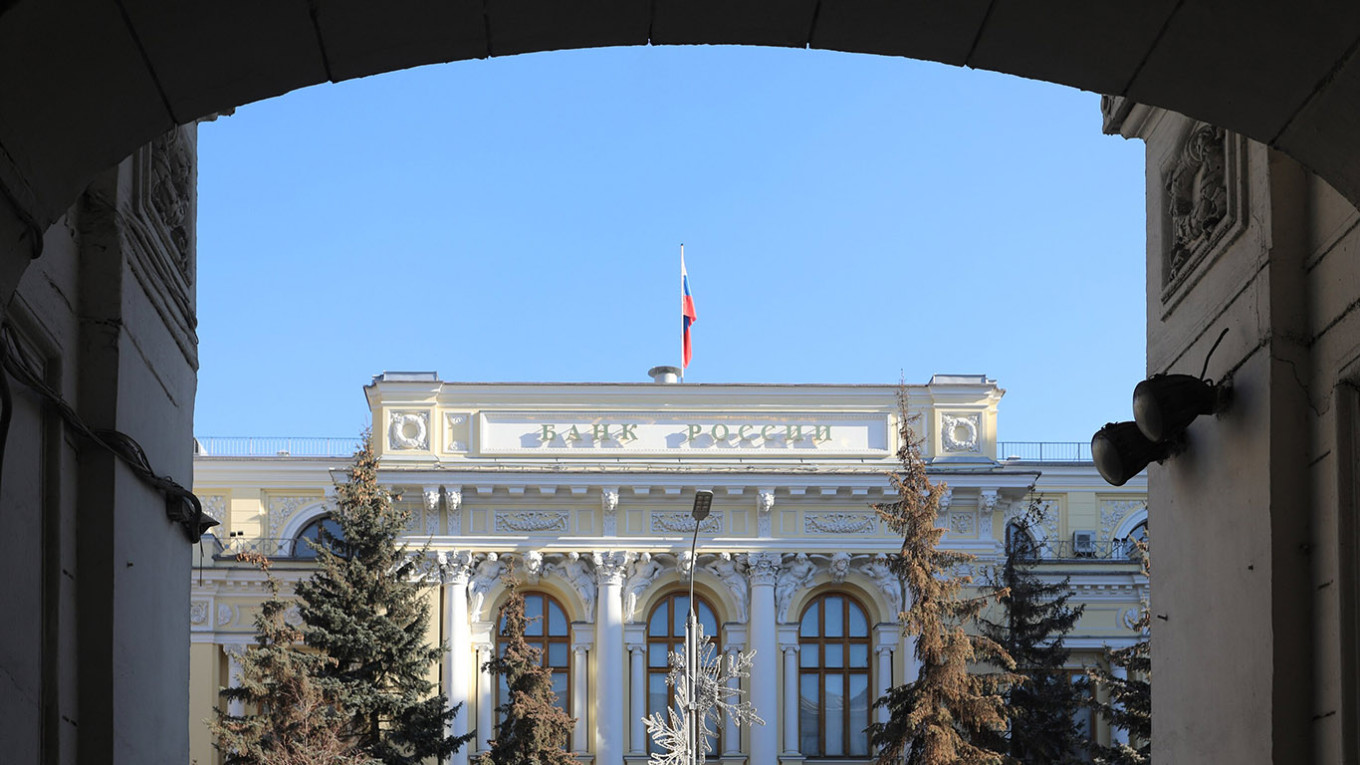
Russia’s Central Bank said Thursday that it would seek damages from European banks after officials in Brussels immobilized billions of Russian sovereign assets that the bloc hopes to use to finance aid for Ukraine.
“In view of the ongoing attempts by EU authorities to unlawfully seize or use, without the consent of the Bank of Russia, its assets held in EU financial institutions... the Bank of Russia, in line with its previously stated position on safeguarding its interests, announces that it will seek to recover damages from European banks in Russian arbitration courts,” the regulator said in a statement.
“These damages will correspond to the value of the assets unlawfully blocked and used, as well as the resulting lost profits,” it added, without mentioning the names of the banks it plans to take to court.
The move marks Russia’s latest pushback against the indefinite immobilization of roughly 210 billion euros ($246.5 billion) in Russian sovereign assets. European leaders are meeting in Brussels on Thursday for a high-stakes summit focused on whether to use those frozen assets to back a reparations loan that would initially provide Ukraine with 90 billion euros over two years.
Last week, Russia’s Central Bank filed a lawsuit in a Moscow arbitration court seeking damages equivalent to the 185 billion euros ($217 billion) held at Belgium-based Euroclear, Europe’s largest securities depository. A preliminary hearing in that case is scheduled for Jan. 16.
After Belgium, France is the next-largest holder of frozen Russian assets, with about 18 billion euros largely held by commercial banks, the Financial Times reported. Paris has so far resisted pressure from its EU partners to disclose which French lenders hold the assets.
Overall, commercial banks in the EU are estimated to hold around 25 billion euros ($29 billion) in Russian state assets, according to FT.
France’s largest bank, BNP Paribas, denied suggestions that it may hold most of the funds, saying it “does not hold any assets in France from Russian public entities, including the Central Bank of Russia.”
Among other EU countries, Germany holds about 200 million euros ($234.7 million) in Russian sovereign assets, Cyprus less than 100 million euros ($117.3 million), and Sweden and Luxembourg about 10,000 euros ($11,700) each, FT reported.
Belgian officials expect Russia to retaliate first by seizing roughly 17 billion euros ($20 billion) worth of Euroclear clients’ assets still held in Russia, according to the newspaper.
Several major European banks, meanwhile, continue to have significant exposure to the Russian market.
Italy’s UniCredit has about 3.5 billion euros ($4.1 billion) in capital stranded in Russia, while Austria’s Raiffeisen reported $2.9 billion in revenue there last year.
Both banks are among more than 2,300 foreign companies that remain active in Russia, even as nearly 1,900 others have withdrawn or scaled back since Moscow’s full-scale invasion of Ukraine.
“If Europe makes a move on Russia’s reserves, Russia can just transfer funds from [frozen] type-C accounts into the budget,” said Alexandra Prokopenko, an economics analyst and former Central Bank official.
“It gives them a source of direct revenue when they’re running a deficit and overspending on defense,” she told FT.
A Message from The Moscow Times:
Dear readers,
We are facing unprecedented challenges. Russia's Prosecutor General's Office has designated The Moscow Times as an "undesirable" organization, criminalizing our work and putting our staff at risk of prosecution. This follows our earlier unjust labeling as a "foreign agent."
These actions are direct attempts to silence independent journalism in Russia. The authorities claim our work "discredits the decisions of the Russian leadership." We see things differently: we strive to provide accurate, unbiased reporting on Russia.
We, the journalists of The Moscow Times, refuse to be silenced. But to continue our work, we need your help.
Your support, no matter how small, makes a world of difference. If you can, please support us monthly starting from just $2. It's quick to set up, and every contribution makes a significant impact.
By supporting The Moscow Times, you're defending open, independent journalism in the face of repression. Thank you for standing with us.

Remind me later.