
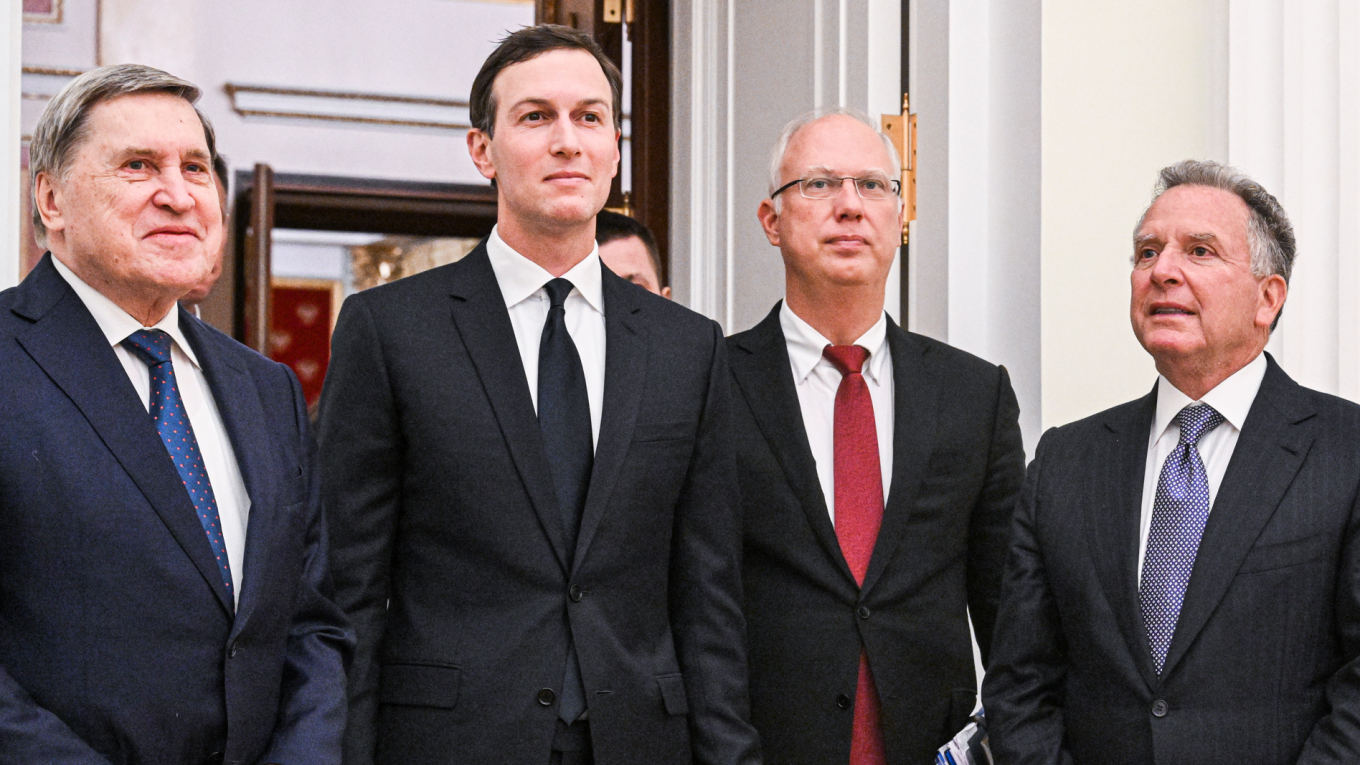
U.S. President Donald Trump’s special envoy Steve Witkoff and son-in-law Jared Kushner have arrived in Moscow for talks with President Vladimir Putin on the White House’s latest plan to end the war in Ukraine.
Trump, emboldened by his mediation of the Gaza ceasefire, has renewed his push in recent weeks to broker a peace deal for Russia’s nearly four-year invasion of Ukraine. But his efforts face steep obstacles.
“I think that there’s a good chance we can make a deal,” Trump said on Sunday.
Here’s what we know about the meeting:
What will they discuss?
Trump's special envoy and son-in-law are expected to personally seek Putin's buy-in on the White House's peace framework.
The White House’s initial 28-point draft that leaked in late November was widely criticized for involving painful concessions from Ukraine and delivering on many of Russia’s other longstanding demands.
It would also freeze fighting in the Kherson and Zaporizhzhia regions, cap the size of Ukraine’s army at 600,000 troops, kickstart a process to use $100 billion in frozen Russian assets to rebuild Ukraine and potentially lift sanctions on Russia.
It was reportedly reduced to around 20 points and made more palatable to Ukraine after criticism from Kyiv and European countries set off a flurry of diplomatic meetings. The updated framework has not yet been made public.
The Kremlin confirmed that Witkoff will be joined by Trump’s son-in-law Kushner, who was previously heavily involved in the president’s Middle East peace efforts.
Video published by the Kremlin showed Putin's foreign policy aide Yury Ushakov, his economic envoy Kirill Dmitriev and a translator joining the Russian president at the talks.
Putin said last week that a sit-down was necessary to discuss details of the plan, but in the same breath warned Ukraine that Russian forces would continue their advance in the Donbas region if Kyiv refused to accept his conditions for a ceasefire.
What does Ukraine think?
Ukraine says that many of the points in the original 28-point plan, including a ban on the country from joining NATO, restrictions on its army and relinquishing territorial claims to Crimea and the Donbas region, are red lines that would leave it vulnerable to renewed Russian aggression in the future.
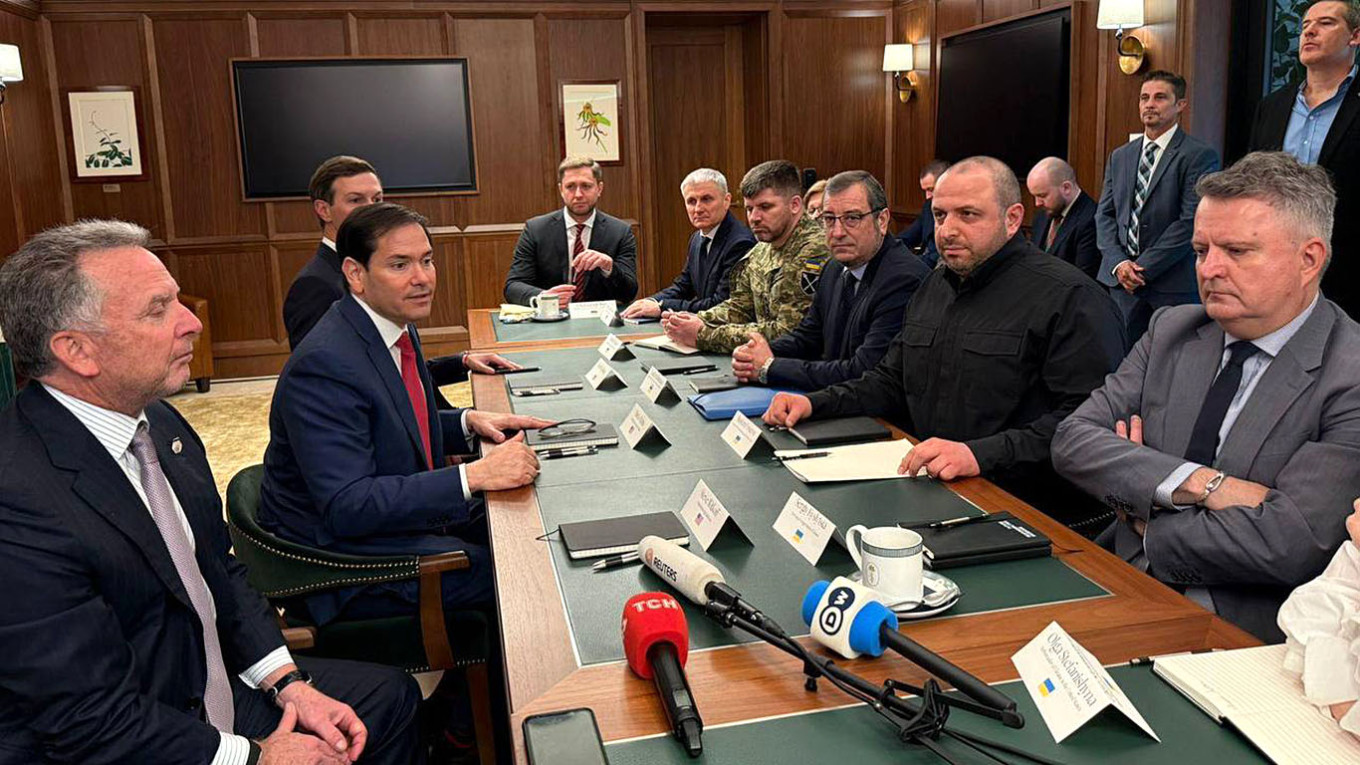
A delegation of Ukrainian negotiators led by Rustem Umerov, the head of Ukraine’s National Security and Defense Council, flew to Florida over the weekend to meet with senior U.S. officials including Secretary of State Marco Rubio, Witkoff and Kushner.
The delegation went to Florida to advocate for Ukraine’s “priorities,” according to President Volodymyr Zelensky.
After speaking for five hours, the two sides gave scant details on their discussions but sounded an optimistic note.
“We had a very productive session,” Rubio told reporters after the meeting. “We don't want to only end the war but make Ukraine safe forever.”
He added that “there is more work to be done” and that Witkoff will try to get buy-in from Putin at Tuesday’s talks.
After the meetings, Zelensky said that the revised proposal “looks better” but that it needed more work.
The Ukrainian leader was in France on Monday to meet with President Emmanuel Macron and shore up support from a key European ally.
What is at stake?
Trump, a self-envisioned peacemaker, has increasingly voiced his frustration with the lack of progress on ending the war. He previously said that he was prepared to walk away from talks if Ukraine did not accept his administration’s peace plan by Nov. 27.
That day came and went without news of a deal. Since then, the U.S. appears to have tried to mold the plan into something acceptable for both Russia and Ukraine. The current round of talks looks to build on those efforts.
But hurdles to peace remain, including the likelihood that Putin might not be interested in a deal at all.
“I see nothing at the moment that would force Putin to recalculate his goals or abandon his core demands,” Tatiana Stanovaya, a senior fellow at the Carnegie Russia Eurasia Center, wrote in a recent post on X.
Stanovaya added that Putin is “more confident than ever” and convinced that Russia can hold off negotiating until Ukraine “finally accepts that it cannot win and must negotiate on Russia’s well-known terms.”
“If the Americans can help move things in that direction — fine. If not, he knows how to proceed anyway,” Stanovaya wrote.
Russia is meanwhile advancing on the battlefield, with the Kremlin claiming Monday evening that its armed forces captured the eastern Ukrainian city of Pokrovsk, a major logistical hub, as well as Vovchansk in the northeast.
Moscow currently occupies nearly 20% of Ukraine's territory, and Western assessments place the number of men killed on both sides in the hundreds of thousands.
The talks also come as Witkoff is facing criticism over his conduct in negotiations with Russia.
As Witkoff’s trip was being planned, Bloomberg published the details of a leaked call between him and Kremlin foreign policy aide Yury Ushakov in which he appeared to coach his Russian counterpart on how to best sell a peace deal to Trump.
That Witkoff’s travel plans were not altered implies that the White House is not making any sudden changes to his position.
Trump has said that the call was a “standard thing” that a “dealmaker does” in negotiations, but the apparent coaching by Witkoff in key negotiations drew bipartisan criticism in the U.S.
“For those who oppose the Russian invasion and want to see Ukraine prevail as a sovereign & democratic country,” Rep. Don Bacon (R-Neb.) wrote in a post on X, “it is clear that Witkoff fully favors the Russians.”
A Message from The Moscow Times:
Dear readers,
We are facing unprecedented challenges. Russia's Prosecutor General's Office has designated The Moscow Times as an "undesirable" organization, criminalizing our work and putting our staff at risk of prosecution. This follows our earlier unjust labeling as a "foreign agent."
These actions are direct attempts to silence independent journalism in Russia. The authorities claim our work "discredits the decisions of the Russian leadership." We see things differently: we strive to provide accurate, unbiased reporting on Russia.
We, the journalists of The Moscow Times, refuse to be silenced. But to continue our work, we need your help.
Your support, no matter how small, makes a world of difference. If you can, please support us monthly starting from just $2. It's quick to set up, and every contribution makes a significant impact.
By supporting The Moscow Times, you're defending open, independent journalism in the face of repression. Thank you for standing with us.

Remind me later.