

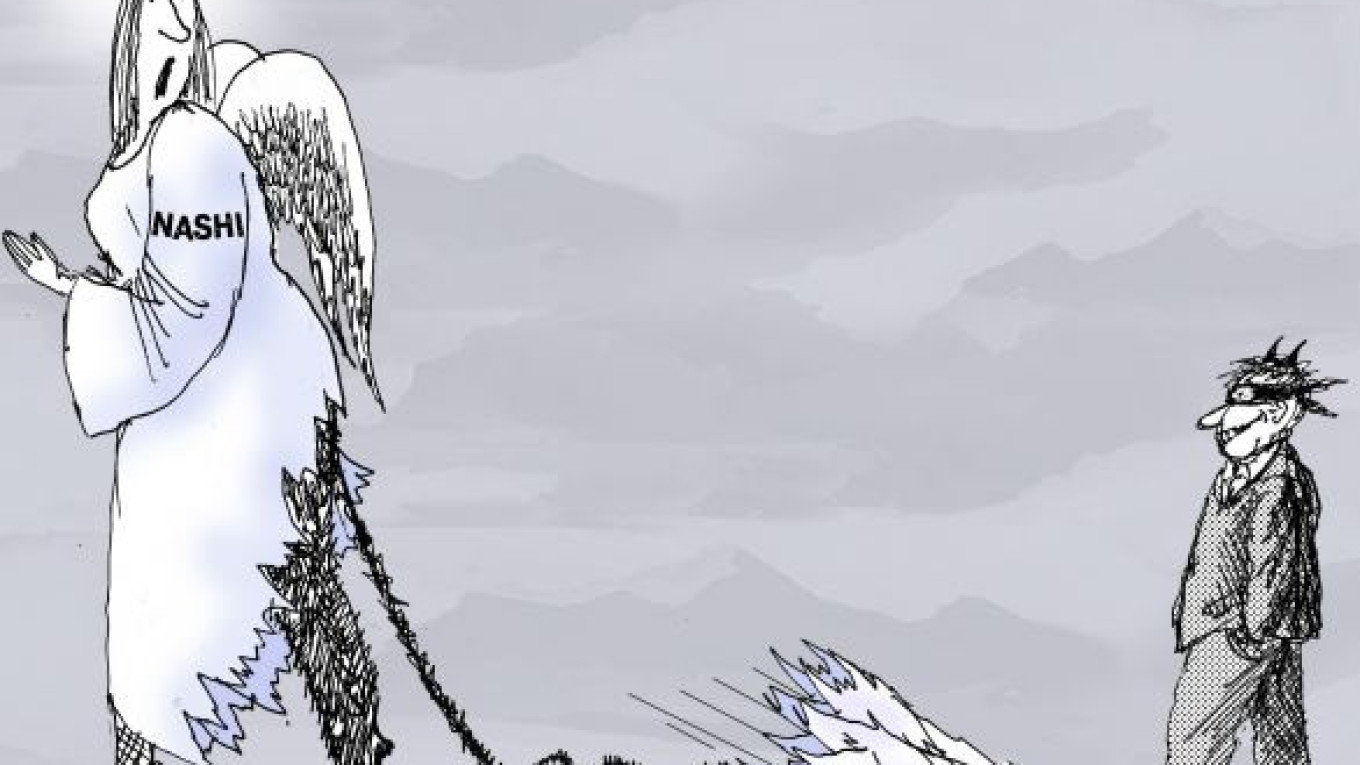
In the Internet age, the famous aphorism of the 19th-century military theorist Karl von Clausewitz, "War is the continuation of policy by other means," may no longer be applicable. Today it's difficult to say whether an Internet war is the continuation of political battles "by other means," or whether it's the spark that sets off new political conflicts.
In Russia, the opposition's struggle for civil rights got a boost after correspondence between the leaders of the Federal Youth Agency was hacked by an anonymous group. This is already being called "Potupchik-gate" after Kristina Potupchik, the agency's press secretary whose fateful e-mail was made public.
While hacking the e-mail of Russian opposition leaders has almost become routine, this is the first time the ploy was used against the purported hackers. The result was what the journalist Oleg Kashin called on his LiveJournal blog "the most serious political scandal of the last 12 years."
Potupchik-gate differs in one key respect from the publication of correspondence of opposition leaders organized by pro-Kremlin hackers. When Alexei Navalny's e-mail was hacked, everyone could read correspondence from his wife, parents and other private individuals whose right to privacy is protected by the law and basic morality. Nothing of this nature was revealed in Potupchik's e-mails. What they did reveal was a huge cache of sensational information that makes the state agency on youth affairs look like a branch of the Cosa Nostra.
As the well-known blogger Anton Nosik wrote on his LiveJournal blog: "What I saw in the published correspondence indicates fraud, embezzlement of public funds, an unbridled information war unleashed against Russian citizens, felony activities and misuse of the Federal Youth Agency's budget. This is the money of Russian taxpayers who have the right to know how they were spammed and deceived with that money."
The e-mails seem to show that the Federal Youth Agency moved huge amounts of money through the leaders of Nashi to organize DDoS attacks on websites unfriendly to the Kremlin, to buy off a number of top 10 bloggers and on other activities that are dubious both morally and legally.
The most innocent activity was the creation of "independent" sites that criticized the opposition. Far less innocent was paying for wildly critical comments about opposition leaders on popular blogs. The amount of money mentioned in the e-mails would turn even a fighter for "freedom of information" like WikiLeaks founder Julian Assange green with envy. A blogger going by the name of Wild_che asked for no less than 18 million rubles a year (about $600,000) for his services.
These prices rival those of an ad campaign in top-end magazines. Publicizing the opening of Nashi's summer camp at Seliger, for example, cost 1.5 million rubles (about $50,000), and the price tag for covering Prime Minister Vladimir Putin's visit to the camp came in at 2.5 million rubles (about $83,000).
Sergei Dik writes on his LiveJournal blog: "While my fellow citizens are selflessly giving 100 rubles, 500 rubles or 1,000 rubles of their salaries to aid seriously ill children, their taxes are being used to hype some stupid clip about Putin on the Internet or used to nullify an article critical of the government on Gazeta.ru. I don't know what budget line this comes out of, but it's a clear misuse of funds. And the Prosecutor's General Office should look into it."
The alleged correspondence shows their technique for organizing "call-in votes" for television shows like "Poyedinok" ("Duel"), hosted by Vladimir Solovyov, clearing up the mystery of how xenophobic and pro-Soviet guests consistently rack up 90 percent of the "audience" rating against their liberal opponents.
The most sensational part of the correspondence concerns the alleged organization of DDoS attacks on sites that criticize pro-Kremlin movements. After an article in Kommersant painted Nashi's activities in a negative light, Potupchik suggests "making Kommersant's life unbearable: Block their work, and break them physically and psychologically." As a state employee, Potupchik knows this is criminal: "[These are] criminal acts. No one will be able to prove it, but those bastards will realize that it's better to leave us alone."
But even in the Internet age, some old truths have not lost their meaning — like learning the lessons of history. For all the power of the propaganda machine in the Soviet Union, it couldn't prolong the life of the regime by a single day. As journalist Pavel Sheremet wrote on his LiveJournal blog: "When society's attitude to the authorities reaches a certain point, no amount of propaganda can keep the situation under control. Discrediting the protest leaders doesn't work anymore. People just don't believe it."
And the more society learns about the activities of Potupchik & Co., the more the authorities are discrediting themselves — and this comes at a time when their trust rating is almost hitting rock bottom.
Victor Davidoff is a Moscow-based writer and journalist whose blog is
A Message from The Moscow Times:
Dear readers,
We are facing unprecedented challenges. Russia's Prosecutor General's Office has designated The Moscow Times as an "undesirable" organization, criminalizing our work and putting our staff at risk of prosecution. This follows our earlier unjust labeling as a "foreign agent."
These actions are direct attempts to silence independent journalism in Russia. The authorities claim our work "discredits the decisions of the Russian leadership." We see things differently: we strive to provide accurate, unbiased reporting on Russia.
We, the journalists of The Moscow Times, refuse to be silenced. But to continue our work, we need your help.
Your support, no matter how small, makes a world of difference. If you can, please support us monthly starting from just $2. It's quick to set up, and every contribution makes a significant impact.
By supporting The Moscow Times, you're defending open, independent journalism in the face of repression. Thank you for standing with us.

Remind me later.