

 | To Our Readers |
The Moscow Times welcomes letters to the editor. Letters for publication should be signed and bear the signatory's address and telephone number. |
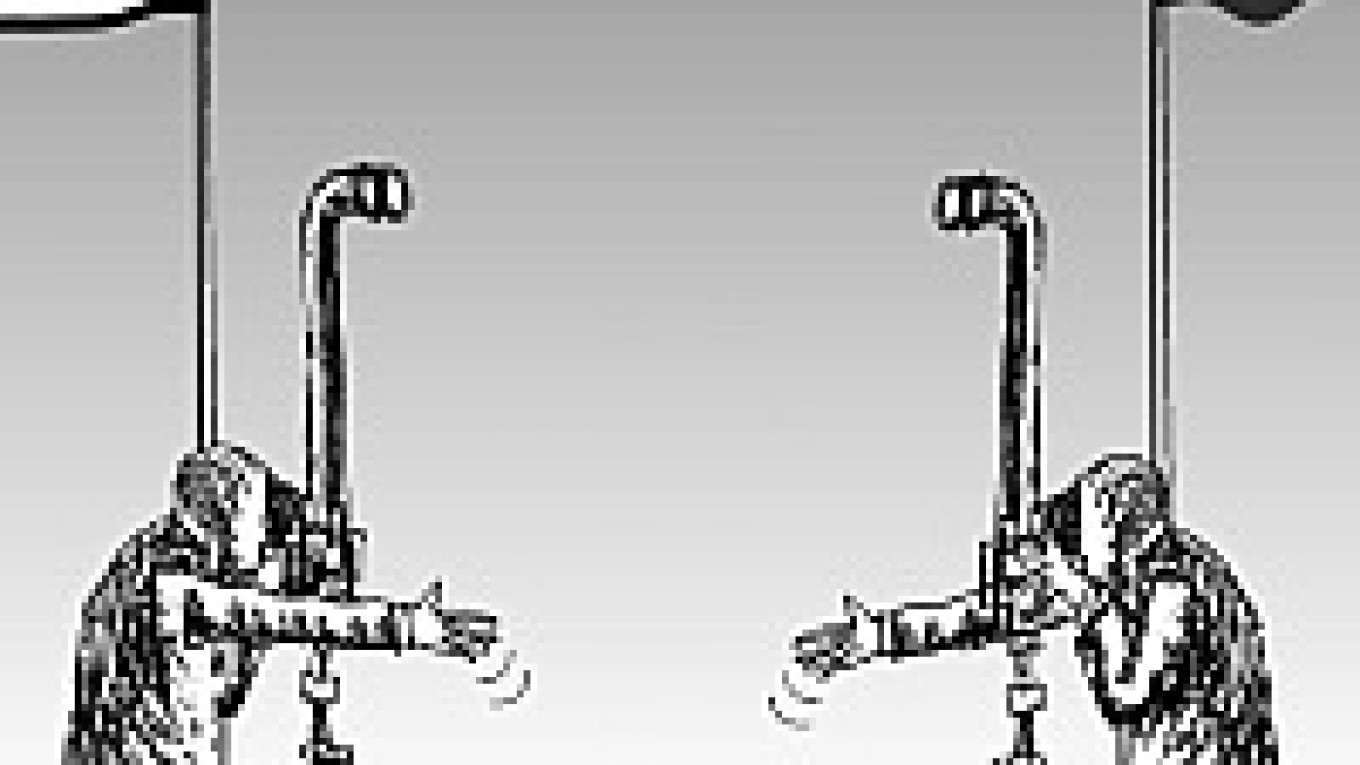
The United States and Russia are slipping and sliding into a dark vortex together. If this continues, the results won't be pretty. Neither side can gain from the current downward spiral of bad relations. Both have much to gain from a cooperative future despite the many problem areas between them. The world continues to look to them for leadership, not squabbling. It has taken two sides to make things bad, and it will take two to bring them right.
It is time to look at this situation "straight up." It is getting late to make a change, but the coming elections in the United States hold out prospects, even if the present teams in power seem to be caught up in a mindless tit-for-tat framework.
What's wrong? The simple answer is too much -- too much old history, too much thinking about the present relationship in outdated zero-sum terms, too much retaliation and too little imagination and innovation in looking to the future.
Those sound like tough conclusions, but what do they really mean?
The United States still looks at Russia too much in Cold War terms -- as if nothing had really changed. For example, many Americans still use the term "Soviet Union" when they are talking about and asking questions concerning Russia. In addition, many in the United States view the country as an expansionist and nationalist monolith that poses a danger to itself and its friends in Europe. And they largely ignore Russia's positive contributions and accomplishments, such as its withdrawal from military bases in Cuba and Vietnam, its early offer of help and assistance after Sept. 11 and its economic recovery and growth to name just a few
For its part, Russia looks at the United States too often through "red-colored" glasses. NATO is still seen as the same old NATO that the Soviet propagandists made it out to be -- aggressive, threatening and a danger to Russia. Any enlargement of NATO still seems like a continuation of the Cold War on new grounds. The difficult period of the 1990s economic crises is viewed as U.S machinations intent on humiliating Russia, instead of a natural consequence of the country's emergence from the economic and other failures of communism. U.S. actions in Afghanistan and Iraq are both seen as offensive, not defensive. Unlike the case of Iraq -- which most Americans now see as a bad mistake -- most Russians don't take into consideration that Afghanistan was, in fact, a large base and a refuge for the al-Qaida terrorists who attacked the United States.
Where can we go from here?
Continuing the status quo will take us further downhill. New approaches are necessary. We won't change easily the mind-sets outlined above, but we need to begin that process by first thinking before we speak about each other. Second, we need to look at the Cold War platitudes of the past as bygones that neither accurately describe our current world nor the relationship we want to see prevail. This can lead as it must to a more fruitful dialogue and cooperation.
Both Russia and the United States enter the 21st century as great powers that will have much to say about the world and how it proceeds. They are joined by China, India, Japan, the European Union, Brazil and perhaps one or two others. Relations among them will be governed by the need to have a firm bilateral basis for cooperation and a developing commitment to solving key problems multilaterally.
The key to strong U.S.-Russian bilateral relations is the need to discover and develop a common positive agenda. The world will look to Russia and the United States to lead on nuclear disarmament with serious new cuts in weapons and delivery vehicles in the near future. Nuclear nonproliferation, U.S. ratification of the Comprehensive Nuclear Test Ban Treaty and U.S.-Russian cooperation on a fissile-material production cutoff can do much to move us toward the goal of establishing a world without nukes -- an ambitious idea promoted by former U.S. Secretary of State Henry Kissinger, former U.S. Senator Sam Nunn, former U.S. Defense Secretary William Perry and former U.S. Secretary of State George Shultz. Trade cooperation, Russia's membership in the World Trade Organization and more joint scientific research in aerospace and medicine mark out just a few of the special areas where we could both learn and lead together.
The next stage should be putting these steps into place, one by one. These positive accomplishments will help to offset some of the negatives. We both need frank and open discussions about the rest of the world and it views on each others strategic interests, especially in the 'near abroad'. That may not produce an agreement, but it will at least foster understanding about where each would like to go and how and why.
Finally, we need once again "adult supervision." This is by no means meant as criticism of the present leaders in each country; in fact, they have been successful in preserving and strengthening cooperation much better than their subordinates. But U.S. President George W. Bush (and his successor come January), President Dmitry Medvedev and Prime Minister Vladimir Putin should seriously consider appointing a senior figure holding their trust and confidence to oversee and manage the relationship. We need senior leaders on both sides who can take over the agenda and assure that projects are brought to completion. They also need to understand how to lead Cabinet members and private-sector leaders to improve U.S.-Russian relations if we are to avoid catastrophic competition and continued controversy.
And what about working with others? With better bilateral relations this should be easier. We should not get caught up on institutional frameworks. The United Nations Security Council and the Group of Eight sometimes works well and sometimes does not. There is a clear need for others to be part of key issues, such as climate change, trade, economic development, battling with AIDS or going to the moon and Mars.
There is much that must be done to improve U.S.-Russian relations, and with new administrations in place in both countries, the challenges will be significant. Let us all hope that the time for a turnaround has come at last. Despite manifold differences, our leaders can find new opportunities to do what we both do best -- cooperate for mutual gain.
Thomas R. Pickering served as U.S. ambassador to the United Nations from 1989 to 1992, U.S. ambassador to Russia from 1993 to 1996 and U.S. undersecretary of state for political affairs from 1997 to 2001.
A Message from The Moscow Times:
Dear readers,
We are facing unprecedented challenges. Russia's Prosecutor General's Office has designated The Moscow Times as an "undesirable" organization, criminalizing our work and putting our staff at risk of prosecution. This follows our earlier unjust labeling as a "foreign agent."
These actions are direct attempts to silence independent journalism in Russia. The authorities claim our work "discredits the decisions of the Russian leadership." We see things differently: we strive to provide accurate, unbiased reporting on Russia.
We, the journalists of The Moscow Times, refuse to be silenced. But to continue our work, we need your help.
Your support, no matter how small, makes a world of difference. If you can, please support us monthly starting from just $2. It's quick to set up, and every contribution makes a significant impact.
By supporting The Moscow Times, you're defending open, independent journalism in the face of repression. Thank you for standing with us.

Remind me later.