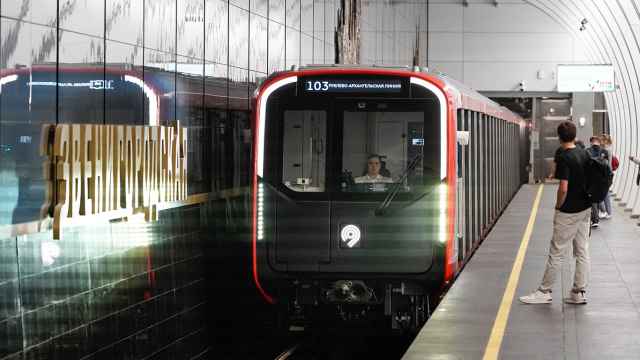
Moscow Mayor Sergei Sobyanin announced Tuesday plans to extend two of the city’s oldest metro lines, bringing transit access to nearly half a million residents in the northeastern districts and the southwestern outskirts.
The Sokolnicheskaya Line, commonly known as the Red Line, will expand northeast by 8.1 kilometers (5 miles) beyond its current Bulvar Rokossovskogo terminus.
The project features two new stations serving the Moscow State University of Civil Engineering and the Yaroslavsky District, a move expected to connect 100,000 residents and slash travel times by 20 minutes.
Meanwhile, the light-blue Filyovskaya Line will expand westward by 12 kilometers (7.5 miles), adding five new stations past the Kuntsevskaya terminal.
That branch will provide transit links to roughly 320,000 people across four municipal districts, including Skolkovo, the high-tech business area sometimes referred to as “Russia’s Silicon Valley.”
Sobyanin did not provide an official completion deadline for either extension.
Moscow’s metro system has expanded rapidly since Sobyanin took office more than 15 years ago.
A Message from The Moscow Times:
Dear readers,
We are facing unprecedented challenges. Russia's Prosecutor General's Office has designated The Moscow Times as an "undesirable" organization, criminalizing our work and putting our staff at risk of prosecution. This follows our earlier unjust labeling as a "foreign agent."
These actions are direct attempts to silence independent journalism in Russia. The authorities claim our work "discredits the decisions of the Russian leadership." We see things differently: we strive to provide accurate, unbiased reporting on Russia.
We, the journalists of The Moscow Times, refuse to be silenced. But to continue our work, we need your help.
Your support, no matter how small, makes a world of difference. If you can, please support us monthly starting from just $2. It's quick to set up, and every contribution makes a significant impact.
By supporting The Moscow Times, you're defending open, independent journalism in the face of repression. Thank you for standing with us.

Remind me later.