

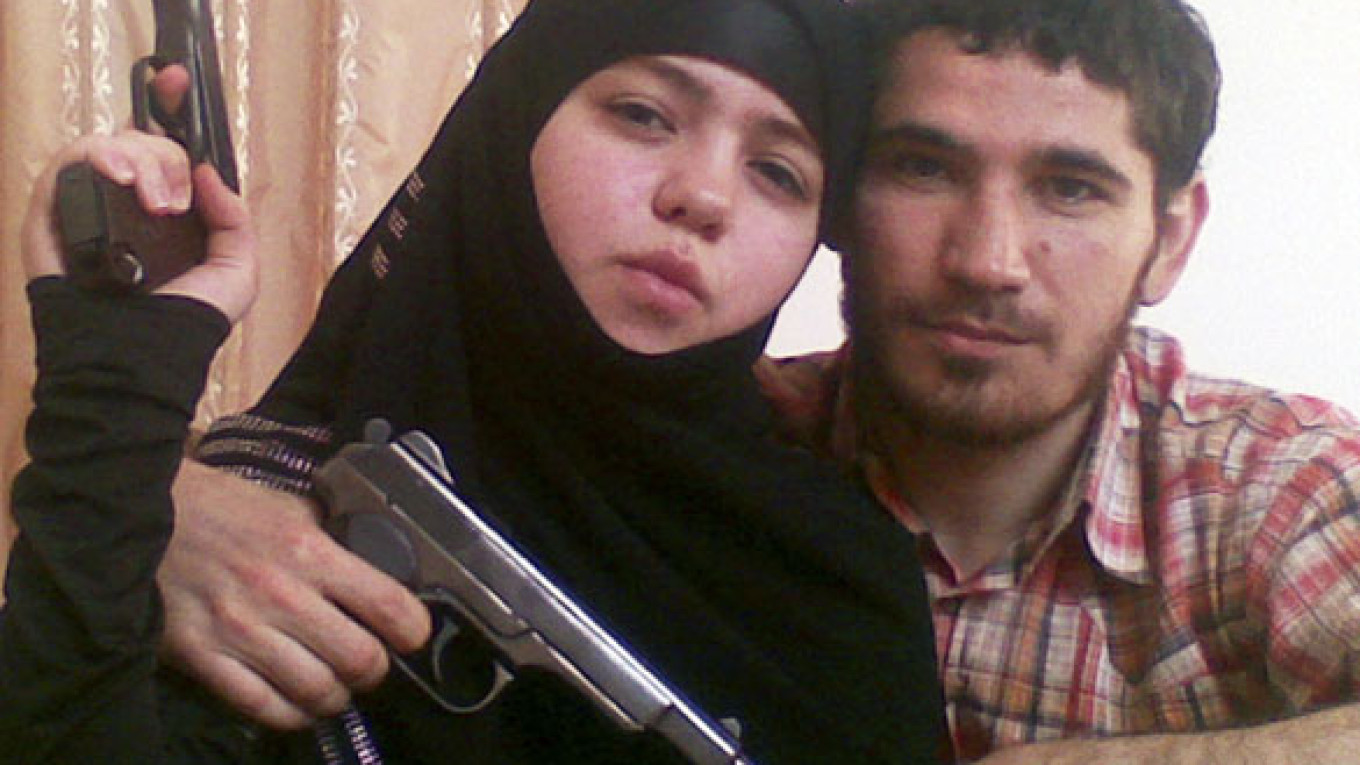
The bombing at the Park Kultury metro station could have been carried out by Dzhennet Abdurakhmanova, the young widow of a North Caucasus rebel who was killed in a sweep operation by the Federal Security Service late last year.
Abdurakhmanova, also identified as Abdullayeva, is the 17-year-old widow of Dagestani rebel leader Umalat Magomedov, also identified as Al Bar, who was killed on Dec. 31, a source in the National Anti-Terrorism Committee told Interfax Friday.
The other suspected suicide bomber is Markha Ustarkhanova, the 20-year-old widow of Chechen rebel leader Said-Emin Khizriyev, who was killed in October after law enforcement agencies received a tip that he was preparing to assassinate Chechen President Ramzan Kadyrov, Kommersant reported Thursday, citing a source in the Chechen Interior Ministry.
However, a Chechen law enforcement source told RIA-Novosti Thursday that Ustarkhanova was not one of the two suicide bombers.
Ustarkhanova, who is on a list of missing persons, wanted to become a suicide bomber to avenge her husband's death, a Chechen Interior Ministry source told Kommersant.
President Dmitry Medvedev called upon leaders of the political parties present in the State Duma on Friday to support tougher measures against terrorists but was firm that there would be no capital punishment for them despite recent calls for it to be reintroduced.
"Those who committed the terrorist attacks will be held responsible, but as for the death penalty — here we have our obligations," the president said at the Kremlin meeting, referring to the 1997 moratorium.
The party leaders convened to discuss the response to the series of the suicide bomb attacks this week in Moscow and the Dagestani town of Kizlyar. Doku Umarov, the leader of the so-called Caucasus Emirate, has claimed responsibility for Monday’s attacks in the Moscow metro, in which 40 people died as of Friday.
Medvedev on Friday called for a "merciless" attitude to those who help terrorists, independently of what they do to them.
"I believe that for the terrorism crimes we need to create such a model when anyone who helps terrorists — be it cooking a soup for them or doing their laundry — will have committed a legally defined crime," the president said.
Medvedev said he might consider proposing amendments to the Criminal Code, to change the legal definitions of terrorism.
The president also demanded for consolidation of the society and of the Duma parties in order to fight terror.
State Duma speaker Boris Gryzlov, who leads the pro-Kremlin United Russia’s faction in the parliament, demonstrated willingness to support tougher measures against terrorists.
"Those who plan bombings, including in the metro, should be destroyed without any doubt. They cannot be rectified," he said.
Medvedev also defended the criticism of the country’s law enforcement agencies by the media after Federation Council speaker and leader of the Just Russia party Sergei Mironov accused some media outlets of playing on the side of the attackers.
"They tried to demonstrate that the state is not able to prevent the threat and abandons citizens to be slaughtered by terrorists," Mironov said.
Medvedev said that such a reaction on the part of the media was "normal."
Authorities have also drafted a color-coded system for warning the population about terrorism threats that would be similar to systems used in the United States and Britain, Anatoly Safonov, a special presidential envoy for international cooperation in fighting terrorism, told Interfax Thursday.
The population prevention system would include terms such as "dangerous," "high" and "threatening," coded by green, orange and red, to define the level of a terrorist threat, Interfax reported Thursday, citing a 2008 interview with a senior official at the National Anti-Corruption Committee, Yevgeny Ilyin.
The committee has drafted law amendments to introduce the system, Security Council Secretary Nikolai Patrushev told Interfax last week.
Medvedev on Wednesday ordered the government to draft a program within the next four months that would spell out complex safety measures for the country's public transportation system, including the installation within a year of technical devices that would make the system "invulnerable to the acts of illegal intrusion." He said the program would be enforced by introducing safety measures on transportation before January 2014, according to an order published on the Kremlin's web site.
Medvedev's order didn't say what kind of devices the transport could be equipped with or what kind of safety measures could be introduced.
Moscow law enforcement officials have sent screenshots of the two suspected suicide bombers and their suspected male associate taken from video cameras in the Moscow metro to their colleagues in the North Caucasus, a source in the law enforcement agencies of the North Caucasus told RIA-Novosti Friday.
The suspected associate of the suicide bombers could be Pavel Kosolapov, a native of the southern city of Volgograd, whom authorities suspect of masterminding a series of deadly bombings, including the one between the Avtozavodskaya and Paveletskaya metro stations in February 2004, the one outside the Rizhaskaya metro station in August 2004 and the Nevsky Express train bombings in 2007 and 2009, a source in the law enforcement agencies of the North Caucasus told Gazeta.ru Friday.
Kosolapov remains at large.
A Message from The Moscow Times:
Dear readers,
We are facing unprecedented challenges. Russia's Prosecutor General's Office has designated The Moscow Times as an "undesirable" organization, criminalizing our work and putting our staff at risk of prosecution. This follows our earlier unjust labeling as a "foreign agent."
These actions are direct attempts to silence independent journalism in Russia. The authorities claim our work "discredits the decisions of the Russian leadership." We see things differently: we strive to provide accurate, unbiased reporting on Russia.
We, the journalists of The Moscow Times, refuse to be silenced. But to continue our work, we need your help.
Your support, no matter how small, makes a world of difference. If you can, please support us monthly starting from just $2. It's quick to set up, and every contribution makes a significant impact.
By supporting The Moscow Times, you're defending open, independent journalism in the face of repression. Thank you for standing with us.

Remind me later.