

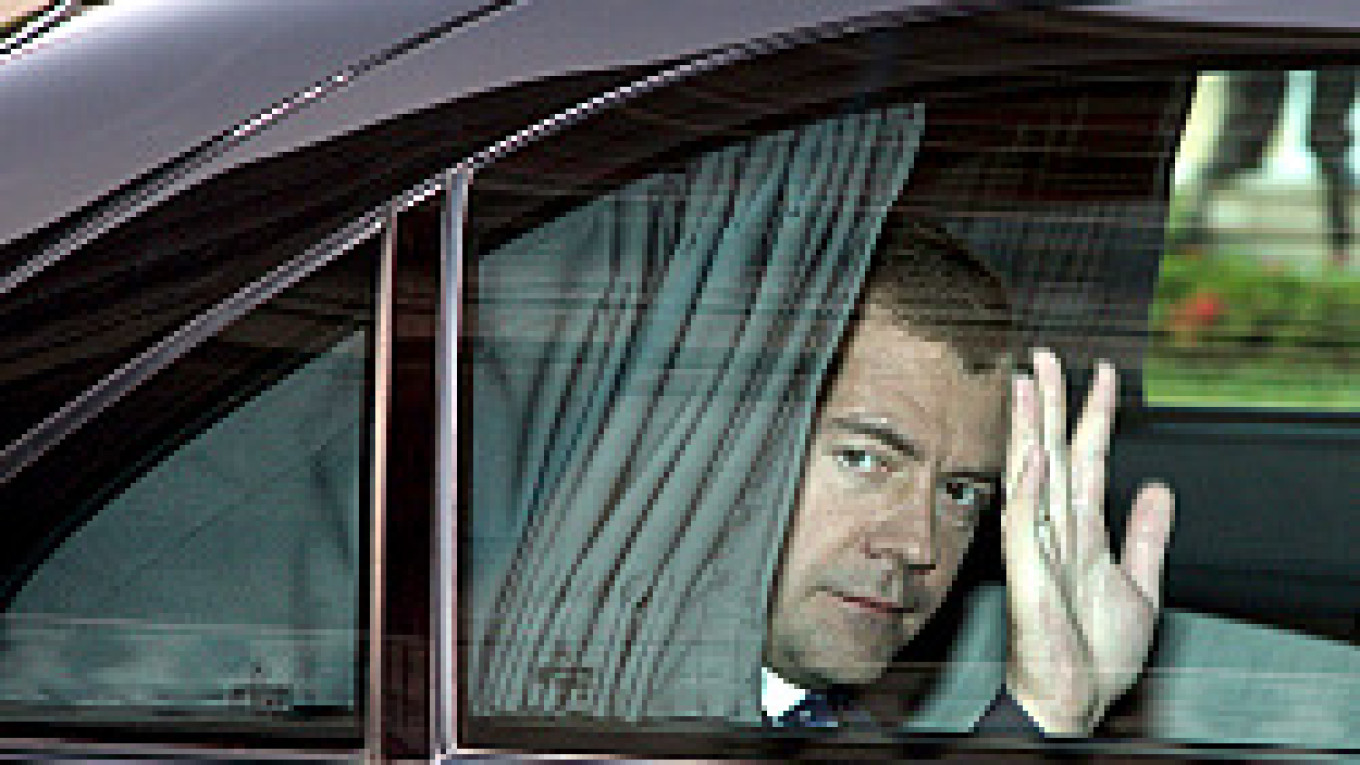
The countries also vowed to work together in areas including energy, mining and telecoms in a bid to bolster ties between the former Cold War allies.
Cooperation with the Organization of the Petroleum Exporting Countries is "particularly important in the current situation, when the oil market is going through serious changes," Medvedev told reporters after talks with Angolan President Jose Eduardo dos Santos.
"We're not entirely satisfied with the state of the market," he said. "The oil market shouldn't be dependent on the situation in a single economy."
He also said state-oil company Zarubezhneft and Angolan state-run oil firm Sonangol were in talks to explore for hydrocarbon deposits.
"We also discussed cooperation in other areas and hope we can realize projects that are worthy of the new age," he said.
One such project is Russia's funding of the construction of two major dams in Angola's Kwanza River.
Another is a $300 million Russian loan from Vneshekonombank, VTB Group and Roseximbank to improve Angola's telecommunications sector with the launch of a satellite branded Angosat.
The countries signed six agreements to cooperate in several sectors of the economy in hopes of increasing trade between them, which stood at just $76 million last year.
Medvedev's visit to Angola, the first to the southern African country by a Russian head of state, follows stops in Egypt, Nigeria and Namibia. Medvedev said in Namibia on Thursday that Russia was "almost late" in returning to Africa. "We should have started working with our African partners a long time ago."
In Nigeria, Gazprom and state-run Nigerian National Petroleum agreed to create a joint venture, NiGaz Energy, worth at least $2.5 billion.
A Message from The Moscow Times:
Dear readers,
We are facing unprecedented challenges. Russia's Prosecutor General's Office has designated The Moscow Times as an "undesirable" organization, criminalizing our work and putting our staff at risk of prosecution. This follows our earlier unjust labeling as a "foreign agent."
These actions are direct attempts to silence independent journalism in Russia. The authorities claim our work "discredits the decisions of the Russian leadership." We see things differently: we strive to provide accurate, unbiased reporting on Russia.
We, the journalists of The Moscow Times, refuse to be silenced. But to continue our work, we need your help.
Your support, no matter how small, makes a world of difference. If you can, please support us monthly starting from just $2. It's quick to set up, and every contribution makes a significant impact.
By supporting The Moscow Times, you're defending open, independent journalism in the face of repression. Thank you for standing with us.

Remind me later.