

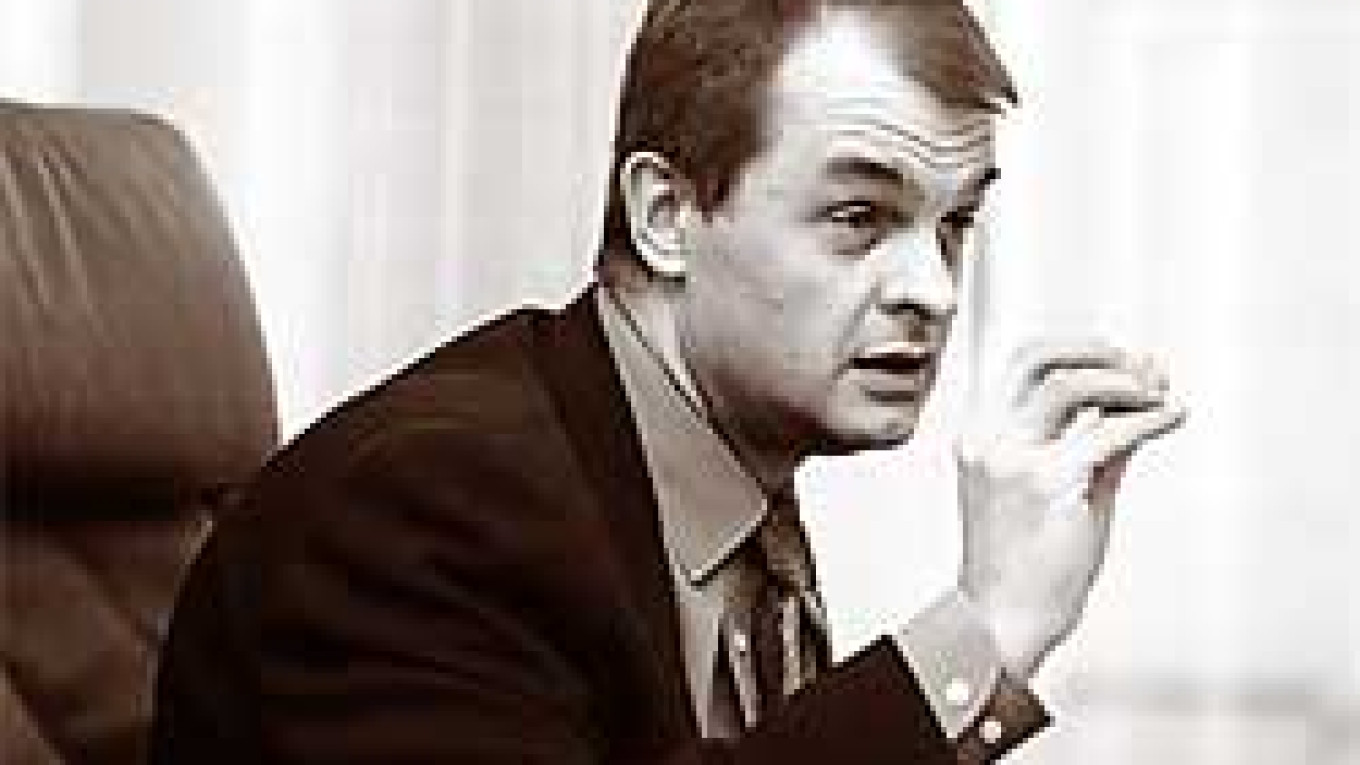
However, Kudrin's deputy Sergei Kolotukhin, who has been in close contact with the creditors for about a year, doesn?€™t think there is anything extraordinary about this. This is the usual way the early stages of negotiations are conducted, he said.
Q:
After meeting with German Chancellor Gerhard Schröder, President Vladimir Putin announced that Russia, "in any event," would settle its debts. Does this mean that the government no longer plans to bring up the question of debt write-offs with the Paris Club?
A:
I won?€™t try to interpret what the president says. Russia?€™s policy has always been to make payments under Soviet-era debt based on the state of the economy and the country?€™s realistic capabilities. It clearly makes more sense to agree to an interim restructuring of the payments falling within the period agreed to with the [International Monetary Fund] and on conditions approximately analogous to the agreement with the Paris Club of Aug. 1, 1999. These conditions propose payment by installments over a period as long as 25 years and stipulate that the creditors will consider the possibility of an all-encompassing regulation of the former Soviet Union's debt over a particular period. The latter instance presupposes the debts would be partially written off. However, this is my own point of view on the prospects and possible conditions for reaching an agreement with the Paris Club.
Q:
Such a provision in the 1999 agreement permits the government to raise the question of writing off part of the debt already.
A:
This all depends on how prepared the creditors are for this. We?€™re not talking about the club?€™s obligation, rather the extent to which it?€™s prepared to conduct a comprehensive restructuring and debt write-off. Creditors are practical people. If the situation in Russia seems to them to be sufficiently stable, then they would find it difficult to agree to write off debt. Moreover, the program of structural reforms in Russia has just gotten under way. It is, therefore, difficult for creditors to determine what volume of debt needs to be written off in order to guarantee the stable economic growth of the economy and, consequently, the level of payments appropriate for the country with respect to foreign debt. This is why today we could ask for the burden of foreign payments to be lightened only in 2001 and possibly 2002. And then return to the question of a global restructuring in 2002 to 2003.
Q:
If the Paris Club won?€™t compromise, could the creditors announce that Russia has defaulted?
A:
The Paris Club doesn?€™t have firmly established rules, nor by extension do they have a concept of default ?€” especially a technical default. It isn?€™t written anywhere that a country will be declared to have defaulted if it has failed to make certain payments to the club over the course of, shall we say, 60 days. This is the way it normally happens. The country that is for some reason unable to pay notifies the club and requests that the debt be restructured. The Paris Club hunkers down to examine the issue. It might say: No, either pay or provide us with more detailed evidence. After this, the consultation and negotiation process begins to determine the scheme for future payments and servicing of the debts.
Q:
And there has been no precedent set whereby default was declared after all this?
A:
Of course, Russia is a country that has set certain precedents. But now, the situation seems quite typical ?€” there is nothing extraordinary about it. In a letter to Jean-Pierre Jouyet, Russia said it couldn?€™t make debt payments in full, due to certain conditions, and as a result requests the issue of restructuring be considered. The club secretariat replied that Russia?€™s economic conditions are such that it can pay. In this response, which has provoked a stormy reaction in the press, there is no mention of the club categorically refusing to consider the question of restructuring. It merely repeats that after the club?€™s assessment of the economic situation in the country, Russia is capable of paying its debts. This is the normal reaction of any creditor at the start of intensive negotiations.
Q:
Which stage have negotiations with the Paris Club reached? Are these consultations, or are Russian officials simply making unofficial contact? Some of your colleagues say the fact that Kudrin and Jouyet are corresponding marks the start of negotiations.
A:
The consultations began last fall. They?€™re being conducted both with the main creditors and with the Paris Club secretariat. The club is a rather complex organization, and it?€™s extremely difficult to distinguish consultations from official negotiations ?€” one flows smoothly into the other. Of course, the consultations held in the fall were needed to explain the position of the parties. In other words, why Russia is asking for a restructuring and on what conditions, approximately, it would like the debt to be restructured. Naturally, the creditors set out their position. Informal contact has been ongoing for some time, but the exchange of letters between Kudrin and Jouyet has elevated it to a higher official plane.
Q:
Before agreeing with the Paris Club, the government must, over the next couple of months, bring its assessment of the payments balance in line with the IMF forecast and agree with the Fund on economic programs in general. This is not the easiest of tasks.
A:
First, our assessments are already converging. In November last year, the IMF mission presented an extremely optimistic forecast for Russia?€™s payments balance. It has now been corrected both to allow for oil prices as well as other elements. It would seem that the IMF is starting to orient itself not just on the immediate state of the economy, but is also taking into consideration the possible risks. Only an approach such as this will permit a reliable economic strategy.
Q:
And if the IMF board of directors does not approve the Russian program?
A:
In my opinion, this is no reason for the Paris Club of creditors to reject the restructuring. As a rule, the Paris Club operates thus: If there is no IMF-approved program, then there is no debt restructuring. At the same time, the club acts according to a principle of "conditionality" ?€” and makes allowances for the particular economic conditions of a country. If a program isn?€™t agreed to with the IMF despite all efforts, but it?€™s clear that Russia is unable to service and pay back in its current volumes, I believe that the said principle could come into play.
Q:
Why then has the club taken such an inflexible stance with regard to Russia? Ukraine, for instance, hasn?€™t even paid the club interest payments and doesn?€™t have an agreement either with them or the IMF. They merely notified the club by letter of their refusal, and there has been no international scandal as a result.
A:
Behind the attractive title of the Paris Club, there are people working just like us who are encouraged by the results achieved today. Therefore, it?€™s easy to understand the creditors?€™ position ?€” they want to receive the maximum funds while the economic situation in the borrower country seems comparatively stable. The pressure on Russia just goes to show once again that the Paris Club doesn?€™t have confidence that the current state of world prices will hold forever. But by making the government pay in full, the creditors are actually reducing the value of their demands from the Russian Federation.
If we make an allowance for the negative tendency on the raw materials market, we can expect the payments balance to get significantly worse. With tax reforms under way, it?€™s unlikely there will be a significant growth of revenue coming into the budget. If the Paris Club payments are made in full, then, along with other foreign payments, they comprise about 40 percent of budget expenses. A budget deficit will be the result. It can be financed by attracting [Central Bank] funds or borrowing on the internal market. Taking money from the Central Bank means reducing hard currency reserves and putting macroeconomic stability in danger. Borrowing on the internal market is no better ?€” the credits are very short-term and extremely expensive. This puts an additional burden on the budget. We get into a magic circle when any step taken outside its perimeter will undermine the state of the budget and drive Russia into a true default. Taxes must be raised in order to avoid this. But then, we would be putting economic growth at stake, which is the source of these foreign payments. Payments under foreign loans, in any case, account for a quarter of this year?€™s budget expenses and exceed expenses on education, health care and other social elements combined.
If we break loose entirely and there are significant financial and fiscal explosions as a result, then in the future, Russia will not be in a position to service the debt at all. Their market value will naturally fall. Therefore, the creditors must look ahead ?€” what are they more interested in, achieving a small part of the payments immediately or receiving regular interest payments over a long period as well as the pay back of the principal debt?
Q:
Could the government?€™s position change over this quarter?
A:
I doubt it. We will have to see how the negotiations go with the IMF. How they assess the situation in Russia in the light of falling oil prices and increased import costs. In addition, we?€™re looking at data on capital flight, which also affects the payments balance.
Q:
How much is to be paid to the Paris Club according to the original schedule?
A:
In the first quarter, according to our calculations, the amount was $1.6 billion and $3.8 billion for the year. But many of the loan agreements have floating interest rates and, as a result, the amount changes.
Q:
But the club mentions a different amount for Russia?€™s debt ?€” $5.9 billion.
A:
They are probably counting the total Soviet and Russian debt that was formed after 1991 from loans guaranteed by the government.
Q:
As of January 2000, the total debt to the Paris Club was $39.5 billion, but by January 2001 this amount had increased to $48.6 billion. Surely the interest can?€™t have accumulated so much over the year?
A:
The confusion is connected with [State] Duma discussions regarding the limits of the country?€™s foreign debt. The $48.6 billion figure came from adding the U.S.S.R. debt and the new Russian debt. In reality, as of January 2001, the debt of the former U.S.S.R. to the Paris Club was $38.7 billion.
Q:
Doesn?€™t it seem to you that the IMF and the Paris Club have forced the government into a corner? The club doesn?€™t want to discuss restructuring until the IMF approves the program. Meanwhile, according to IMF director for Russia Alexei Mozhin?€™s announcements, if the Fund approves a country?€™s program, which has delayed debt, it "must hear from creditors that the country will negotiate and that it truly does have difficulties that are recognized by the creditors."
A:
First, the Paris Club hasn?€™t announced that Russia has a delayed debt. Second, the situation is normal ?€” we have a long way to go before we get to a dead end. The IMF always asks creditors to express whether they are prepared for negotiations on restructuring. Furthermore, this position doesn?€™t have to been indicated in writing. There is no set procedure here ?€” it can be in any other form. The most important thing for the Fund is to know that the club is not against restructuring in principle.
A Message from The Moscow Times:
Dear readers,
We are facing unprecedented challenges. Russia's Prosecutor General's Office has designated The Moscow Times as an "undesirable" organization, criminalizing our work and putting our staff at risk of prosecution. This follows our earlier unjust labeling as a "foreign agent."
These actions are direct attempts to silence independent journalism in Russia. The authorities claim our work "discredits the decisions of the Russian leadership." We see things differently: we strive to provide accurate, unbiased reporting on Russia.
We, the journalists of The Moscow Times, refuse to be silenced. But to continue our work, we need your help.
Your support, no matter how small, makes a world of difference. If you can, please support us monthly starting from just $2. It's quick to set up, and every contribution makes a significant impact.
By supporting The Moscow Times, you're defending open, independent journalism in the face of repression. Thank you for standing with us.

Remind me later.