

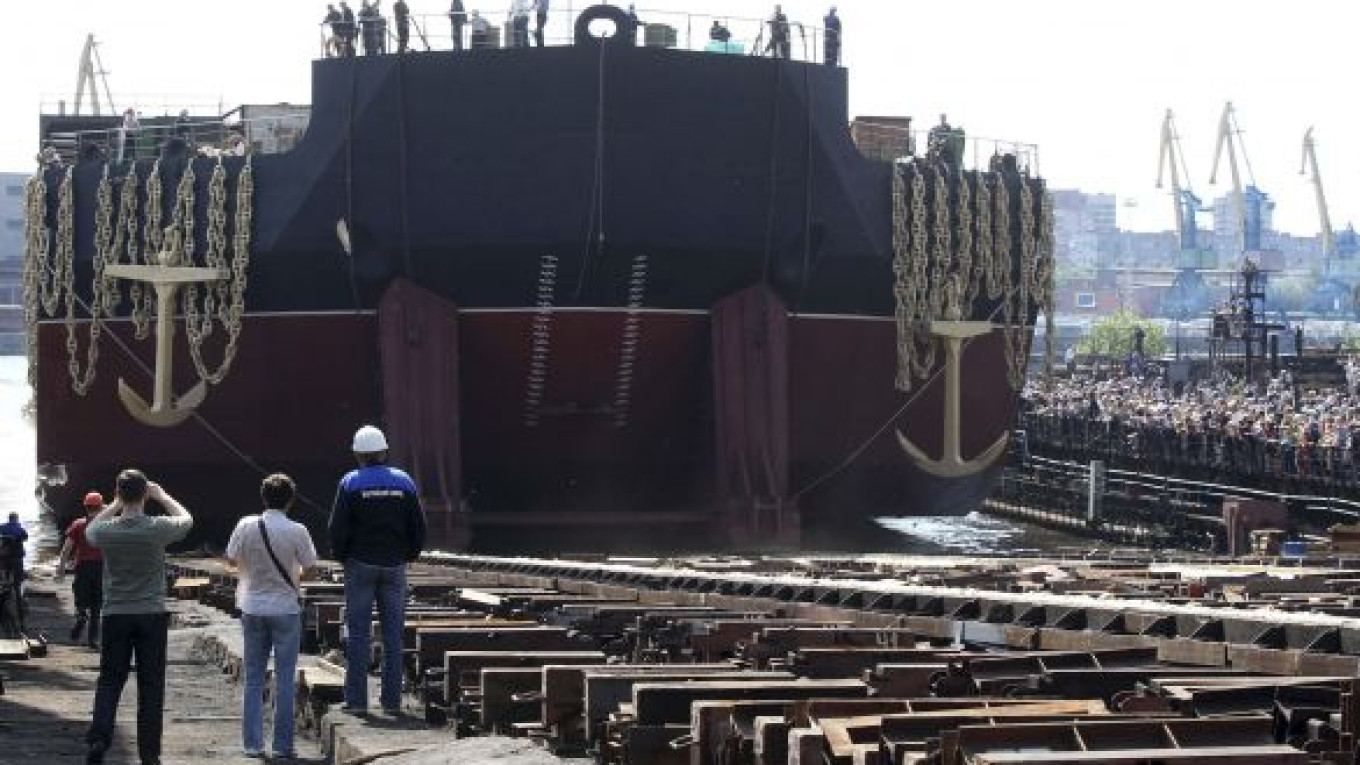
ST. PETERSBURG — Russia has taken a big step toward the controversial creation of the world's first floating nuclear power station, putting a barge that will house the plant into the water.
Environmentalists say Russia's plan to dot its northern coastline with floating nuclear power plants is risky.
Rosatom head Sergei Kiriyenko said Wednesday that the plant would be "absolutely safe" and predicted "big interest from foreign customers."
The vessel housing the plant, which Kiriyenko said should be ready to operate in late 2012, was launched at the Baltiisky shipyard in Russia's Imperial-era capital on the Baltic Sea.
Kiriyenko said nuclear fuel for the plant would be loaded later in the Murmansk region, further north, and the station towed to its place of operation. It would be hauled away after 32 years of service, he said, leaving the surrounding area "the same as before the station arrives."
Environmentalists are not convinced.
"The danger begins when the reactor is installed and nuclear fuel put there," said Vladimir Chuprov, Greenpeace Russia's energy projects chief.
"If something goes wrong … it could mean the nuclearization of several dozen hectares of land at a minimum and tens of thousands of people evacuated from the polluted area," he said.
Critics also warily recall Soviet-era nuclear accidents and Russia's naval disasters such as the loss of the nuclear-powered submarine Kursk, which sank in the Barents Sea after explosions on board, killing all 118 crew members.
Kiriyenko said the floating plant, called the Academician Lomonosov, would have the capacity to produce 80 megawatts of electricity. He said at least six potential sites for such plants have been chosen in northern Russia.
A Message from The Moscow Times:
Dear readers,
We are facing unprecedented challenges. Russia's Prosecutor General's Office has designated The Moscow Times as an "undesirable" organization, criminalizing our work and putting our staff at risk of prosecution. This follows our earlier unjust labeling as a "foreign agent."
These actions are direct attempts to silence independent journalism in Russia. The authorities claim our work "discredits the decisions of the Russian leadership." We see things differently: we strive to provide accurate, unbiased reporting on Russia.
We, the journalists of The Moscow Times, refuse to be silenced. But to continue our work, we need your help.
Your support, no matter how small, makes a world of difference. If you can, please support us monthly starting from just $2. It's quick to set up, and every contribution makes a significant impact.
By supporting The Moscow Times, you're defending open, independent journalism in the face of repression. Thank you for standing with us.

Remind me later.