

What follows is a small example of how history and personal lives can intertwine over time in unexpected and significant ways. The personal side of this story is largely my own, but not entirely. It usually takes a lot of people coming together to make a story worth telling.
Let’s say the story begins in the Black Sea resort town of Gagry in 1933. It was there that Nikolai Erdman, one of the most respected writers of the time, was arrested with his friend and colleague Vladimir Mass. They had written the script for a film comedy, the so-called first Soviet musical, and they were attending the filming of its early scenes, which take place at a bucolic Black Sea resort.
The script the pair had written was called “The Shepherd from Abrau-Dyurso.” By the time the film was released the title had changed to “Jolly Fellows,” a title and a film that no individual living in Russia to this day can possibly fail to recognize. But the huge success of “Jolly Fellows” is a different story, for by the time it began its triumphant run of Soviet cinemas, Erdman and Mass had long been exiled to Siberia: Mass to Tobolsk, Erdman to the tiny, frozen town of Yeniseisk.
One year later, in recognition of good behavior, Erdman was reassigned to the larger, more culturally active city of Tomsk. This was at the end of 1934.
Thanks to the intercession of Lina Samborskaya, an actress and director well-known in Siberia at the time, an exception was made and the officially exiled Erdman was even allowed to work at the city’s drama theater. He held the position of literary director from 1935 to late 1936, when he was given permission to leave Tomsk. But as far as we know, his biggest task there was to write a dramatization of Maxim Gorky’s novel “Mother.” His name was not included in the credits of the production staged by Samborskaya.
Now let us leap ahead 55 years. I am in Washington taking the first baby steps of an academic career that soon enough I would abandon. I am fascinated by the Soviet playwright Nikolai Erdman, the author of “The Suicide” and “The Warrant,” and I am looking everywhere for information about their author. Virtually none is to be had. Erdman remained a banned playwright to his death at age 69 in 1970. Under a blanket ban in the Soviet Union, his plays only began surfacing in the West in 1969. Soviet history books invariably passed over Erdman in silence. With minor exceptions, Western scholars had not yet discovered him.
So what was my astonishment one day in 1980, when I was perusing books in the stacks at the Library of Congress and came across a dusty, yellowed Soviet publication from the mid-1960s that included two detailed articles discussing Erdman’s plays. The volume was published in the unlikely city of Tomsk. The author of both articles was a professor of literature named Nikolai Kiselyov.
This was an unheard-of and, in my understanding, impossible discovery. As I continued my research, Kiselyov remained a mythical figure for me — a scholar in West Siberia who had dared not just to mention Erdman in his studies, but who had published extensive analyses of the writer’s work.
I never doubted that some special connection stood behind this unusual scholarly event. I assumed Kiselyov knew Erdman during the latter’s years of exile in Tomsk and that these articles were an old friend’s way of paying up old dues. I also assumed that the articles received permission to be published because of the substantial distance separating Tomsk from Moscow. Some official, my romanticized version went, turned a blind eye while a local scholar indulged himself in semi-harmless whims. What the folks in the capital don’t know won’t hurt them, I imagined this imaginary official thinking.
Fifteen years later, in 2005, I learned once again that truth is stranger than fiction. Kiselyov, it so happened to my total astonishment, had no idea that Erdman had lived in Tomsk. He met him for the first time only briefly in the late 1960s when he visited the writer in Moscow. Erdman knew perfectly well that his visitor was from Tomsk, but he never let on that he had first-hand experience of the city in the distant past.
Moreover, Kiselyov wound up in serious hot water for writing and attempting to publish one of those two articles. The offending study, a detailed exploration of “The Suicide,” was physically ripped out of most of the few published volumes. Later editions of the collection bore no trace of its existence. The copy that found its way to the Library of Congress was an extremely rare example of the first printing, which still included the article on “The Suicide.”
When I arrived in Moscow in 1988 to research a dissertation and book on Erdman, one of the first things I did was to contact Kiselyov. I wanted to travel to Tomsk and meet the man himself. I spoke to Kiselyov briefly on the phone and he said he would be happy to receive me.
The Soviet authorities denied my request to travel to Tomsk, however. It was a “closed city” because of a nearby factory building nuclear rockets. My book came out in 1992 and Kiselyov died five years later. I had missed my opportunity.
Some things are meant to happen, however, even if they assume unexpected form. Enter Valentina Golovchiner. She is a professor of literature at the Tomsk State Pedagogical University, and her dissertation adviser when she was a grad student at Tomsk University was none other than Nikolai Kiselyov. Golovchiner, an expert on Soviet comic drama, knew of my book on Erdman and she sought me out in Moscow. When the opportunity arose, she hosted me in Tomsk.
It was on my first trip to Tomsk that Golovchiner arranged for me to visit the theater where Erdman once worked. I was moved by seeing the interior of the theater, its corridors, its stage, its hall, its offices, all places that Erdman would have frequented in 1935 and 1936. As we walked out onto the sunny street that day, I tossed off a phrase that I instantly forgot: “Wouldn’t it be nice if there were a plaque at the theater commemorating the fact that Erdman worked here?”
Little did I know that Golovchiner took that loose phrase to heart. For over half a decade she made calls, paid visits, wrote letters, collected signatures, drummed up interest and enlisted support. When Andrei Kuzichkin, head of the Tomsk region Department of Culture, threw his support behind her idea, dream became a reality.
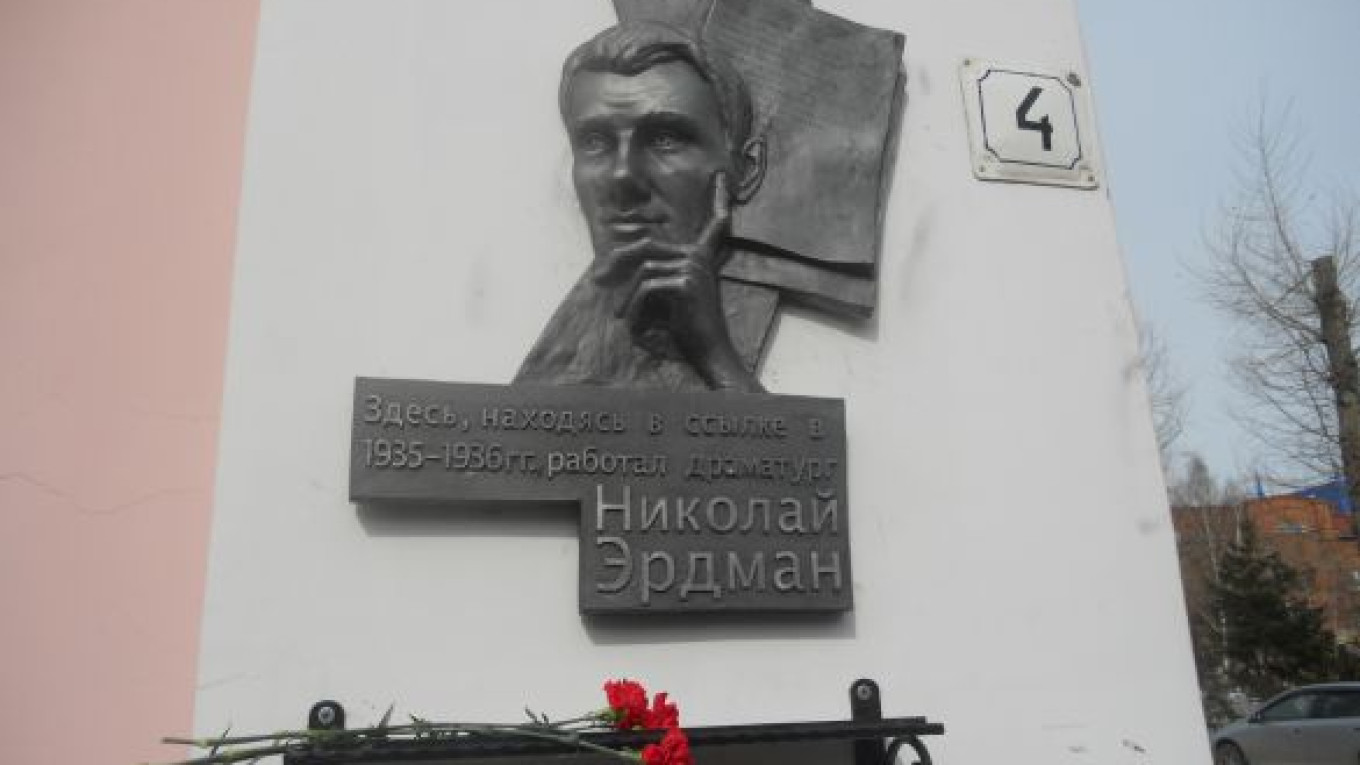
On Thursday, March 31, 2011, 75 years after Erdman left Tomsk for the last time, a handsome plaque honoring Erdman was unveiled at what is now called the Tomsk Young Spectator Theater. The plaque was designed by Chingiz Bazarov, and it is a warm, human likeness that gives Erdman sad eyes and a generous smile.
A Message from The Moscow Times:
Dear readers,
We are facing unprecedented challenges. Russia's Prosecutor General's Office has designated The Moscow Times as an "undesirable" organization, criminalizing our work and putting our staff at risk of prosecution. This follows our earlier unjust labeling as a "foreign agent."
These actions are direct attempts to silence independent journalism in Russia. The authorities claim our work "discredits the decisions of the Russian leadership." We see things differently: we strive to provide accurate, unbiased reporting on Russia.
We, the journalists of The Moscow Times, refuse to be silenced. But to continue our work, we need your help.
Your support, no matter how small, makes a world of difference. If you can, please support us monthly starting from just $2. It's quick to set up, and every contribution makes a significant impact.
By supporting The Moscow Times, you're defending open, independent journalism in the face of repression. Thank you for standing with us.

Remind me later.