

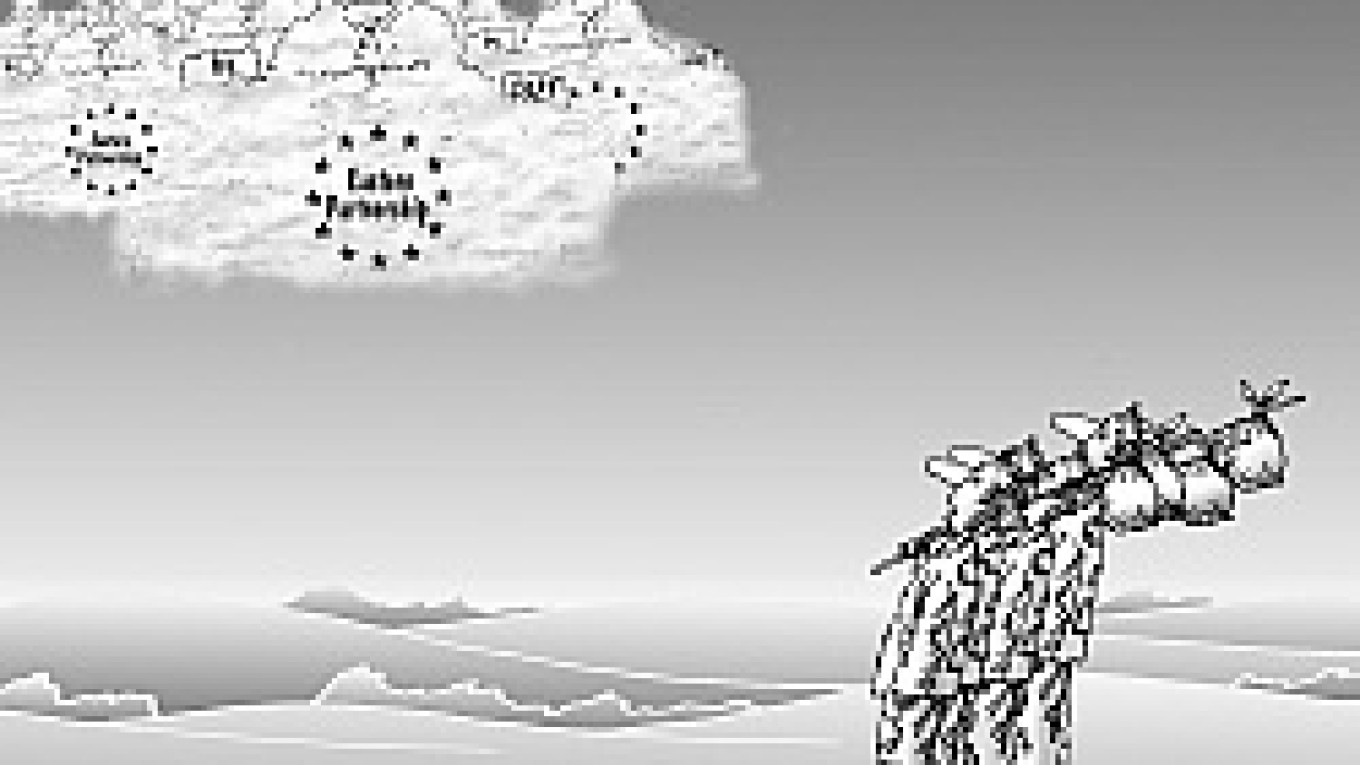
The idea for the Eastern Partnership came from a Polish-Swedish initiative early last summer. So, by EU standards, it has been rushed through on a very fast track. The new initiative is exclusively for the region to the union's east -- Ukraine, Moldova, Belarus, Georgia, Armenia and Azerbaijan -- and is designed to complement the European Neighborhood Policy. It has few new resources and a limited budget for technical projects. The idea is that the Eastern Partnership will provide a positive signal to these countries, change the climate in which the region is discussed in the EU and slowly help pull it into the EU's orbit.
The offer has annoyed Russia. But the EU has its own problems with the initiative. For example, it had a lot of trouble persuading leaders to turn up in Prague on Thursday. And those who agreed to come are not a good advertisement for the region.
Ukrainian President Viktor Yushchenko's popularity ratings are below 5 percent after steering his country from crisis to crisis since the Orange Revolution in 2004. Georgian President Mikheil Saakashvili is dealing with domestic protests after his disastrous military misadventure in August. Armenia also faces protests, following the controversial election of President Serzh Sargsyan in February 2008, which led to the killing of 10 people. In March, Azeri President Ilham Aliyev staged a constitutional referendum that opened the way for his lifetime presidency. Most controversial of all has been "Europe's last dictator," Belarussian President Alexander Lukashenko. Previously, Belarus was not even in the European Neighborhood Policy.
Five years after the EU's "big bang" expansion took in eight former communist countries to its east, the union is in danger of losing the hearts and minds of its eastern neighbors because of its complacency and long-winded approach to crises. The eastern neighbors are not like the Central European states that negotiated EU accession in the 1990s. Their statehood is weak, their leadership often weaker, and they lack the consensus about their European destiny that enabled difficult reforms in Poland, Slovakia and the Baltic States to be pursued.
By an accident of bureaucratic timing, the Eastern Partnership is seen by many in the east as merely the EU's response to the global economic crisis, not as a strategy tailored for the region. Indeed, Moldovan President Vladimir Voronin dismisses it as "candies."
 | To Our Readers |
The Moscow Times welcomes letters to the editor. Letters for publication should be signed and bear the signatory's address and telephone number. |
Russia has managed to revamp the way it operates in the region since it got its fingers burned by interfering so crudely in Ukraine in 2004. It now uses a broad range of hard and soft power, some incommensurate to that of the EU -- for instance, the military bases that it has managed to secure in each of the six states. Moreover, it does things that the EU does and does them better, a notable example -- until recently -- being its more open labor market. Russia is also using less coercion and more carrots, offering economic assistance, security guarantees and an ideology of "sovereign democracy" that appeals to many post-Soviet elites.
The Eastern Partnership is a typical long-term EU technocratic instrument. The EU pledges to help set up "Western-type public institutions" and to transform the Eastern economies through comprehensive free-trade agreements.
That's all good, but the EU needs to be quicker. It needs to show that its mission is to build up weak states, help them overcome short-term crises and nurture democracy rather than treat them as empty vessels for the export of EU policy. As a follow-up to the Eastern Partnership summit, the EU must initiate lower-level meetings of interior ministers to discuss migration, visas and counterterrorism and should seek to integrate Ukraine and Moldova into the European energy market.
The alternative is a wall of instability in what is, after all, Europe's neighborhood. As with the United States and Mexico, the consequences of growing gaps in living standards, good governance and the rule of law will inevitably flow across borders. The EU's eastern policy should not be seen as philanthropy but as a strategy promoting clear-cut pan-European interests.
Andrew Wilson and Nicu Popescu are policy fellows and experts on Eastern Europe at the European Council on Foreign Relations. ?© Project Syndicate
A Message from The Moscow Times:
Dear readers,
We are facing unprecedented challenges. Russia's Prosecutor General's Office has designated The Moscow Times as an "undesirable" organization, criminalizing our work and putting our staff at risk of prosecution. This follows our earlier unjust labeling as a "foreign agent."
These actions are direct attempts to silence independent journalism in Russia. The authorities claim our work "discredits the decisions of the Russian leadership." We see things differently: we strive to provide accurate, unbiased reporting on Russia.
We, the journalists of The Moscow Times, refuse to be silenced. But to continue our work, we need your help.
Your support, no matter how small, makes a world of difference. If you can, please support us monthly starting from just $2. It's quick to set up, and every contribution makes a significant impact.
By supporting The Moscow Times, you're defending open, independent journalism in the face of repression. Thank you for standing with us.

Remind me later.