

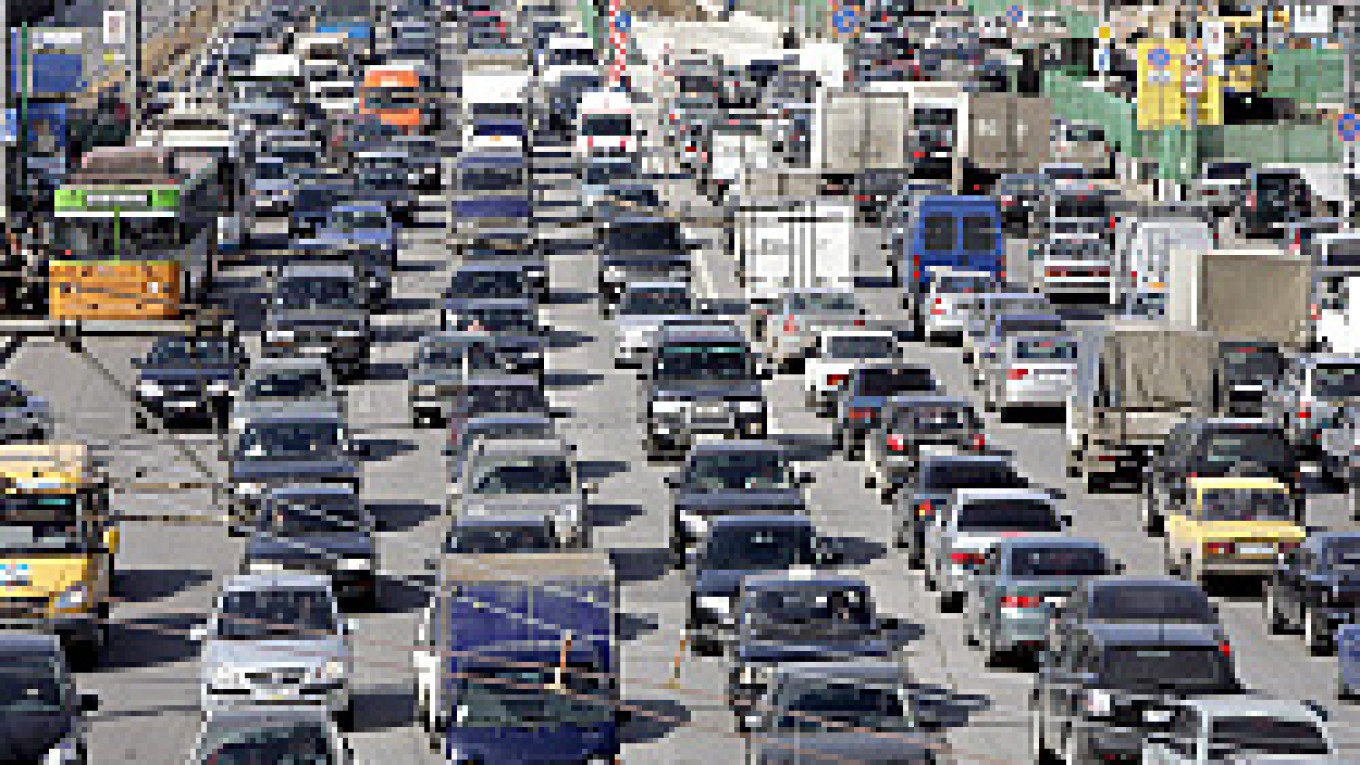
The city sees about 800 traffic jams every day, robbing the average driver of 12.5 hours per month, according to a new report by Yandex, provider of the popular, continually updated traffic reports for drivers on the Internet.
Last year, in comparison, Moscow had about 750 traffic jams per day, and drivers spent 30 minutes less time stuck in traffic, the report said.
The average number of traffic jams in the city in 2006 was 650, it said.
Each traffic jam these days contains about 1,400 cars, said the report by Yandex, which is also the country's largest Internet search portal.
"Muscovites are the victims of a good life brought on by higher standards of living," said Yelena Kolmanovskaya, editor of Yandex.
"The traffic situation will only get worse, but we hope the government would be forced to introduce some limitations on vehicles traveling in the city center," she said.
Areas that are perpetually in gridlock include the Third Ring Road from Kutuzovsky Prospekt to Shmitovsky Proyezd and the stretch from the Savyolovsky overpass to Sheremetyevskaya Ulitsa.
During rush hour, vehicles can stretch for kilometers along the Moscow Ring Road from Novorizhskoye to Volokolomskoye shosse and along the Third Ring Road from Khodynskaya Ulitsa to Leningradsky Prospekt.
By varying degrees, Yaroslavskoye Shosse, Kashirskoye Shosse and the Third Ring Road are always locked in traffic jams during peak hours on workdays.
Moscow is basking in the country's resource-fueled economic boom, and easy access to car loans has helped spur a boom in cars. Moscow boasts 3.78 million registered vehicles, of which 400,000 are on the city's roads daily, according to figures from the city's transportation and communications department.
"When Muscovites have at least one car in every family, the city will come to a virtual standstill," said Vladimir Semenov, commercial director at Ipsilon-S, which transports refrigerated foods.
"Even now, it is colossal waste to deal in refrigerated food in summer because of the ubiquitous traffic jams," he said.
The only weekday that offers drivers some relief is Monday, Yandex said, without elaborating.
"Traffic is always light on a Monday because Muscovites regard the day as part of the weekend," Semenov said. "It's a great day to get over a hangover and avoid contacts with the traffic police."
The report relied on data supplied by motorists as well as Yandex's analytical center Yandex-Probka, formally known as SMIlink.
A Message from The Moscow Times:
Dear readers,
We are facing unprecedented challenges. Russia's Prosecutor General's Office has designated The Moscow Times as an "undesirable" organization, criminalizing our work and putting our staff at risk of prosecution. This follows our earlier unjust labeling as a "foreign agent."
These actions are direct attempts to silence independent journalism in Russia. The authorities claim our work "discredits the decisions of the Russian leadership." We see things differently: we strive to provide accurate, unbiased reporting on Russia.
We, the journalists of The Moscow Times, refuse to be silenced. But to continue our work, we need your help.
Your support, no matter how small, makes a world of difference. If you can, please support us monthly starting from just $2. It's quick to set up, and every contribution makes a significant impact.
By supporting The Moscow Times, you're defending open, independent journalism in the face of repression. Thank you for standing with us.

Remind me later.