

MOSCOW/VIENNA — The biggest spy swap since the end of the Cold War appeared to have taken place on Friday as Russian and U.S. planes met in Vienna to exchange agents, defusing an espionage drama that threatened improving relations.
Two planes involved in the swap, one Russian, one U.S., parked side by side on the tarmac at Vienna airport for about an hour and a half as vehicles shuttled between them. The Russian plane then took off, followed by the U.S. plane.
A Russian security official confirmed that Russian agents arrested in the United States left Vienna on a plane headed for Russia, Russian news agencies reported.
Local officials maintained a strict news blackout throughout.
Moscow and Washington had earlier agreed to swap 10 Russian agents held in the United States for four Russians jailed in Russia on charges of spying for the West.
The dramatic conclusion to the espionage scandal that has gripped America came after spymasters brokered the deal on the instructions of presidents keen not to derail a series of important diplomatic breakthroughs in Russia-U.S. relations.
In the first step of the carefully choreographed swap, the 10 Russian agents pleaded guilty on Thursday in a New York court to charges against them and were immediately deported.
Then, around midnight local time, President Dmitry Medvedev signed a decree pardoning four spies serving jail terms in Russia on charges of spying for the West.
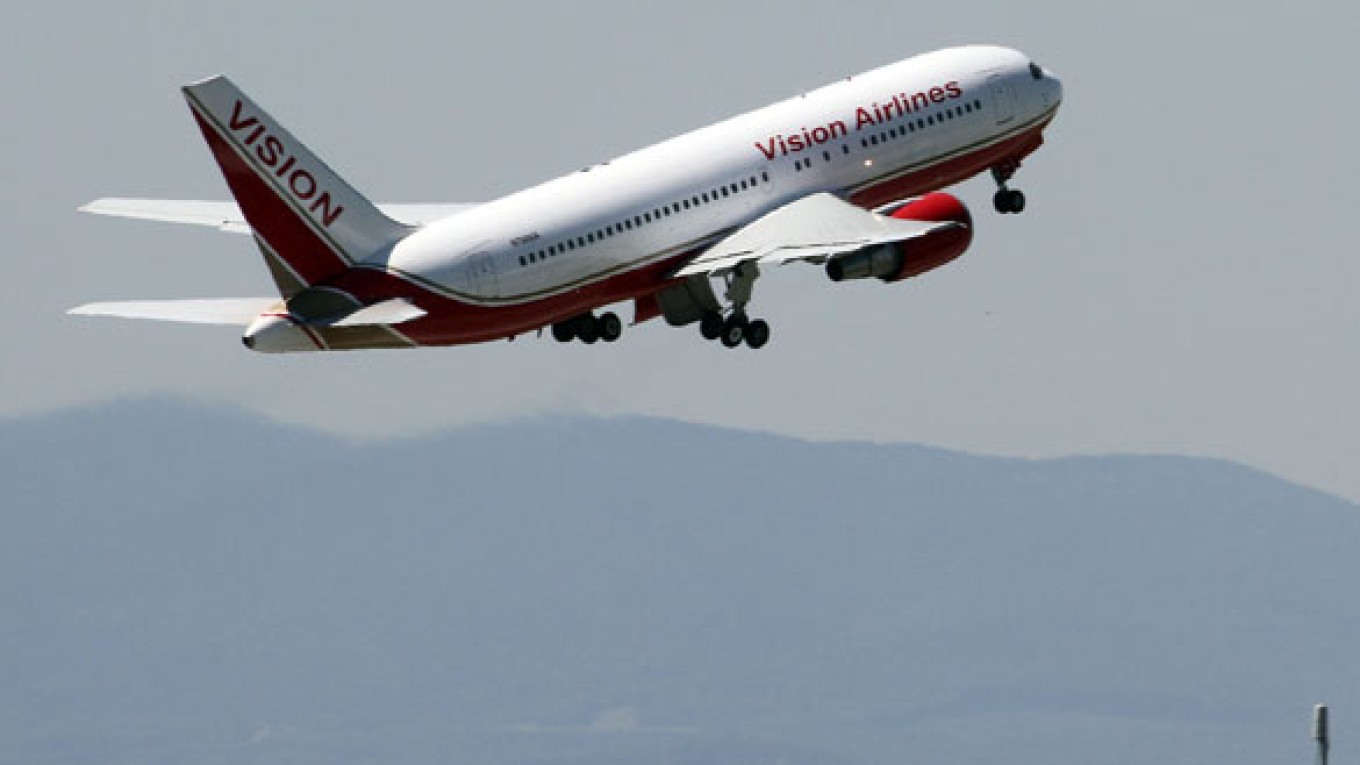
Some of those accused in the U.S. boarded a plane in New York on Thursday night and the same Vision Airlines jet landed in Vienna on Friday, a Reuters witness said.
As the planes stood parked in the bright sunshine, some people were seen boarding the Russian Emergency Ministry jet at the airport and others boarded the Vision Airlines jet. The Russian aircraft then took off, followed about 10 minutes later by the U.S. jet.
"The United States has agreed to transfer these individuals to the custody of the Russian Federation," the United States Justice Department said on Thursday.
"In exchange, the Russian Federation has agreed to release four individuals who are incarcerated in Russia for alleged contact with Western intelligence agencies," it said.
The spy scandal broke at an awkward time for U.S.-Russia ties, just days after Presidents Barack Obama and Dmitry Medvedev met for a friendly Washington summit last month.
The U.S. and Russian legislatures are also considering ratification of a key treaty cutting nuclear weapons and Russian accession to the World Trade Organisation, things neither side wants to jeopardise.
Russia's Foreign Ministry said in a statement that the spy swap "gives reason to expect that the course agreed on by the leaders of Russia and the U.S. will be consistently implemented in practice and that attempts to knock the parties off this course will not succeed".
But the swap itself — which one Russian internet site quipped was "Russia 10: USA 4" — may add fuel to Republican accusations that President Barack Obama is being too soft on Moscow.
Relatives of spies on both sides of the swap had waited anxiously in Russia — all except one of the 14 agents are Russian citizens — for news of the swap. Russia's Foreign Intelligence Service (SVR) declined all comment on details of the affair.
Moscow has always prided itself on bringing trusted agents back home and Washington has agreed to swaps before, though rarely on this scale.
The largest known Cold War spy swap was in 1985 when more than 20 spies were exchanged between East and West on the Glienicke Bridge in the then divided city of Berlin.
Spymasters on both sides say that despite generally warmer relations, the two former Cold War foes still fund generous intelligence operations against each other.
The current scandal broke when the United States said on June 28 that it had uncovered a ring of suspected Russian secret agents who were using false identities to try to gather sensitive intelligence on the United States.
FBI counterintelligence agents explained that the Russians had communicated with Moscow by concealing invisible text messages in photographs posted on public internet sites and some had met Russian diplomats from the U.S. mission in New York.
Russian diplomats said the timing of the announcement, just days after Obama and Medvedev's June 24 summit in Washington, could be an attempt by U.S. hardliners to torpedo the so-called reset in ties that Obama has championed.
A Kremlin source said Medvedev and Obama's warm relations had allowed the swap deal to be reached so swiftly.
"This was due to the new spirit set in Russian-American relations and the high level of mutual understanding and trust between the Russian and American presidents that no one will be able to shake," the source said.
A Message from The Moscow Times:
Dear readers,
We are facing unprecedented challenges. Russia's Prosecutor General's Office has designated The Moscow Times as an "undesirable" organization, criminalizing our work and putting our staff at risk of prosecution. This follows our earlier unjust labeling as a "foreign agent."
These actions are direct attempts to silence independent journalism in Russia. The authorities claim our work "discredits the decisions of the Russian leadership." We see things differently: we strive to provide accurate, unbiased reporting on Russia.
We, the journalists of The Moscow Times, refuse to be silenced. But to continue our work, we need your help.
Your support, no matter how small, makes a world of difference. If you can, please support us monthly starting from just $2. It's quick to set up, and every contribution makes a significant impact.
By supporting The Moscow Times, you're defending open, independent journalism in the face of repression. Thank you for standing with us.

Remind me later.